

20
2 Electrodynamics at Interface
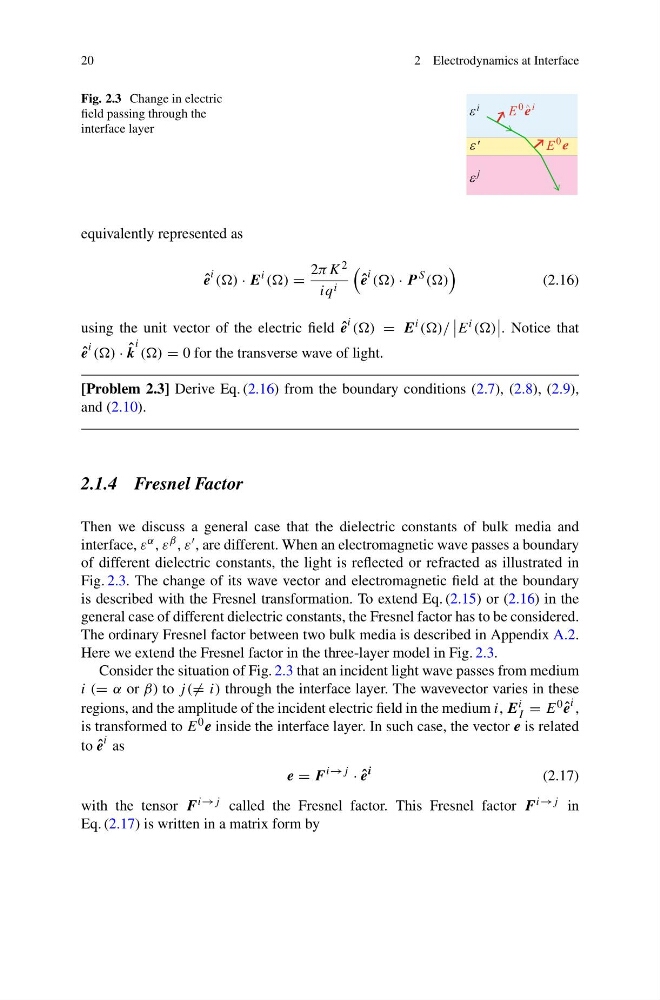
Fig. 2.3 Change in electric
field passing through the
interface layer
j
i
'
E
0 i
e
E
0 e
equivalently represented as
ˆ
e
i (() · E
i (() =
2πK 2
iq i
ˆ
e
i (() · P
S (()
(2.16)
using the unit vector of the electric field ˆ
e
i (() = E i (()/
E i (()
. Notice that
ˆ
e
i (() · ˆ
k
i
(() = 0 for the transverse wave of light.
[Problem 2.3] Derive Eq. (2.16) from the boundary conditions (2.7), (2.8), (2.9),
and (2.10).
2.1.4 Fresnel Factor
Then we discuss a general case that the dielectric constants of bulk media and
interface, ε α , ε β , ε , are different. When an electromagnetic wave passes a boundary
of different dielectric constants, the light is reflected or refracted as illustrated in
Fig. 2.3. The change of its wave vector and electromagnetic field at the boundary
is described with the Fresnel transformation. To extend Eq. (2.15) or (2.16) in the
general case of different dielectric constants, the Fresnel factor has to be considered.
The ordinary Fresnel factor between two bulk media is described in Appendix A.2.
Here we extend the Fresnel factor in the three-layer model in Fig. 2.3.
Consider the situation of Fig. 2.3 that an incident light wave passes from medium
i (= α or β) to j ( = i) through the interface layer. The wavevector varies in these
regions, and the amplitude of the incident electric field in the medium i, E i
I = E 0 ˆ
e
i ,
is transformed to E 0 e inside the interface layer. In such case, the vector e is related
to ˆ
e
i as
e = F
i→j
· ˆ
e
i
(2.17)
with the tensor F i→j called the Fresnel factor. This Fresnel factor F i→j in
Eq. (2.17) is written in a matrix form by
2 Electrodynamics at Interface
Fig. 2.3 Change in electric
field passing through the
interface layer
j
i
'
E
0 i
e
E
0 e
equivalently represented as
ˆ
e
i (() · E
i (() =
2πK 2
iq i
ˆ
e
i (() · P
S (()
(2.16)
using the unit vector of the electric field ˆ
e
i (() = E i (()/
E i (()
. Notice that
ˆ
e
i (() · ˆ
k
i
(() = 0 for the transverse wave of light.
[Problem 2.3] Derive Eq. (2.16) from the boundary conditions (2.7), (2.8), (2.9),
and (2.10).
2.1.4 Fresnel Factor
Then we discuss a general case that the dielectric constants of bulk media and
interface, ε α , ε β , ε , are different. When an electromagnetic wave passes a boundary
of different dielectric constants, the light is reflected or refracted as illustrated in
Fig. 2.3. The change of its wave vector and electromagnetic field at the boundary
is described with the Fresnel transformation. To extend Eq. (2.15) or (2.16) in the
general case of different dielectric constants, the Fresnel factor has to be considered.
The ordinary Fresnel factor between two bulk media is described in Appendix A.2.
Here we extend the Fresnel factor in the three-layer model in Fig. 2.3.
Consider the situation of Fig. 2.3 that an incident light wave passes from medium
i (= α or β) to j ( = i) through the interface layer. The wavevector varies in these
regions, and the amplitude of the incident electric field in the medium i, E i
I = E 0 ˆ
e
i ,
is transformed to E 0 e inside the interface layer. In such case, the vector e is related
to ˆ
e
i as
e = F
i→j
· ˆ
e
i
(2.17)
with the tensor F i→j called the Fresnel factor. This Fresnel factor F i→j in
Eq. (2.17) is written in a matrix form by