

2.1 Electromagnetic Fields at Interface
19
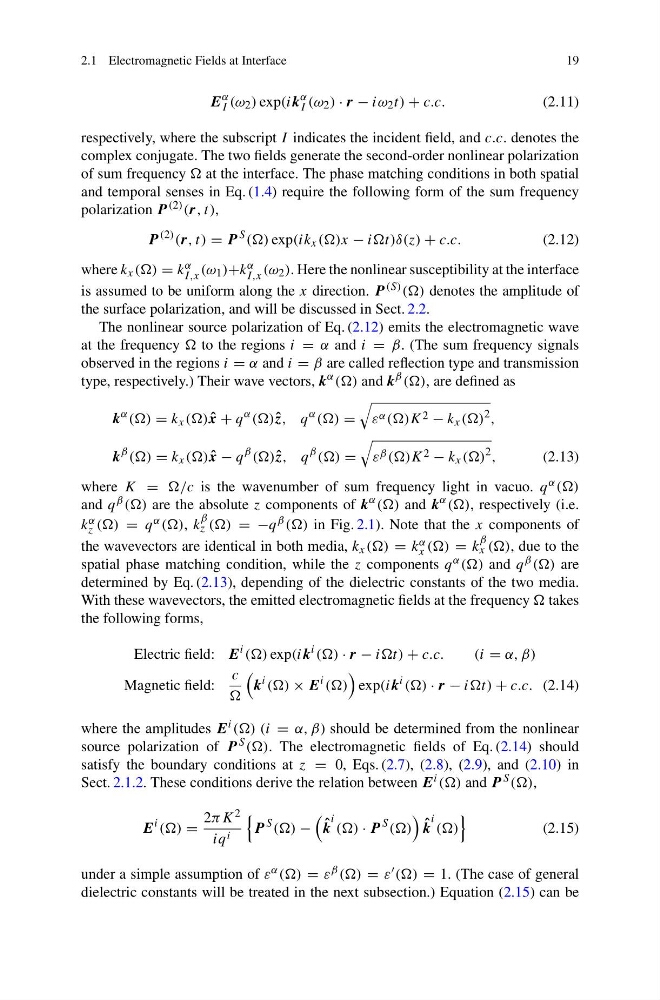
E
α
I (ω 2 ) exp(ik
α
I (ω 2 ) · r − iω 2 t) + c.c.
(2.11)
respectively, where the subscript I indicates the incident field, and c.c. denotes the
complex conjugate. The two fields generate the second-order nonlinear polarization
of sum frequency at the interface. The phase matching conditions in both spatial
and temporal senses in Eq. (1.4) require the following form of the sum frequency
polarization P (2) (r, t),
P
(2) (r, t) = P
S (() exp(ik x (()x − iit)δ(z) + c.c.
(2.12)
where k x (() = k α
I,x (ω 1 )+k α
I,x (ω 2 ). Here the nonlinear susceptibility at the interface
is assumed to be uniform along the x direction. P (S) (() denotes the amplitude of
the surface polarization, and will be discussed in Sect. 2.2.
The nonlinear source polarization of Eq. (2.12) emits the electromagnetic wave
at the frequency to the regions i = α and i = β. (The sum frequency signals
observed in the regions i = α and i = β are called reflection type and transmission
type, respectively.) Their wave vectors, k
α (() and k
β ((), are defined as
k
α (() = k x (() ˆ
x + q
α (()ˆ z, q
α (() =
ε α (()K 2 − k x (()
2 ,
k
β (() = k x (() ˆ
x − q
β (()ˆ z, q
β (() =
ε β (()K 2 − k x (()
2 ,
(2.13)
where K = /c is the wavenumber of sum frequency light in vacuo. q α (()
and q β (() are the absolute z components of k
α (() and k
α ((), respectively (i.e.
k α
z (() = q α ((), k
β
z (() = −q β (() in Fig. 2.1). Note that the x components of
the wavevectors are identical in both media, k x (() = k α
x (() = k
β
x ((), due to the
spatial phase matching condition, while the z components q α (() and q β (() are
determined by Eq. (2.13), depending of the dielectric constants of the two media.
With these wavevectors, the emitted electromagnetic fields at the frequency takes
the following forms,
Electric field: E
i (() exp(ik
i (() · r − iit) + c.c.
(i = α, β)
Magnetic field:
c
k
i (() × E
i (()
exp(ik
i (() · r − iit) + c.c. (2.14)
where the amplitudes E i (() (i = α, β) should be determined from the nonlinear
source polarization of P S ((). The electromagnetic fields of Eq. (2.14) should
satisfy the boundary conditions at z = 0, Eqs. (2.7), (2.8), (2.9), and (2.10) in
Sect. 2.1.2. These conditions derive the relation between E i (() and P S ((),
E
i (() =
2πK 2
iq i
P
S (() −
ˆ
k
i
(() · P
S (()
ˆ
k
i
(()
(2.15)
under a simple assumption of ε α (() = ε β (() = ε (() = 1. (The case of general
dielectric constants will be treated in the next subsection.) Equation (2.15) can be
19
E
α
I (ω 2 ) exp(ik
α
I (ω 2 ) · r − iω 2 t) + c.c.
(2.11)
respectively, where the subscript I indicates the incident field, and c.c. denotes the
complex conjugate. The two fields generate the second-order nonlinear polarization
of sum frequency at the interface. The phase matching conditions in both spatial
and temporal senses in Eq. (1.4) require the following form of the sum frequency
polarization P (2) (r, t),
P
(2) (r, t) = P
S (() exp(ik x (()x − iit)δ(z) + c.c.
(2.12)
where k x (() = k α
I,x (ω 1 )+k α
I,x (ω 2 ). Here the nonlinear susceptibility at the interface
is assumed to be uniform along the x direction. P (S) (() denotes the amplitude of
the surface polarization, and will be discussed in Sect. 2.2.
The nonlinear source polarization of Eq. (2.12) emits the electromagnetic wave
at the frequency to the regions i = α and i = β. (The sum frequency signals
observed in the regions i = α and i = β are called reflection type and transmission
type, respectively.) Their wave vectors, k
α (() and k
β ((), are defined as
k
α (() = k x (() ˆ
x + q
α (()ˆ z, q
α (() =
ε α (()K 2 − k x (()
2 ,
k
β (() = k x (() ˆ
x − q
β (()ˆ z, q
β (() =
ε β (()K 2 − k x (()
2 ,
(2.13)
where K = /c is the wavenumber of sum frequency light in vacuo. q α (()
and q β (() are the absolute z components of k
α (() and k
α ((), respectively (i.e.
k α
z (() = q α ((), k
β
z (() = −q β (() in Fig. 2.1). Note that the x components of
the wavevectors are identical in both media, k x (() = k α
x (() = k
β
x ((), due to the
spatial phase matching condition, while the z components q α (() and q β (() are
determined by Eq. (2.13), depending of the dielectric constants of the two media.
With these wavevectors, the emitted electromagnetic fields at the frequency takes
the following forms,
Electric field: E
i (() exp(ik
i (() · r − iit) + c.c.
(i = α, β)
Magnetic field:
c
k
i (() × E
i (()
exp(ik
i (() · r − iit) + c.c. (2.14)
where the amplitudes E i (() (i = α, β) should be determined from the nonlinear
source polarization of P S ((). The electromagnetic fields of Eq. (2.14) should
satisfy the boundary conditions at z = 0, Eqs. (2.7), (2.8), (2.9), and (2.10) in
Sect. 2.1.2. These conditions derive the relation between E i (() and P S ((),
E
i (() =
2πK 2
iq i
P
S (() −
ˆ
k
i
(() · P
S (()
ˆ
k
i
(()
(2.15)
under a simple assumption of ε α (() = ε β (() = ε (() = 1. (The case of general
dielectric constants will be treated in the next subsection.) Equation (2.15) can be