

2.2 Response to Incident Lights
23
P
S (() =
χ
(2) ((, ω 1 , ω 2 ) : e(ω 1 )e(ω 2 )
E
i1
I (ω 1 )E
i2
I (ω 2 )
(2.21)
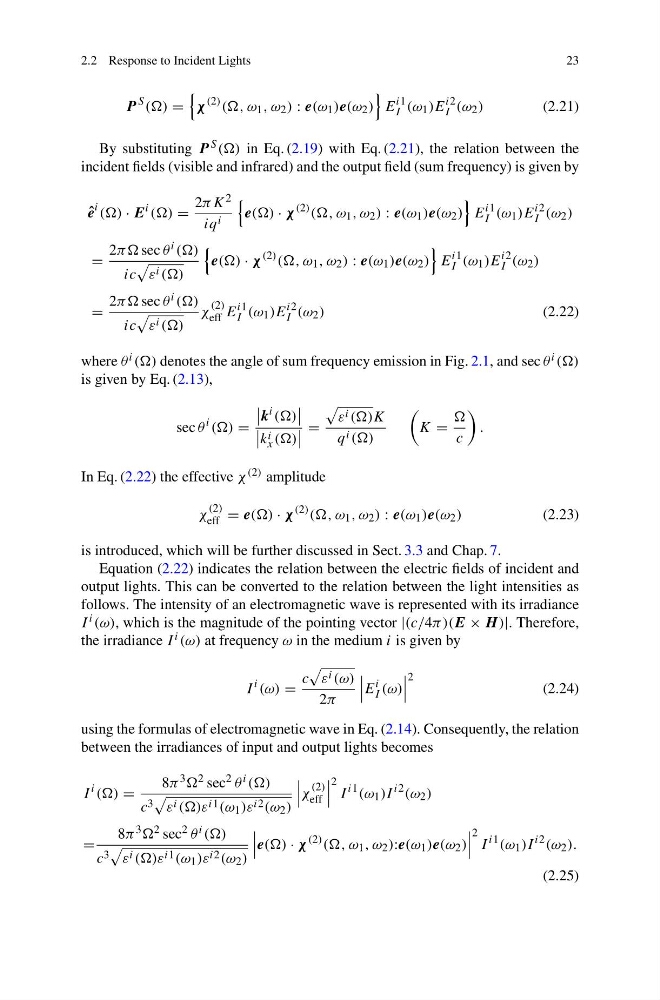
By substituting P S (() in Eq. (2.19) with Eq. (2.21), the relation between the
incident fields (visible and infrared) and the output field (sum frequency) is given by
ˆ
e
i (() · E
i (() =
2πK 2
iq i
e(() · χ
(2) ((, ω 1 , ω 2 ) : e(ω 1 )e(ω 2 )
E
i1
I (ω 1 )E
i2
I (ω 2 )
=
2ππ sec θ i (()
ic
ε i (()
e(() · χ
(2) ((, ω 1 , ω 2 ) : e(ω 1 )e(ω 2 )
E
i1
I (ω 1 )E
i2
I (ω 2 )
=
2ππ sec θ i (()
ic
ε i (()
χ
(2)
eff E
i1
I (ω 1 )E
i2
I (ω 2 )
(2.22)
where θ i (() denotes the angle of sum frequency emission in Fig. 2.1, and sec θ i (()
is given by Eq. (2.13),
sec θ
i (() =
k
i (()
k i
x (()
=
ε i (()K
q i (()
K =
c
.
In Eq. (2.22) the effective χ (2) amplitude
χ
(2)
eff = e(() · χ
(2) ((, ω 1 , ω 2 ) : e(ω 1 )e(ω 2 )
(2.23)
is introduced, which will be further discussed in Sect. 3.3 and Chap. 7.
Equation (2.22) indicates the relation between the electric fields of incident and
output lights. This can be converted to the relation between the light intensities as
follows. The intensity of an electromagnetic wave is represented with its irradiance
I i (ω), which is the magnitude of the pointing vector |(c/4π)(E × H )|. Therefore,
the irradiance I i (ω) at frequency ω in the medium i is given by
I
i (ω) =
c
ε i (ω)
2π
E
i
I (ω)
2
(2.24)
using the formulas of electromagnetic wave in Eq. (2.14). Consequently, the relation
between the irradiances of input and output lights becomes
I
i (() =
8π 3 2 sec 2 θ i (()
c 3
ε i (()ε i1 (ω 1 )ε i2 (ω 2 )
χ
(2)
eff
2
I
i1 (ω 1 )I
i2 (ω 2 )
=
8π 3 2 sec 2 θ i (()
c 3
ε i (()ε i1 (ω 1 )ε i2 (ω 2 )
e(() · χ
(2) ((, ω 1 , ω 2 ):e(ω 1 )e(ω 2 )
2
I
i1 (ω 1 )I
i2 (ω 2 ).
(2.25)
23
P
S (() =
χ
(2) ((, ω 1 , ω 2 ) : e(ω 1 )e(ω 2 )
E
i1
I (ω 1 )E
i2
I (ω 2 )
(2.21)
By substituting P S (() in Eq. (2.19) with Eq. (2.21), the relation between the
incident fields (visible and infrared) and the output field (sum frequency) is given by
ˆ
e
i (() · E
i (() =
2πK 2
iq i
e(() · χ
(2) ((, ω 1 , ω 2 ) : e(ω 1 )e(ω 2 )
E
i1
I (ω 1 )E
i2
I (ω 2 )
=
2ππ sec θ i (()
ic
ε i (()
e(() · χ
(2) ((, ω 1 , ω 2 ) : e(ω 1 )e(ω 2 )
E
i1
I (ω 1 )E
i2
I (ω 2 )
=
2ππ sec θ i (()
ic
ε i (()
χ
(2)
eff E
i1
I (ω 1 )E
i2
I (ω 2 )
(2.22)
where θ i (() denotes the angle of sum frequency emission in Fig. 2.1, and sec θ i (()
is given by Eq. (2.13),
sec θ
i (() =
k
i (()
k i
x (()
=
ε i (()K
q i (()
K =
c
.
In Eq. (2.22) the effective χ (2) amplitude
χ
(2)
eff = e(() · χ
(2) ((, ω 1 , ω 2 ) : e(ω 1 )e(ω 2 )
(2.23)
is introduced, which will be further discussed in Sect. 3.3 and Chap. 7.
Equation (2.22) indicates the relation between the electric fields of incident and
output lights. This can be converted to the relation between the light intensities as
follows. The intensity of an electromagnetic wave is represented with its irradiance
I i (ω), which is the magnitude of the pointing vector |(c/4π)(E × H )|. Therefore,
the irradiance I i (ω) at frequency ω in the medium i is given by
I
i (ω) =
c
ε i (ω)
2π
E
i
I (ω)
2
(2.24)
using the formulas of electromagnetic wave in Eq. (2.14). Consequently, the relation
between the irradiances of input and output lights becomes
I
i (() =
8π 3 2 sec 2 θ i (()
c 3
ε i (()ε i1 (ω 1 )ε i2 (ω 2 )
χ
(2)
eff
2
I
i1 (ω 1 )I
i2 (ω 2 )
=
8π 3 2 sec 2 θ i (()
c 3
ε i (()ε i1 (ω 1 )ε i2 (ω 2 )
e(() · χ
(2) ((, ω 1 , ω 2 ):e(ω 1 )e(ω 2 )
2
I
i1 (ω 1 )I
i2 (ω 2 ).
(2.25)