

10.3 Molecular Orientation and Polarization Analysis
257
10.3.2 Acetonitrile
Acetonitrile CH 3 CN is an excellent model molecule to clarify the relation between
the orientation and polarization, since it is a rod-like molecule with C 3v symmetry.
Accordingly, the molecular orientation is readily described with the tilt angle θ , as
discussed in Sect. 4.2.2. The experimental polarization analysis of acetonitrile in
aqueous solutions was carried out by a number of groups so far [19, 28, 30, 39, 41],
though their results of orientation appear inconsistent. Zhang et al. [39, 41] reported
that the tilt angle θ of the methyl group of acetonitrile changes abruptly with
increasing mole fraction of acetonitrile x at x 0.07, whereas Kim et al. [19]
concluded that the orientation changes gradually with increasing x. Shultz et al. [30]
and Saito et al. [28] reported nearly invariant orientation over x. These intriguing
discrepancies should be resolved with the help of reliable theoretical analysis
of polarization and orientation, and the MD simulation has been performed in
collaboration with experimental measurement [28].
The MD simulation reproduced neary invariant orientation, and thus supported
the recent conclusion by Shultz and Saito. The reason for discrepancies from the
former previous studies is not clear at present, though the polarization analysis of
acetonitrile may suffer from very weak SPS signal. (The recent experiments [28,
30] adopted the polarization angle null method to circumvent this problem.) The
MD simulation of the polarization analysis revealed two significant problems in the
quantitative accuracy. One issue is the orientational distribution, as we discussed in
the case of methanol above. Caution should be required to apply the polarization
analysis to an interface with an unknown distribution of orientation, particularly to
liquid interfaces.
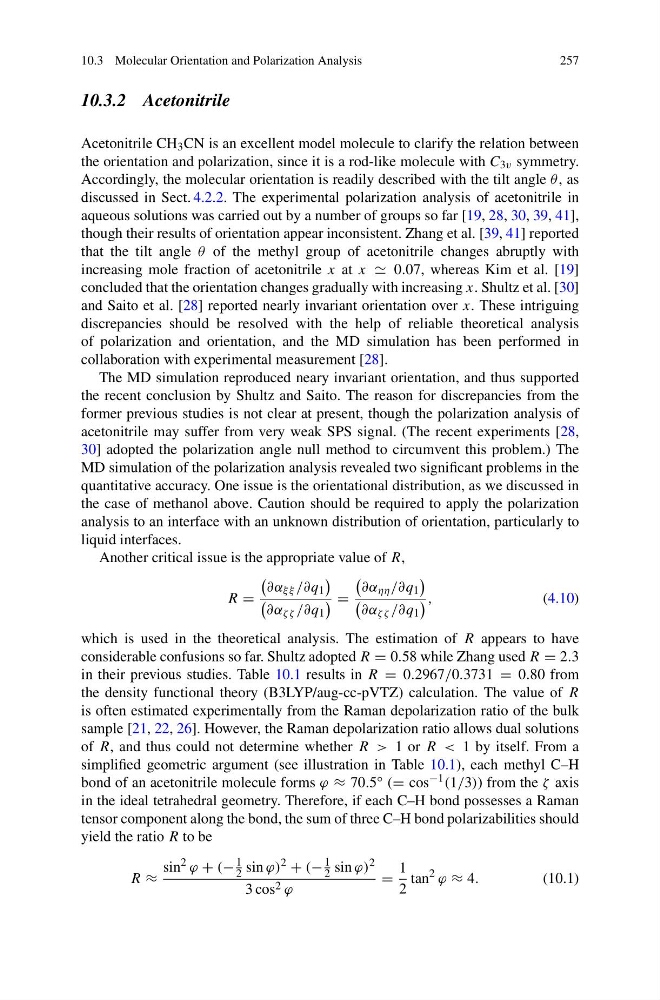
Another critical issue is the appropriate value of R,
R =
∂α ξξ /∂q 1
∂α ζ ζ /∂q 1
=
∂α ηη /∂q 1
∂α ζ ζ /∂q 1
,
(4.10)
which is used in the theoretical analysis. The estimation of R appears to have
considerable confusions so far. Shultz adopted R = 0.58 while Zhang used R = 2.3
in their previous studies. Table 10.1 results in R = 0.2967/0.3731 = 0.80 from
the density functional theory (B3LYP/aug-cc-pVTZ) calculation. The value of R
is often estimated experimentally from the Raman depolarization ratio of the bulk
sample [21, 22, 26]. However, the Raman depolarization ratio allows dual solutions
of R, and thus could not determine whether R > 1 or R < 1 by itself. From a
simplified geometric argument (see illustration in Table 10.1), each methyl C–H
bond of an acetonitrile molecule forms ϕ ≈ 70.5 ◦ (= cos −1 (1/3)) from the ζ axis
in the ideal tetrahedral geometry. Therefore, if each C–H bond possesses a Raman
tensor component along the bond, the sum of three C–H bond polarizabilities should
yield the ratio R to be
R ≈
sin
2 ϕ + (−
1
2 sin ϕ) 2 + (−
1
2 sin ϕ) 2
3 cos 2 ϕ
=
1
2
tan
2 ϕ ≈ 4.
(10.1)
257
10.3.2 Acetonitrile
Acetonitrile CH 3 CN is an excellent model molecule to clarify the relation between
the orientation and polarization, since it is a rod-like molecule with C 3v symmetry.
Accordingly, the molecular orientation is readily described with the tilt angle θ , as
discussed in Sect. 4.2.2. The experimental polarization analysis of acetonitrile in
aqueous solutions was carried out by a number of groups so far [19, 28, 30, 39, 41],
though their results of orientation appear inconsistent. Zhang et al. [39, 41] reported
that the tilt angle θ of the methyl group of acetonitrile changes abruptly with
increasing mole fraction of acetonitrile x at x 0.07, whereas Kim et al. [19]
concluded that the orientation changes gradually with increasing x. Shultz et al. [30]
and Saito et al. [28] reported nearly invariant orientation over x. These intriguing
discrepancies should be resolved with the help of reliable theoretical analysis
of polarization and orientation, and the MD simulation has been performed in
collaboration with experimental measurement [28].
The MD simulation reproduced neary invariant orientation, and thus supported
the recent conclusion by Shultz and Saito. The reason for discrepancies from the
former previous studies is not clear at present, though the polarization analysis of
acetonitrile may suffer from very weak SPS signal. (The recent experiments [28,
30] adopted the polarization angle null method to circumvent this problem.) The
MD simulation of the polarization analysis revealed two significant problems in the
quantitative accuracy. One issue is the orientational distribution, as we discussed in
the case of methanol above. Caution should be required to apply the polarization
analysis to an interface with an unknown distribution of orientation, particularly to
liquid interfaces.
Another critical issue is the appropriate value of R,
R =
∂α ξξ /∂q 1
∂α ζ ζ /∂q 1
=
∂α ηη /∂q 1
∂α ζ ζ /∂q 1
,
(4.10)
which is used in the theoretical analysis. The estimation of R appears to have
considerable confusions so far. Shultz adopted R = 0.58 while Zhang used R = 2.3
in their previous studies. Table 10.1 results in R = 0.2967/0.3731 = 0.80 from
the density functional theory (B3LYP/aug-cc-pVTZ) calculation. The value of R
is often estimated experimentally from the Raman depolarization ratio of the bulk
sample [21, 22, 26]. However, the Raman depolarization ratio allows dual solutions
of R, and thus could not determine whether R > 1 or R < 1 by itself. From a
simplified geometric argument (see illustration in Table 10.1), each methyl C–H
bond of an acetonitrile molecule forms ϕ ≈ 70.5 ◦ (= cos −1 (1/3)) from the ζ axis
in the ideal tetrahedral geometry. Therefore, if each C–H bond possesses a Raman
tensor component along the bond, the sum of three C–H bond polarizabilities should
yield the ratio R to be
R ≈
sin
2 ϕ + (−
1
2 sin ϕ) 2 + (−
1
2 sin ϕ) 2
3 cos 2 ϕ
=
1
2
tan
2 ϕ ≈ 4.
(10.1)