

9.4 Oil/Water Interfaces
237
0
Z
^
Z thres
^
cos
Vapor
Bulk
Surface
Anion FFS
(A)
(B)
(C)
OH -
H
O
H
H
O
H
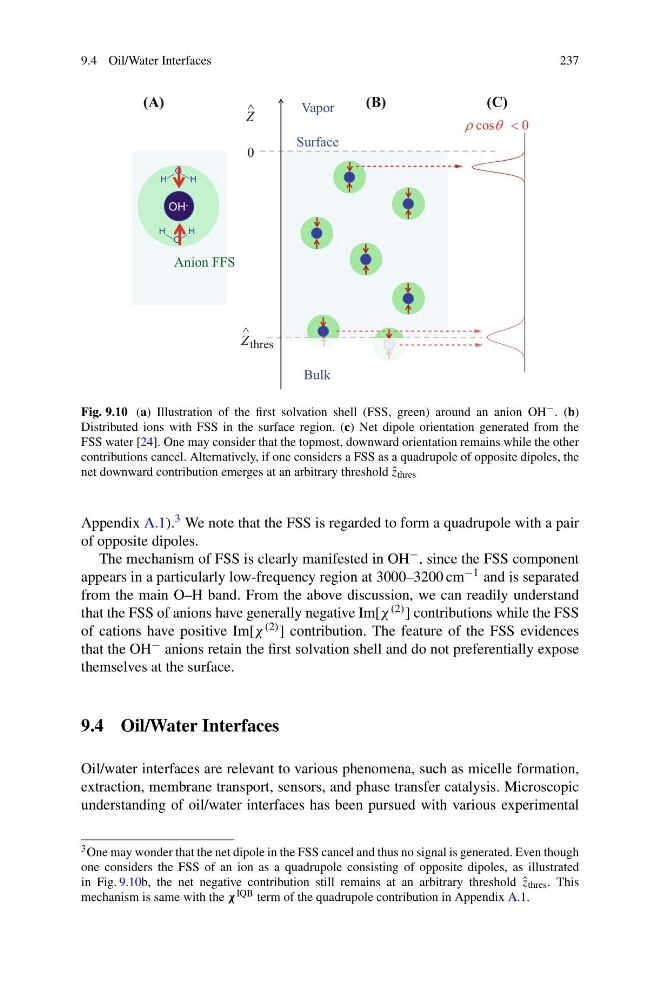
Fig. 9.10 (a) Illustration of the first solvation shell (FSS, green) around an anion OH
− . (b)
Distributed ions with FSS in the surface region. (c) Net dipole orientation generated from the
FSS water [24]. One may consider that the topmost, downward orientation remains while the other
contributions cancel. Alternatively, if one considers a FSS as a quadrupole of opposite dipoles, the
net downward contribution emerges at an arbitrary threshold ˆ
z thres
Appendix A.1). 3 We note that the FSS is regarded to form a quadrupole with a pair
of opposite dipoles.
The mechanism of FSS is clearly manifested in OH
− , since the FSS component
appears in a particularly low-frequency region at 3000–3200 cm −1 and is separated
from the main O–H band. From the above discussion, we can readily understand
that the FSS of anions have generally negative Im[χ (2) ] contributions while the FSS
of cations have positive Im[χ (2) ] contribution. The feature of the FSS evidences
that the OH − anions retain the first solvation shell and do not preferentially expose
themselves at the surface.
9.4 Oil/Water Interfaces
Oil/water interfaces are relevant to various phenomena, such as micelle formation,
extraction, membrane transport, sensors, and phase transfer catalysis. Microscopic
understanding of oil/water interfaces has been pursued with various experimental
3 One may wonder that the net dipole in the FSS cancel and thus no signal is generated. Even though
one considers the FSS of an ion as a quadrupole consisting of opposite dipoles, as illustrated
in Fig. 9.10b, the net negative contribution still remains at an arbitrary threshold ˆ
z thres . This
mechanism is same with the χ IQB term of the quadrupole contribution in Appendix A.1.
237
0
Z
^
Z thres
^
cos
Vapor
Bulk
Surface
Anion FFS
(A)
(B)
(C)
OH -
H
O
H
H
O
H
Fig. 9.10 (a) Illustration of the first solvation shell (FSS, green) around an anion OH
− . (b)
Distributed ions with FSS in the surface region. (c) Net dipole orientation generated from the
FSS water [24]. One may consider that the topmost, downward orientation remains while the other
contributions cancel. Alternatively, if one considers a FSS as a quadrupole of opposite dipoles, the
net downward contribution emerges at an arbitrary threshold ˆ
z thres
Appendix A.1). 3 We note that the FSS is regarded to form a quadrupole with a pair
of opposite dipoles.
The mechanism of FSS is clearly manifested in OH
− , since the FSS component
appears in a particularly low-frequency region at 3000–3200 cm −1 and is separated
from the main O–H band. From the above discussion, we can readily understand
that the FSS of anions have generally negative Im[χ (2) ] contributions while the FSS
of cations have positive Im[χ (2) ] contribution. The feature of the FSS evidences
that the OH − anions retain the first solvation shell and do not preferentially expose
themselves at the surface.
9.4 Oil/Water Interfaces
Oil/water interfaces are relevant to various phenomena, such as micelle formation,
extraction, membrane transport, sensors, and phase transfer catalysis. Microscopic
understanding of oil/water interfaces has been pursued with various experimental
3 One may wonder that the net dipole in the FSS cancel and thus no signal is generated. Even though
one considers the FSS of an ion as a quadrupole consisting of opposite dipoles, as illustrated
in Fig. 9.10b, the net negative contribution still remains at an arbitrary threshold ˆ
z thres . This
mechanism is same with the χ IQB term of the quadrupole contribution in Appendix A.1.