

236
9 Applications: Aqueous Interfaces
(MD)
3000
3200
3400
3600
3800
(arb. unit)
Frequency [cm ]
-1
(Exp.)
0
(arb. unit)
0
pure water
NaOH
OH -
Na +
O
H
H
O
H
H
OH -
Na +
O
H
H
O
H
H
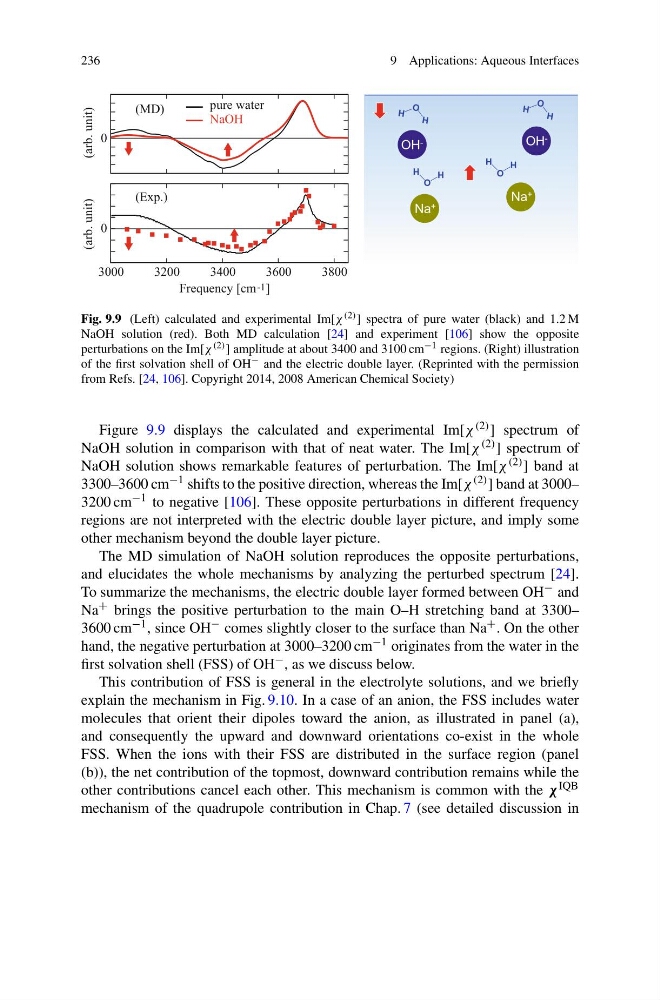
Fig. 9.9 (Left) calculated and experimental Im[χ (2) ] spectra of pure water (black) and 1.2 M
NaOH solution (red). Both MD calculation [24] and experiment [106] show the opposite
perturbations on the Im[χ (2) ] amplitude at about 3400 and 3100 cm −1 regions. (Right) illustration
of the first solvation shell of OH
− and the electric double layer. (Reprinted with the permission
from Refs. [24, 106]. Copyright 2014, 2008 American Chemical Society)
Figure 9.9 displays the calculated and experimental Im[χ (2) ] spectrum of
NaOH solution in comparison with that of neat water. The Im[χ (2) ] spectrum of
NaOH solution shows remarkable features of perturbation. The Im[χ (2) ] band at
3300–3600 cm −1 shifts to the positive direction, whereas the Im[χ (2) ] band at 3000–
3200 cm −1 to negative [106]. These opposite perturbations in different frequency
regions are not interpreted with the electric double layer picture, and imply some
other mechanism beyond the double layer picture.
The MD simulation of NaOH solution reproduces the opposite perturbations,
and elucidates the whole mechanisms by analyzing the perturbed spectrum [24].
To summarize the mechanisms, the electric double layer formed between OH
− and
Na
+ brings the positive perturbation to the main O–H stretching band at 3300–
3600 cm −1 , since OH
− comes slightly closer to the surface than Na
+ . On the other
hand, the negative perturbation at 3000–3200 cm −1 originates from the water in the
first solvation shell (FSS) of OH
− , as we discuss below.
This contribution of FSS is general in the electrolyte solutions, and we briefly
explain the mechanism in Fig. 9.10. In a case of an anion, the FSS includes water
molecules that orient their dipoles toward the anion, as illustrated in panel (a),
and consequently the upward and downward orientations co-exist in the whole
FSS. When the ions with their FSS are distributed in the surface region (panel
(b)), the net contribution of the topmost, downward contribution remains while the
other contributions cancel each other. This mechanism is common with the χ IQB
mechanism of the quadrupole contribution in Chap. 7 (see detailed discussion in
9 Applications: Aqueous Interfaces
(MD)
3000
3200
3400
3600
3800
(arb. unit)
Frequency [cm ]
-1
(Exp.)
0
(arb. unit)
0
pure water
NaOH
OH -
Na +
O
H
H
O
H
H
OH -
Na +
O
H
H
O
H
H
Fig. 9.9 (Left) calculated and experimental Im[χ (2) ] spectra of pure water (black) and 1.2 M
NaOH solution (red). Both MD calculation [24] and experiment [106] show the opposite
perturbations on the Im[χ (2) ] amplitude at about 3400 and 3100 cm −1 regions. (Right) illustration
of the first solvation shell of OH
− and the electric double layer. (Reprinted with the permission
from Refs. [24, 106]. Copyright 2014, 2008 American Chemical Society)
Figure 9.9 displays the calculated and experimental Im[χ (2) ] spectrum of
NaOH solution in comparison with that of neat water. The Im[χ (2) ] spectrum of
NaOH solution shows remarkable features of perturbation. The Im[χ (2) ] band at
3300–3600 cm −1 shifts to the positive direction, whereas the Im[χ (2) ] band at 3000–
3200 cm −1 to negative [106]. These opposite perturbations in different frequency
regions are not interpreted with the electric double layer picture, and imply some
other mechanism beyond the double layer picture.
The MD simulation of NaOH solution reproduces the opposite perturbations,
and elucidates the whole mechanisms by analyzing the perturbed spectrum [24].
To summarize the mechanisms, the electric double layer formed between OH
− and
Na
+ brings the positive perturbation to the main O–H stretching band at 3300–
3600 cm −1 , since OH
− comes slightly closer to the surface than Na
+ . On the other
hand, the negative perturbation at 3000–3200 cm −1 originates from the water in the
first solvation shell (FSS) of OH
− , as we discuss below.
This contribution of FSS is general in the electrolyte solutions, and we briefly
explain the mechanism in Fig. 9.10. In a case of an anion, the FSS includes water
molecules that orient their dipoles toward the anion, as illustrated in panel (a),
and consequently the upward and downward orientations co-exist in the whole
FSS. When the ions with their FSS are distributed in the surface region (panel
(b)), the net contribution of the topmost, downward contribution remains while the
other contributions cancel each other. This mechanism is common with the χ IQB
mechanism of the quadrupole contribution in Chap. 7 (see detailed discussion in