

216
8 Other Topics
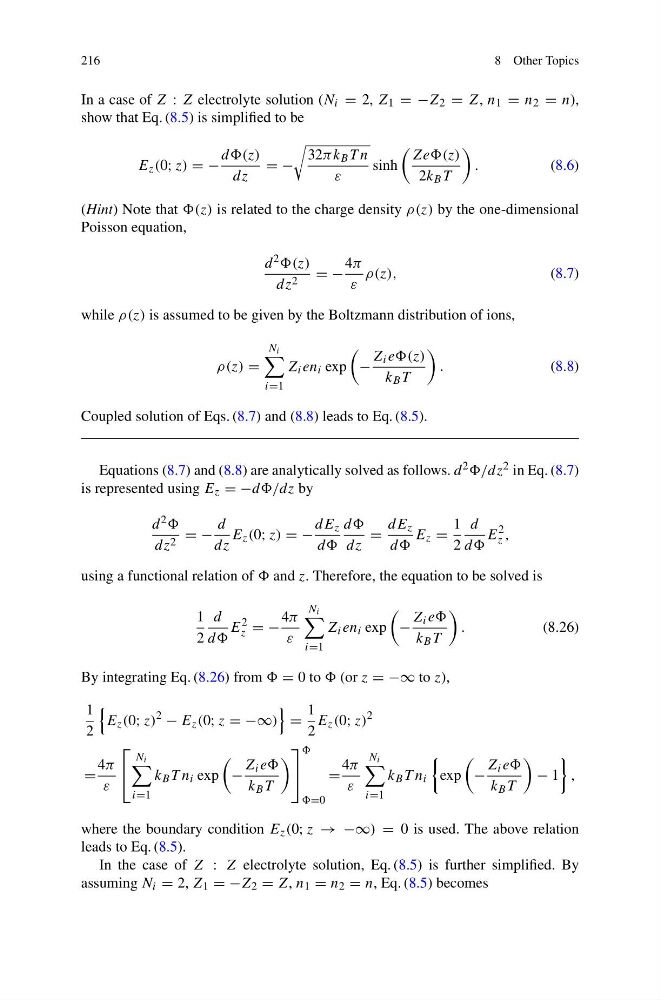
In a case of Z : Z electrolyte solution (N i = 2, Z 1 = −Z 2 = Z, n 1 = n 2 = n),
show that Eq. (8.5) is simplified to be
E z (0; z) = −
dd(z)
dz
= −
32πk B T n
ε
sinh
Zee(z)
2k B T
.
(8.6)
(Hint) Note that is related to the charge density ρ(z) by the one-dimensional
Poisson equation,
d 2 (z)
dz 2 = −
4π
ε
ρ(z),
(8.7)
while ρ(z) is assumed to be given by the Boltzmann distribution of ions,
ρ(z) =
N i
i=1
Z i en i exp
−
Z i ee(z)
k B T
.
(8.8)
Coupled solution of Eqs. (8.7) and (8.8) leads to Eq. (8.5).
Equations (8.7) and (8.8) are analytically solved as follows. d 2 2 in Eq. (8.7)
is represented using E z = −dd/dz by
d 2
dz 2 = −
d
dz
E z (0; z) = −
dE z
dd
dd
dz
=
dE z
dd
E z =
1
2
d
dd
E
2
z ,
using a functional relation of and z. Therefore, the equation to be solved is
1
2
d
dd
E
2
z = −
4π
ε
N i
i=1
Z i en i exp
−
Z i ee
k B T
.
(8.26)
By integrating Eq. (8.26) from = 0 to (or z = −∞ to z),
1
2
E z (0; z)
2
− E z (0; z = −∞)
=
1
2
E z (0; z)
2
=
4π
ε
⎡
⎣
N i
i=1
k B T n i exp
−
Z i ee
k B T
⎤
⎦
=0
=
4π
ε
N i
i=1
k B T n i
exp
−
Z i ee
k B T
− 1
,
where the boundary condition E z (0; z → −∞) = 0 is used. The above relation
leads to Eq. (8.5).
In the case of Z : Z electrolyte solution, Eq. (8.5) is further simplified. By
assuming N i = 2, Z 1 = −Z 2 = Z, n 1 = n 2 = n, Eq. (8.5) becomes
8 Other Topics
In a case of Z : Z electrolyte solution (N i = 2, Z 1 = −Z 2 = Z, n 1 = n 2 = n),
show that Eq. (8.5) is simplified to be
E z (0; z) = −
dd(z)
dz
= −
32πk B T n
ε
sinh
Zee(z)
2k B T
.
(8.6)
(Hint) Note that is related to the charge density ρ(z) by the one-dimensional
Poisson equation,
d 2 (z)
dz 2 = −
4π
ε
ρ(z),
(8.7)
while ρ(z) is assumed to be given by the Boltzmann distribution of ions,
ρ(z) =
N i
i=1
Z i en i exp
−
Z i ee(z)
k B T
.
(8.8)
Coupled solution of Eqs. (8.7) and (8.8) leads to Eq. (8.5).
Equations (8.7) and (8.8) are analytically solved as follows. d 2 2 in Eq. (8.7)
is represented using E z = −dd/dz by
d 2
dz 2 = −
d
dz
E z (0; z) = −
dE z
dd
dd
dz
=
dE z
dd
E z =
1
2
d
dd
E
2
z ,
using a functional relation of and z. Therefore, the equation to be solved is
1
2
d
dd
E
2
z = −
4π
ε
N i
i=1
Z i en i exp
−
Z i ee
k B T
.
(8.26)
By integrating Eq. (8.26) from = 0 to (or z = −∞ to z),
1
2
E z (0; z)
2
− E z (0; z = −∞)
=
1
2
E z (0; z)
2
=
4π
ε
⎡
⎣
N i
i=1
k B T n i exp
−
Z i ee
k B T
⎤
⎦
=0
=
4π
ε
N i
i=1
k B T n i
exp
−
Z i ee
k B T
− 1
,
where the boundary condition E z (0; z → −∞) = 0 is used. The above relation
leads to Eq. (8.5).
In the case of Z : Z electrolyte solution, Eq. (8.5) is further simplified. By
assuming N i = 2, Z 1 = −Z 2 = Z, n 1 = n 2 = n, Eq. (8.5) becomes