

8.3 Solutions to Problems
215
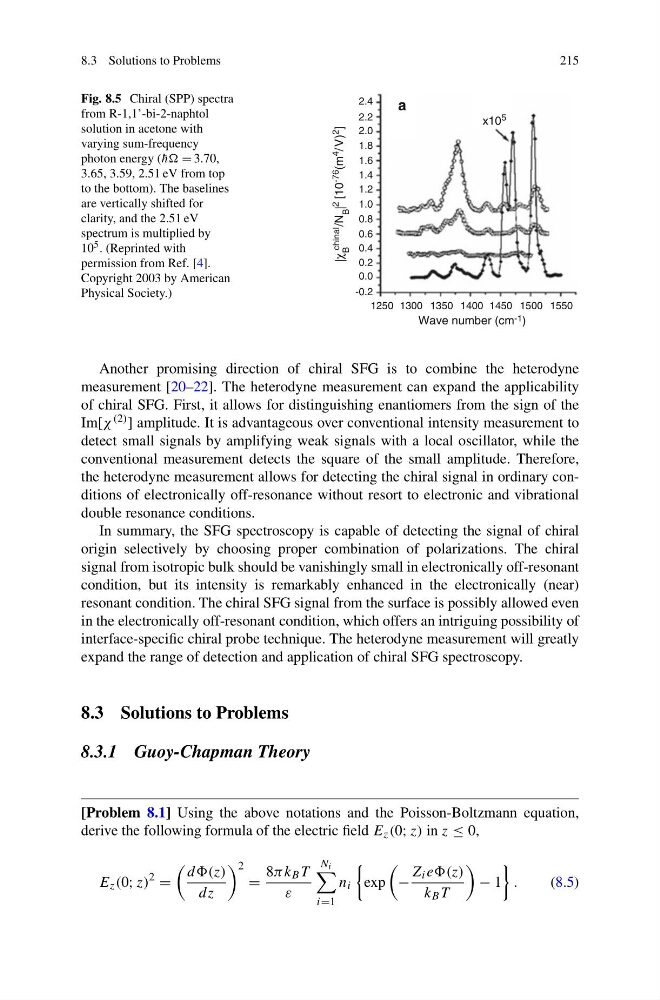
Fig. 8.5 Chiral (SPP) spectra
from R-1,1’-bi-2-naphtol
solution in acetone with
varying sum-frequency
photon energy ( ¯
hh = 3.70,
3.65, 3.59, 2.51 eV from top
to the bottom). The baselines
are vertically shifted for
clarity, and the 2.51 eV
spectrum is multiplied by
10 5 . (Reprinted with
permission from Ref. [4].
Copyright 2003 by American
Physical Society.)
2.4
2.2
2.0
1.8
1.6
1.4
x10
5
a
1.2
1.0
0.8
0.6
0.4
|χ
B
/N
B
| 2
[10 -76
(m 4
/V) 2
]
0.2
0.0
-0.2
1250 1300 1350 1400
Wave number (cm -1 )
1450 1500 1550
chinal
Another promising direction of chiral SFG is to combine the heterodyne
measurement [20–22]. The heterodyne measurement can expand the applicability
of chiral SFG. First, it allows for distinguishing enantiomers from the sign of the
Im[χ (2) ] amplitude. It is advantageous over conventional intensity measurement to
detect small signals by amplifying weak signals with a local oscillator, while the
conventional measurement detects the square of the small amplitude. Therefore,
the heterodyne measurement allows for detecting the chiral signal in ordinary conditions of electronically off-resonance without resort to electronic and vibrational
double resonance conditions.
In summary, the SFG spectroscopy is capable of detecting the signal of chiral
origin selectively by choosing proper combination of polarizations. The chiral
signal from isotropic bulk should be vanishingly small in electronically off-resonant
condition, but its intensity is remarkably enhanced in the electronically (near)
resonant condition. The chiral SFG signal from the surface is possibly allowed even
in the electronically off-resonant condition, which offers an intriguing possibility of
interface-specific chiral probe technique. The heterodyne measurement will greatly
expand the range of detection and application of chiral SFG spectroscopy.
8.3 Solutions to Problems
8.3.1 Guoy-Chapman Theory
[Problem 8.1] Using the above notations and the Poisson-Boltzmann equation,
derive the following formula of the electric field E z (0; z) in z ≤ 0,
E z (0; z)
2
=
dd(z)
dz
2
=
8πk B T
ε
N i
i=1
n i
exp
−
Z i ee(z)
k B T
− 1
.
(8.5)
215
Fig. 8.5 Chiral (SPP) spectra
from R-1,1’-bi-2-naphtol
solution in acetone with
varying sum-frequency
photon energy ( ¯
hh = 3.70,
3.65, 3.59, 2.51 eV from top
to the bottom). The baselines
are vertically shifted for
clarity, and the 2.51 eV
spectrum is multiplied by
10 5 . (Reprinted with
permission from Ref. [4].
Copyright 2003 by American
Physical Society.)
2.4
2.2
2.0
1.8
1.6
1.4
x10
5
a
1.2
1.0
0.8
0.6
0.4
|χ
B
/N
B
| 2
[10 -76
(m 4
/V) 2
]
0.2
0.0
-0.2
1250 1300 1350 1400
Wave number (cm -1 )
1450 1500 1550
chinal
Another promising direction of chiral SFG is to combine the heterodyne
measurement [20–22]. The heterodyne measurement can expand the applicability
of chiral SFG. First, it allows for distinguishing enantiomers from the sign of the
Im[χ (2) ] amplitude. It is advantageous over conventional intensity measurement to
detect small signals by amplifying weak signals with a local oscillator, while the
conventional measurement detects the square of the small amplitude. Therefore,
the heterodyne measurement allows for detecting the chiral signal in ordinary conditions of electronically off-resonance without resort to electronic and vibrational
double resonance conditions.
In summary, the SFG spectroscopy is capable of detecting the signal of chiral
origin selectively by choosing proper combination of polarizations. The chiral
signal from isotropic bulk should be vanishingly small in electronically off-resonant
condition, but its intensity is remarkably enhanced in the electronically (near)
resonant condition. The chiral SFG signal from the surface is possibly allowed even
in the electronically off-resonant condition, which offers an intriguing possibility of
interface-specific chiral probe technique. The heterodyne measurement will greatly
expand the range of detection and application of chiral SFG spectroscopy.
8.3 Solutions to Problems
8.3.1 Guoy-Chapman Theory
[Problem 8.1] Using the above notations and the Poisson-Boltzmann equation,
derive the following formula of the electric field E z (0; z) in z ≤ 0,
E z (0; z)
2
=
dd(z)
dz
2
=
8πk B T
ε
N i
i=1
n i
exp
−
Z i ee(z)
k B T
− 1
.
(8.5)