

Bibliography
217
E z (0; z)
2
=
8πk B T
ε
n
exp
−
Zee
k B T
+ exp
Zee
k B T
− 2
=
8πk B T
ε
n
2 sinh
Zee
2k B T
2
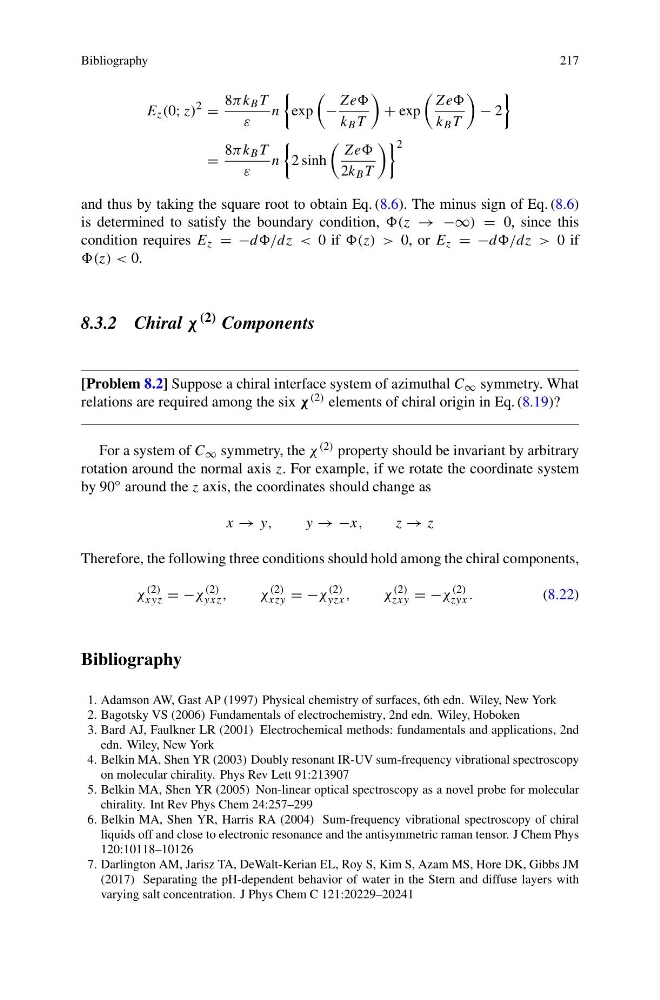
and thus by taking the square root to obtain Eq. (8.6). The minus sign of Eq. (8.6)
is determined to satisfy the boundary condition, (z → −∞) = 0, since this
condition requires E z = −dd/dz < 0 if > 0, or E z = −dd/dz > 0 if
< 0.
8.3.2 Chiral χ (2) Components
[Problem 8.2] Suppose a chiral interface system of azimuthal C ∞ symmetry. What
relations are required among the six χ (2) elements of chiral origin in Eq. (8.19)?
For a system of C ∞ symmetry, the χ (2) property should be invariant by arbitrary
rotation around the normal axis z. For example, if we rotate the coordinate system
by 90 ◦ around the z axis, the coordinates should change as
x → y,
y → −x,
z → z
Therefore, the following three conditions should hold among the chiral components,
χ
(2)
xyz = −χ
(2)
yxz ,
χ
(2)
xzy = −χ
(2)
yzx ,
χ
(2)
zxy = −χ
(2)
zyx .
(8.22)
Bibliography
1. Adamson AW, Gast AP (1997) Physical chemistry of surfaces, 6th edn. Wiley, New York
2. Bagotsky VS (2006) Fundamentals of electrochemistry, 2nd edn. Wiley, Hoboken
3. Bard AJ, Faulkner LR (2001) Electrochemical methods: fundamentals and applications, 2nd
edn. Wiley, New York
4. Belkin MA, Shen YR (2003) Doubly resonant IR-UV sum-frequency vibrational spectroscopy
on molecular chirality. Phys Rev Lett 91:213907
5. Belkin MA, Shen YR (2005) Non-linear optical spectroscopy as a novel probe for molecular
chirality. Int Rev Phys Chem 24:257–299
6. Belkin MA, Shen YR, Harris RA (2004) Sum-frequency vibrational spectroscopy of chiral
liquids off and close to electronic resonance and the antisymmetric raman tensor. J Chem Phys
120:10118–10126
7. Darlington AM, Jarisz TA, DeWalt-Kerian EL, Roy S, Kim S, Azam MS, Hore DK, Gibbs JM
(2017) Separating the pH-dependent behavior of water in the Stern and diffuse layers with
varying salt concentration. J Phys Chem C 121:20229–20241
217
E z (0; z)
2
=
8πk B T
ε
n
exp
−
Zee
k B T
+ exp
Zee
k B T
− 2
=
8πk B T
ε
n
2 sinh
Zee
2k B T
2
and thus by taking the square root to obtain Eq. (8.6). The minus sign of Eq. (8.6)
is determined to satisfy the boundary condition, (z → −∞) = 0, since this
condition requires E z = −dd/dz < 0 if > 0, or E z = −dd/dz > 0 if
< 0.
8.3.2 Chiral χ (2) Components
[Problem 8.2] Suppose a chiral interface system of azimuthal C ∞ symmetry. What
relations are required among the six χ (2) elements of chiral origin in Eq. (8.19)?
For a system of C ∞ symmetry, the χ (2) property should be invariant by arbitrary
rotation around the normal axis z. For example, if we rotate the coordinate system
by 90 ◦ around the z axis, the coordinates should change as
x → y,
y → −x,
z → z
Therefore, the following three conditions should hold among the chiral components,
χ
(2)
xyz = −χ
(2)
yxz ,
χ
(2)
xzy = −χ
(2)
yzx ,
χ
(2)
zxy = −χ
(2)
zyx .
(8.22)
Bibliography
1. Adamson AW, Gast AP (1997) Physical chemistry of surfaces, 6th edn. Wiley, New York
2. Bagotsky VS (2006) Fundamentals of electrochemistry, 2nd edn. Wiley, Hoboken
3. Bard AJ, Faulkner LR (2001) Electrochemical methods: fundamentals and applications, 2nd
edn. Wiley, New York
4. Belkin MA, Shen YR (2003) Doubly resonant IR-UV sum-frequency vibrational spectroscopy
on molecular chirality. Phys Rev Lett 91:213907
5. Belkin MA, Shen YR (2005) Non-linear optical spectroscopy as a novel probe for molecular
chirality. Int Rev Phys Chem 24:257–299
6. Belkin MA, Shen YR, Harris RA (2004) Sum-frequency vibrational spectroscopy of chiral
liquids off and close to electronic resonance and the antisymmetric raman tensor. J Chem Phys
120:10118–10126
7. Darlington AM, Jarisz TA, DeWalt-Kerian EL, Roy S, Kim S, Azam MS, Hore DK, Gibbs JM
(2017) Separating the pH-dependent behavior of water in the Stern and diffuse layers with
varying salt concentration. J Phys Chem C 121:20229–20241