

8.1 χ (3) Effect at Charged Interfaces
209
Equation (8.15) is integrated over z,
P
S
p =
q,r
χ
(2)
pqr +χ
(3)
pqrz
0
−∞
dzE z (0; z) exp
i(k
β
T ,z (ω 1 )+k
β
T ,z (ω 2 )−k
β
G,z (())z
· L I,q (ω 1 )L I,r (ω 2 )E
α
I,q (ω 1 )E
α
I,r (ω 2 ).
(8.16)
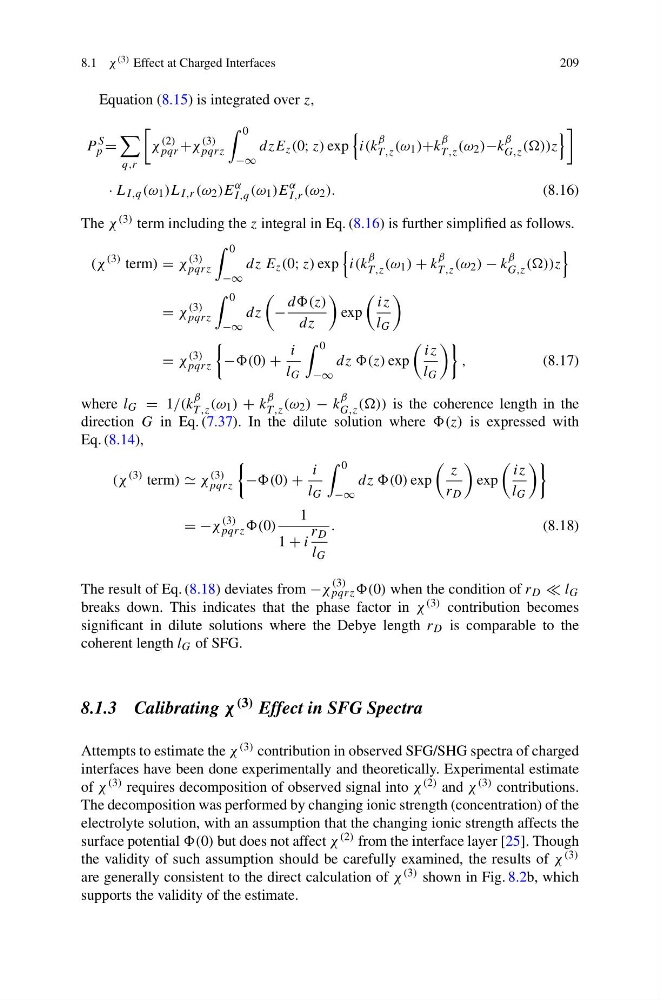
The χ (3) term including the z integral in Eq. (8.16) is further simplified as follows.
(χ
(3) term) = χ
(3)
pqrz
0
−∞
dz E z (0; z) exp
i(k
β
T ,z (ω 1 ) + k
β
T ,z (ω 2 ) − k
β
G,z (())z
= χ
(3)
pqrz
0
−∞
dz
−
dd(z)
dz
exp
iz
l G
= χ
(3)
pqrz
−(0) +
i
l G
0
−∞
dz z(z) exp
iz
l G
,
(8.17)
where l G = 1/(k
β
T ,z (ω 1 ) + k
β
T ,z (ω 2 ) − k
β
G,z (()) is the coherence length in the
direction G in Eq. (7.37). In the dilute solution where is expressed with
Eq. (8.14),
(χ
(3) term) χ
(3)
pqrz
−(0) +
i
l G
0
−∞
dz z(0) exp
z
r D
exp
iz
l G
= −χ
(3)
pqrz (0)
1
1 + i
r D
l G
.
(8.18)
The result of Eq. (8.18) deviates from −χ
(3)
pqrz (0) when the condition of r D l G
breaks down. This indicates that the phase factor in χ (3) contribution becomes
significant in dilute solutions where the Debye length r D is comparable to the
coherent length l G of SFG.
8.1.3 Calibrating χ (3) Effect in SFG Spectra
Attempts to estimate the χ (3) contribution in observed SFG/SHG spectra of charged
interfaces have been done experimentally and theoretically. Experimental estimate
of χ (3) requires decomposition of observed signal into χ (2) and χ (3) contributions.
The decomposition was performed by changing ionic strength (concentration) of the
electrolyte solution, with an assumption that the changing ionic strength affects the
surface potential (0) but does not affect χ (2) from the interface layer [25]. Though
the validity of such assumption should be carefully examined, the results of χ (3)
are generally consistent to the direct calculation of χ (3) shown in Fig. 8.2b, which
supports the validity of the estimate.
209
Equation (8.15) is integrated over z,
P
S
p =
q,r
χ
(2)
pqr +χ
(3)
pqrz
0
−∞
dzE z (0; z) exp
i(k
β
T ,z (ω 1 )+k
β
T ,z (ω 2 )−k
β
G,z (())z
· L I,q (ω 1 )L I,r (ω 2 )E
α
I,q (ω 1 )E
α
I,r (ω 2 ).
(8.16)
The χ (3) term including the z integral in Eq. (8.16) is further simplified as follows.
(χ
(3) term) = χ
(3)
pqrz
0
−∞
dz E z (0; z) exp
i(k
β
T ,z (ω 1 ) + k
β
T ,z (ω 2 ) − k
β
G,z (())z
= χ
(3)
pqrz
0
−∞
dz
−
dd(z)
dz
exp
iz
l G
= χ
(3)
pqrz
−(0) +
i
l G
0
−∞
dz z(z) exp
iz
l G
,
(8.17)
where l G = 1/(k
β
T ,z (ω 1 ) + k
β
T ,z (ω 2 ) − k
β
G,z (()) is the coherence length in the
direction G in Eq. (7.37). In the dilute solution where is expressed with
Eq. (8.14),
(χ
(3) term) χ
(3)
pqrz
−(0) +
i
l G
0
−∞
dz z(0) exp
z
r D
exp
iz
l G
= −χ
(3)
pqrz (0)
1
1 + i
r D
l G
.
(8.18)
The result of Eq. (8.18) deviates from −χ
(3)
pqrz (0) when the condition of r D l G
breaks down. This indicates that the phase factor in χ (3) contribution becomes
significant in dilute solutions where the Debye length r D is comparable to the
coherent length l G of SFG.
8.1.3 Calibrating χ (3) Effect in SFG Spectra
Attempts to estimate the χ (3) contribution in observed SFG/SHG spectra of charged
interfaces have been done experimentally and theoretically. Experimental estimate
of χ (3) requires decomposition of observed signal into χ (2) and χ (3) contributions.
The decomposition was performed by changing ionic strength (concentration) of the
electrolyte solution, with an assumption that the changing ionic strength affects the
surface potential (0) but does not affect χ (2) from the interface layer [25]. Though
the validity of such assumption should be carefully examined, the results of χ (3)
are generally consistent to the direct calculation of χ (3) shown in Fig. 8.2b, which
supports the validity of the estimate.