

208
8 Other Topics
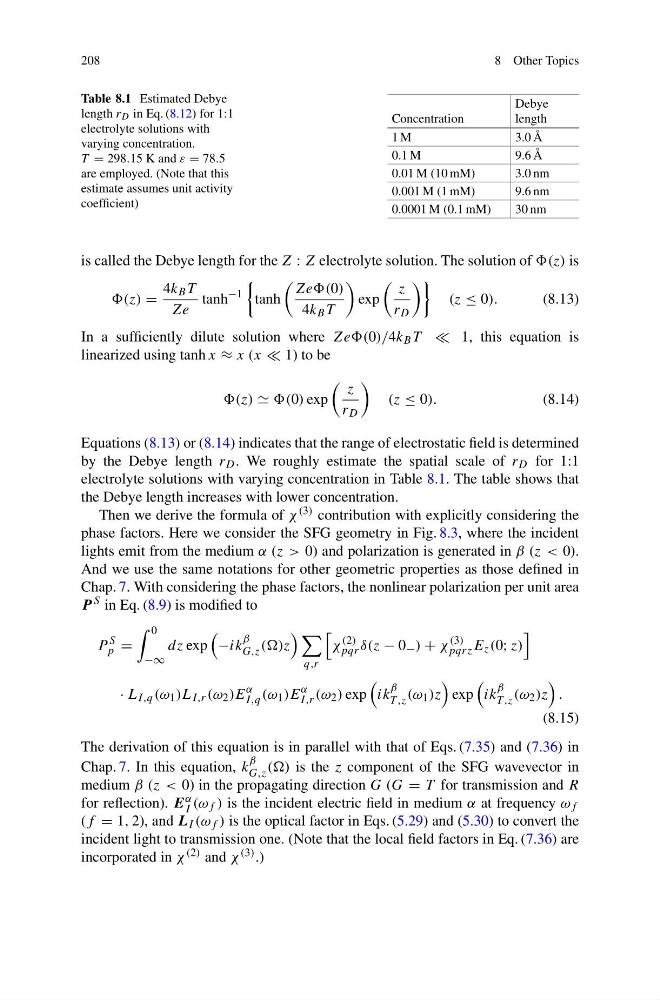
Table 8.1 Estimated Debye
length r D in Eq. (8.12) for 1:1
electrolyte solutions with
varying concentration.
T = 298.15 K and ε = 78.5
are employed. (Note that this
estimate assumes unit activity
coefficient)
Concentration
Debye
length
1 M
3.0 Å
0.1 M
9.6 Å
0.01 M (10 mM)
3.0 nm
0.001 M (1 mM)
9.6 nm
0.0001 M (0.1 mM)
30 nm
is called the Debye length for the Z : Z electrolyte solution. The solution of is
=
4k B T
Ze
tanh
−1
tanh
Zee(0)
4k B T
exp
z
r D
(z ≤ 0).
(8.13)
In a sufficiently dilute solution where Zee(0)/4k B T 1, this equation is
linearized using tanh x ≈ x (x 1) to be
(0) exp
z
r D
(z ≤ 0).
(8.14)
Equations (8.13) or (8.14) indicates that the range of electrostatic field is determined
by the Debye length r D . We roughly estimate the spatial scale of r D for 1:1
electrolyte solutions with varying concentration in Table 8.1. The table shows that
the Debye length increases with lower concentration.
Then we derive the formula of χ (3) contribution with explicitly considering the
phase factors. Here we consider the SFG geometry in Fig. 8.3, where the incident
lights emit from the medium α (z > 0) and polarization is generated in β (z < 0).
And we use the same notations for other geometric properties as those defined in
Chap. 7. With considering the phase factors, the nonlinear polarization per unit area
P S in Eq. (8.9) is modified to
P
S
p =
0
−∞
dz exp
−ik
β
G,z (()z
q,r
χ
(2)
pqr δ(z − 0 − ) + χ
(3)
pqrz E z (0; z)
· L I,q (ω 1 )L I,r (ω 2 )E
α
I,q (ω 1 )E
α
I,r (ω 2 ) exp
ik
β
T ,z (ω 1 )z
exp
ik
β
T ,z (ω 2 )z
.
(8.15)
The derivation of this equation is in parallel with that of Eqs. (7.35) and (7.36) in
Chap. 7. In this equation, k
β
G,z (() is the z component of the SFG wavevector in
medium β (z < 0) in the propagating direction G (G = T for transmission and R
for reflection). E α
I (ω f ) is the incident electric field in medium α at frequency ω f
(f = 1, 2), and L I (ω f ) is the optical factor in Eqs. (5.29) and (5.30) to convert the
incident light to transmission one. (Note that the local field factors in Eq. (7.36) are
incorporated in χ (2) and χ (3) .)
8 Other Topics
Table 8.1 Estimated Debye
length r D in Eq. (8.12) for 1:1
electrolyte solutions with
varying concentration.
T = 298.15 K and ε = 78.5
are employed. (Note that this
estimate assumes unit activity
coefficient)
Concentration
Debye
length
1 M
3.0 Å
0.1 M
9.6 Å
0.01 M (10 mM)
3.0 nm
0.001 M (1 mM)
9.6 nm
0.0001 M (0.1 mM)
30 nm
is called the Debye length for the Z : Z electrolyte solution. The solution of is
=
4k B T
Ze
tanh
−1
tanh
Zee(0)
4k B T
exp
z
r D
(z ≤ 0).
(8.13)
In a sufficiently dilute solution where Zee(0)/4k B T 1, this equation is
linearized using tanh x ≈ x (x 1) to be
(0) exp
z
r D
(z ≤ 0).
(8.14)
Equations (8.13) or (8.14) indicates that the range of electrostatic field is determined
by the Debye length r D . We roughly estimate the spatial scale of r D for 1:1
electrolyte solutions with varying concentration in Table 8.1. The table shows that
the Debye length increases with lower concentration.
Then we derive the formula of χ (3) contribution with explicitly considering the
phase factors. Here we consider the SFG geometry in Fig. 8.3, where the incident
lights emit from the medium α (z > 0) and polarization is generated in β (z < 0).
And we use the same notations for other geometric properties as those defined in
Chap. 7. With considering the phase factors, the nonlinear polarization per unit area
P S in Eq. (8.9) is modified to
P
S
p =
0
−∞
dz exp
−ik
β
G,z (()z
q,r
χ
(2)
pqr δ(z − 0 − ) + χ
(3)
pqrz E z (0; z)
· L I,q (ω 1 )L I,r (ω 2 )E
α
I,q (ω 1 )E
α
I,r (ω 2 ) exp
ik
β
T ,z (ω 1 )z
exp
ik
β
T ,z (ω 2 )z
.
(8.15)
The derivation of this equation is in parallel with that of Eqs. (7.35) and (7.36) in
Chap. 7. In this equation, k
β
G,z (() is the z component of the SFG wavevector in
medium β (z < 0) in the propagating direction G (G = T for transmission and R
for reflection). E α
I (ω f ) is the incident electric field in medium α at frequency ω f
(f = 1, 2), and L I (ω f ) is the optical factor in Eqs. (5.29) and (5.30) to convert the
incident light to transmission one. (Note that the local field factors in Eq. (7.36) are
incorporated in χ (2) and χ (3) .)