

8.1 χ (3) Effect at Charged Interfaces
207
In the final expression of Eq. (8.9), χ (2) is defined as the second-order susceptibility
per unit area, and χ (3) as the third-order susceptibility per unit volume. Since χ (3)
is a bulk property, the definition per unit volume is feasible for a uniform material.
Equation (8.9) includes the surface potential (0) = −
0
−∞
E z (0; z)dz, which
affects the relative amplitude of χ (3) (0) term to χ (2) . 3
The surface potential (0) is related to the surface charge density σ . By applying
the Gauss divergence theorem (see Sect. 2.1.2) to the solid-liquid interface, where
the surface charge σ is located and the electric field E (or electric displacement D)
is along the z direction, one leads to
4πσ = −εE z (0; z = 0 − ).
In the case of Z:Z electrolyte solution, the result of Guoy-Chapman theory in
Eq. (8.6) is further applied to the above equation to obtain
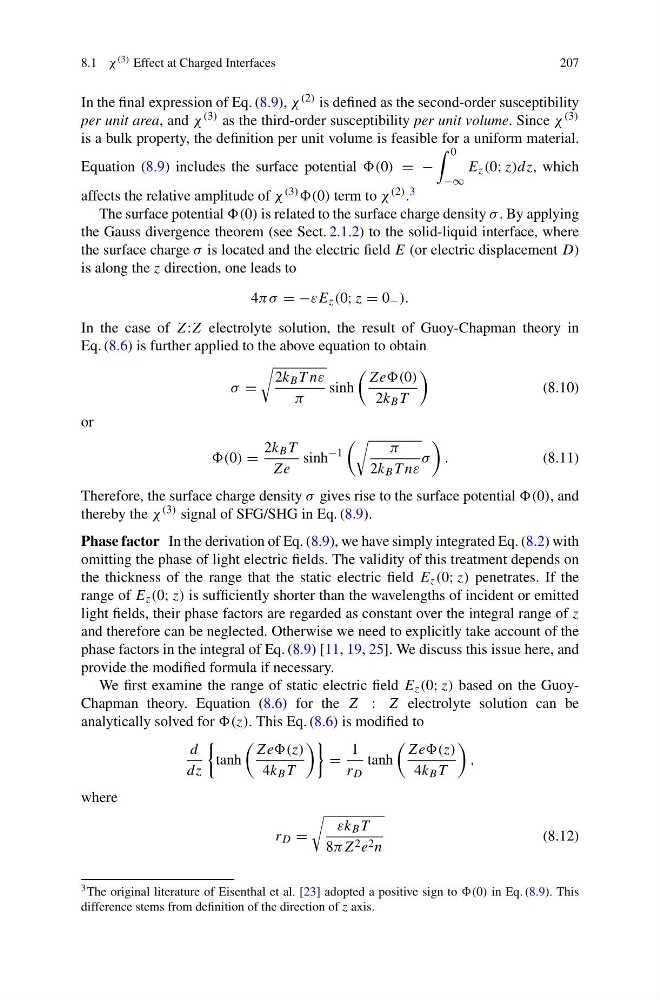
σ =
2k B T nε
π
sinh
Zee(0)
2k B T
(8.10)
or
(0) =
2k B T
Ze
sinh
−1
π
2k B T nε
σ
.
(8.11)
Therefore, the surface charge density σ gives rise to the surface potential (0), and
thereby the χ (3) signal of SFG/SHG in Eq. (8.9).
Phase factor In the derivation of Eq. (8.9), we have simply integrated Eq. (8.2) with
omitting the phase of light electric fields. The validity of this treatment depends on
the thickness of the range that the static electric field E z (0; z) penetrates. If the
range of E z (0; z) is sufficiently shorter than the wavelengths of incident or emitted
light fields, their phase factors are regarded as constant over the integral range of z
and therefore can be neglected. Otherwise we need to explicitly take account of the
phase factors in the integral of Eq. (8.9) [11, 19, 25]. We discuss this issue here, and
provide the modified formula if necessary.
We first examine the range of static electric field E z (0; z) based on the GuoyChapman theory. Equation (8.6) for the Z : Z electrolyte solution can be
analytically solved for This Eq. (8.6) is modified to
d
dz
tanh
Zee(z)
4k B T
=
1
r D
tanh
Zee(z)
4k B T
,
where
r D =
εk B T
8πZ 2 e 2 n
(8.12)
3 The original literature of Eisenthal et al. [23] adopted a positive sign to (0) in Eq. (8.9). This
difference stems from definition of the direction of z axis.
207
In the final expression of Eq. (8.9), χ (2) is defined as the second-order susceptibility
per unit area, and χ (3) as the third-order susceptibility per unit volume. Since χ (3)
is a bulk property, the definition per unit volume is feasible for a uniform material.
Equation (8.9) includes the surface potential (0) = −
0
−∞
E z (0; z)dz, which
affects the relative amplitude of χ (3) (0) term to χ (2) . 3
The surface potential (0) is related to the surface charge density σ . By applying
the Gauss divergence theorem (see Sect. 2.1.2) to the solid-liquid interface, where
the surface charge σ is located and the electric field E (or electric displacement D)
is along the z direction, one leads to
4πσ = −εE z (0; z = 0 − ).
In the case of Z:Z electrolyte solution, the result of Guoy-Chapman theory in
Eq. (8.6) is further applied to the above equation to obtain
σ =
2k B T nε
π
sinh
Zee(0)
2k B T
(8.10)
or
(0) =
2k B T
Ze
sinh
−1
π
2k B T nε
σ
.
(8.11)
Therefore, the surface charge density σ gives rise to the surface potential (0), and
thereby the χ (3) signal of SFG/SHG in Eq. (8.9).
Phase factor In the derivation of Eq. (8.9), we have simply integrated Eq. (8.2) with
omitting the phase of light electric fields. The validity of this treatment depends on
the thickness of the range that the static electric field E z (0; z) penetrates. If the
range of E z (0; z) is sufficiently shorter than the wavelengths of incident or emitted
light fields, their phase factors are regarded as constant over the integral range of z
and therefore can be neglected. Otherwise we need to explicitly take account of the
phase factors in the integral of Eq. (8.9) [11, 19, 25]. We discuss this issue here, and
provide the modified formula if necessary.
We first examine the range of static electric field E z (0; z) based on the GuoyChapman theory. Equation (8.6) for the Z : Z electrolyte solution can be
analytically solved for This Eq. (8.6) is modified to
d
dz
tanh
Zee(z)
4k B T
=
1
r D
tanh
Zee(z)
4k B T
,
where
r D =
εk B T
8πZ 2 e 2 n
(8.12)
3 The original literature of Eisenthal et al. [23] adopted a positive sign to (0) in Eq. (8.9). This
difference stems from definition of the direction of z axis.