

206
8 Other Topics
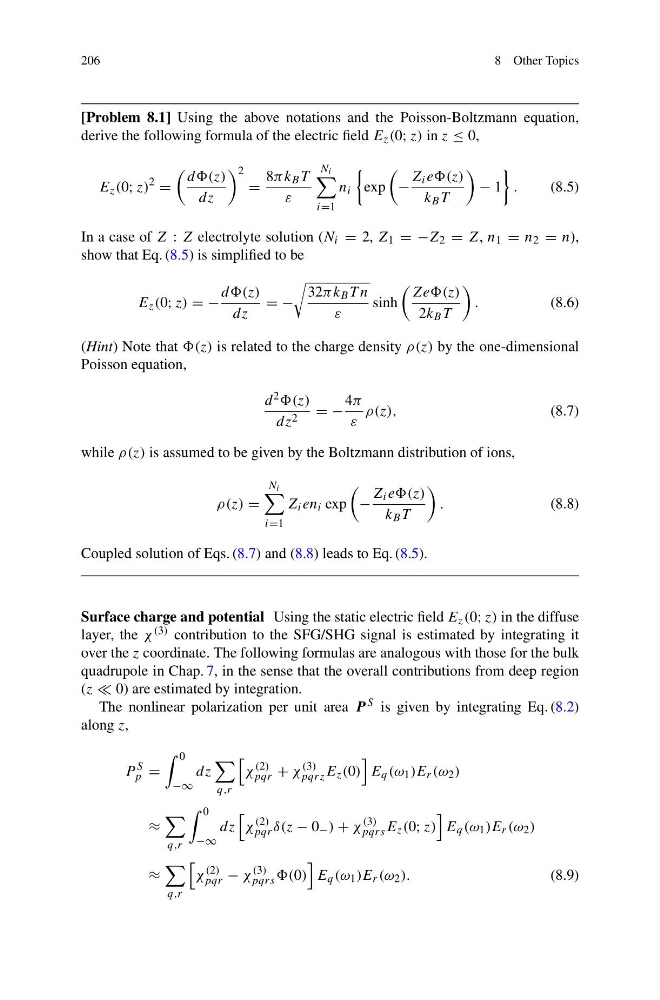
[Problem 8.1] Using the above notations and the Poisson-Boltzmann equation,
derive the following formula of the electric field E z (0; z) in z ≤ 0,
E z (0; z)
2
=
dd(z)
dz
2
=
8πk B T
ε
N i
i=1
n i
exp
−
Z i ee(z)
k B T
− 1
.
(8.5)
In a case of Z : Z electrolyte solution (N i = 2, Z 1 = −Z 2 = Z, n 1 = n 2 = n),
show that Eq. (8.5) is simplified to be
E z (0; z) = −
dd(z)
dz
= −
32πk B T n
ε
sinh
Zee(z)
2k B T
.
(8.6)
(Hint) Note that is related to the charge density ρ(z) by the one-dimensional
Poisson equation,
d 2 (z)
dz 2 = −
4π
ε
ρ(z),
(8.7)
while ρ(z) is assumed to be given by the Boltzmann distribution of ions,
ρ(z) =
N i
i=1
Z i en i exp
−
Z i ee(z)
k B T
.
(8.8)
Coupled solution of Eqs. (8.7) and (8.8) leads to Eq. (8.5).
Surface charge and potential Using the static electric field E z (0; z) in the diffuse
layer, the χ (3) contribution to the SFG/SHG signal is estimated by integrating it
over the z coordinate. The following formulas are analogous with those for the bulk
quadrupole in Chap. 7, in the sense that the overall contributions from deep region
(z 0) are estimated by integration.
The nonlinear polarization per unit area P S is given by integrating Eq. (8.2)
along z,
P
S
p =
0
−∞
dz
q,r
χ
(2)
pqr + χ
(3)
pqrz E z (0)
E q (ω 1 )E r (ω 2 )
≈
q,r
0
−∞
dz
χ
(2)
pqr δ(z − 0 − ) + χ
(3)
pqrs E z (0; z)
E q (ω 1 )E r (ω 2 )
≈
q,r
χ
(2)
pqr − χ
(3)
pqrs (0)
E q (ω 1 )E r (ω 2 ).
(8.9)
8 Other Topics
[Problem 8.1] Using the above notations and the Poisson-Boltzmann equation,
derive the following formula of the electric field E z (0; z) in z ≤ 0,
E z (0; z)
2
=
dd(z)
dz
2
=
8πk B T
ε
N i
i=1
n i
exp
−
Z i ee(z)
k B T
− 1
.
(8.5)
In a case of Z : Z electrolyte solution (N i = 2, Z 1 = −Z 2 = Z, n 1 = n 2 = n),
show that Eq. (8.5) is simplified to be
E z (0; z) = −
dd(z)
dz
= −
32πk B T n
ε
sinh
Zee(z)
2k B T
.
(8.6)
(Hint) Note that is related to the charge density ρ(z) by the one-dimensional
Poisson equation,
d 2 (z)
dz 2 = −
4π
ε
ρ(z),
(8.7)
while ρ(z) is assumed to be given by the Boltzmann distribution of ions,
ρ(z) =
N i
i=1
Z i en i exp
−
Z i ee(z)
k B T
.
(8.8)
Coupled solution of Eqs. (8.7) and (8.8) leads to Eq. (8.5).
Surface charge and potential Using the static electric field E z (0; z) in the diffuse
layer, the χ (3) contribution to the SFG/SHG signal is estimated by integrating it
over the z coordinate. The following formulas are analogous with those for the bulk
quadrupole in Chap. 7, in the sense that the overall contributions from deep region
(z 0) are estimated by integration.
The nonlinear polarization per unit area P S is given by integrating Eq. (8.2)
along z,
P
S
p =
0
−∞
dz
q,r
χ
(2)
pqr + χ
(3)
pqrz E z (0)
E q (ω 1 )E r (ω 2 )
≈
q,r
0
−∞
dz
χ
(2)
pqr δ(z − 0 − ) + χ
(3)
pqrs E z (0; z)
E q (ω 1 )E r (ω 2 )
≈
q,r
χ
(2)
pqr − χ
(3)
pqrs (0)
E q (ω 1 )E r (ω 2 ).
(8.9)