

8.1 χ (3) Effect at Charged Interfaces
205
8.1.2 Role of χ (3) in Electrolyte Solution
Then we discuss the χ (3) effect in electrolyte solutions near solid-liquid interfaces.
In the conventional picture of electrochemistry, the structure of electrolyte solutions
near a solid (or electrode) surface consists of the contact (Stern) layer and the diffuse
(Guoy-Chapman) layer [2, 3]. The former indicates the region of a few monolayers
at the solid-liquid interface, where specific interfacial structure, such as specific
adsorption, is constructed. The latter, diffuse layer extends to the solution over the
Debye screening length, where the counter ions of charged surface are distributed
and the net electric field is penetrated. The χ (3) signal arises from the diffuse layer
of electrolyte solution, while the contact layer is considered to be the source of
interface-specific SFG/SHG signal by χ (2) . Here we formulate the χ (3) contribution
from the diffuse layer based on the Gouy-Chapman theory [1–3].
Guoy-Chapman theory Suppose the normal coordinate z to the solid-liquid
interface. The interface is located at z = 0 and has charge density σ per unit area,
while the electrolyte solution with dielectric constant ε is extended in z < 0. (See
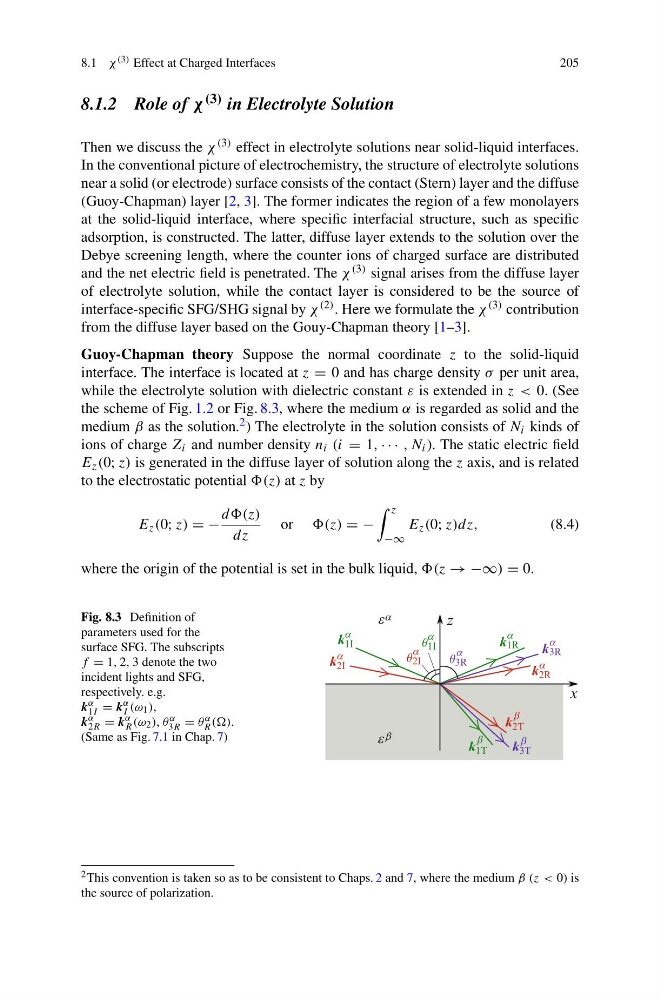
the scheme of Fig. 1.2 or Fig. 8.3, where the medium α is regarded as solid and the
medium β as the solution. 2 ) The electrolyte in the solution consists of N i kinds of
ions of charge Z i and number density n i (i = 1, · · · , N i ). The static electric field
E z (0; z) is generated in the diffuse layer of solution along the z axis, and is related
to the electrostatic potential at z by
E z (0; z) = −
dd(z)
dz
or = −
z
−∞
E z (0; z)dz,
(8.4)
where the origin of the potential is set in the bulk liquid, (z → −∞) = 0.
Fig. 8.3 Definition of
parameters used for the
surface SFG. The subscripts
f = 1, 2, 3 denote the two
incident lights and SFG,
respectively. e.g.
k
α
1I = k
α
I (ω 1 ),
k
α
2R = k
α
R (ω 2 ), θ α
3R = θ α
R (().
(Same as Fig. 7.1 in Chap. 7)
k
k
k
k
k
k
k
k
3R
3R
3T
1I
1I
1R
1T
2I
2I
2R
2T
x
z
2 This convention is taken so as to be consistent to Chaps. 2 and 7, where the medium β (z < 0) is
the source of polarization.
205
8.1.2 Role of χ (3) in Electrolyte Solution
Then we discuss the χ (3) effect in electrolyte solutions near solid-liquid interfaces.
In the conventional picture of electrochemistry, the structure of electrolyte solutions
near a solid (or electrode) surface consists of the contact (Stern) layer and the diffuse
(Guoy-Chapman) layer [2, 3]. The former indicates the region of a few monolayers
at the solid-liquid interface, where specific interfacial structure, such as specific
adsorption, is constructed. The latter, diffuse layer extends to the solution over the
Debye screening length, where the counter ions of charged surface are distributed
and the net electric field is penetrated. The χ (3) signal arises from the diffuse layer
of electrolyte solution, while the contact layer is considered to be the source of
interface-specific SFG/SHG signal by χ (2) . Here we formulate the χ (3) contribution
from the diffuse layer based on the Gouy-Chapman theory [1–3].
Guoy-Chapman theory Suppose the normal coordinate z to the solid-liquid
interface. The interface is located at z = 0 and has charge density σ per unit area,
while the electrolyte solution with dielectric constant ε is extended in z < 0. (See
the scheme of Fig. 1.2 or Fig. 8.3, where the medium α is regarded as solid and the
medium β as the solution. 2 ) The electrolyte in the solution consists of N i kinds of
ions of charge Z i and number density n i (i = 1, · · · , N i ). The static electric field
E z (0; z) is generated in the diffuse layer of solution along the z axis, and is related
to the electrostatic potential at z by
E z (0; z) = −
dd(z)
dz
or = −
z
−∞
E z (0; z)dz,
(8.4)
where the origin of the potential is set in the bulk liquid, (z → −∞) = 0.
Fig. 8.3 Definition of
parameters used for the
surface SFG. The subscripts
f = 1, 2, 3 denote the two
incident lights and SFG,
respectively. e.g.
k
α
1I = k
α
I (ω 1 ),
k
α
2R = k
α
R (ω 2 ), θ α
3R = θ α
R (().
(Same as Fig. 7.1 in Chap. 7)
k
k
k
k
k
k
k
k
3R
3R
3T
1I
1I
1R
1T
2I
2I
2R
2T
x
z
2 This convention is taken so as to be consistent to Chaps. 2 and 7, where the medium β (z < 0) is
the source of polarization.