

8.1 χ (3) Effect at Charged Interfaces
203
50
40
30
20
10
0
2
4
6
8
pH in the bulk
SH electric field (a.u.)
10
12
14
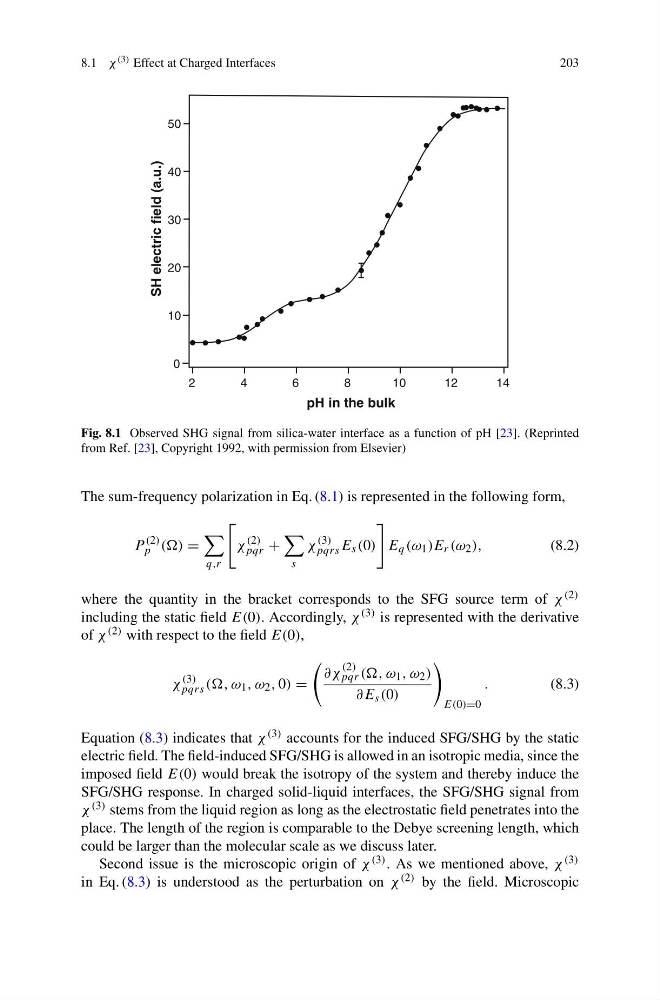
Fig. 8.1 Observed SHG signal from silica-water interface as a function of pH [23]. (Reprinted
from Ref. [23], Copyright 1992, with permission from Elsevier)
The sum-frequency polarization in Eq. (8.1) is represented in the following form,
P
(2)
p (() =
q,r
χ
(2)
pqr +
s
χ
(3)
pqrs E s (0)
E q (ω 1 )E r (ω 2 ),
(8.2)
where the quantity in the bracket corresponds to the SFG source term of χ (2)
including the static field E(0). Accordingly, χ (3) is represented with the derivative
of χ (2) with respect to the field E(0),
χ
(3)
pqrs ((, ω 1 , ω 2 , 0) =
∂χ
(2)
pqr ((, ω 1 , ω 2 )
∂E s (0)
E(0)=0
.
(8.3)
Equation (8.3) indicates that χ (3) accounts for the induced SFG/SHG by the static
electric field. The field-induced SFG/SHG is allowed in an isotropic media, since the
imposed field E(0) would break the isotropy of the system and thereby induce the
SFG/SHG response. In charged solid-liquid interfaces, the SFG/SHG signal from
χ (3) stems from the liquid region as long as the electrostatic field penetrates into the
place. The length of the region is comparable to the Debye screening length, which
could be larger than the molecular scale as we discuss later.
Second issue is the microscopic origin of χ (3) . As we mentioned above, χ (3)
in Eq. (8.3) is understood as the perturbation on χ (2) by the field. Microscopic
203
50
40
30
20
10
0
2
4
6
8
pH in the bulk
SH electric field (a.u.)
10
12
14
Fig. 8.1 Observed SHG signal from silica-water interface as a function of pH [23]. (Reprinted
from Ref. [23], Copyright 1992, with permission from Elsevier)
The sum-frequency polarization in Eq. (8.1) is represented in the following form,
P
(2)
p (() =
q,r
χ
(2)
pqr +
s
χ
(3)
pqrs E s (0)
E q (ω 1 )E r (ω 2 ),
(8.2)
where the quantity in the bracket corresponds to the SFG source term of χ (2)
including the static field E(0). Accordingly, χ (3) is represented with the derivative
of χ (2) with respect to the field E(0),
χ
(3)
pqrs ((, ω 1 , ω 2 , 0) =
∂χ
(2)
pqr ((, ω 1 , ω 2 )
∂E s (0)
E(0)=0
.
(8.3)
Equation (8.3) indicates that χ (3) accounts for the induced SFG/SHG by the static
electric field. The field-induced SFG/SHG is allowed in an isotropic media, since the
imposed field E(0) would break the isotropy of the system and thereby induce the
SFG/SHG response. In charged solid-liquid interfaces, the SFG/SHG signal from
χ (3) stems from the liquid region as long as the electrostatic field penetrates into the
place. The length of the region is comparable to the Debye screening length, which
could be larger than the molecular scale as we discuss later.
Second issue is the microscopic origin of χ (3) . As we mentioned above, χ (3)
in Eq. (8.3) is understood as the perturbation on χ (2) by the field. Microscopic