

202
8 Other Topics
8.1 χ (3) Effect at Charged Interfaces
In the SFG or SHG spectra from liquids at charged interfaces, another mechanism of
SFG/SHG emission arises besides the usual one, called “χ (3) effect”. The charge at
interface generates static electric field E that penetrates into the interface and bulk
of the liquid, and thereby induces additional nonlinear polarization in the liquid. In
such cases, the induced polarization of sum frequency = ω 1 + ω 2 by two incident
light fields of frequencies ω 1 and ω 2 is represented as follows,
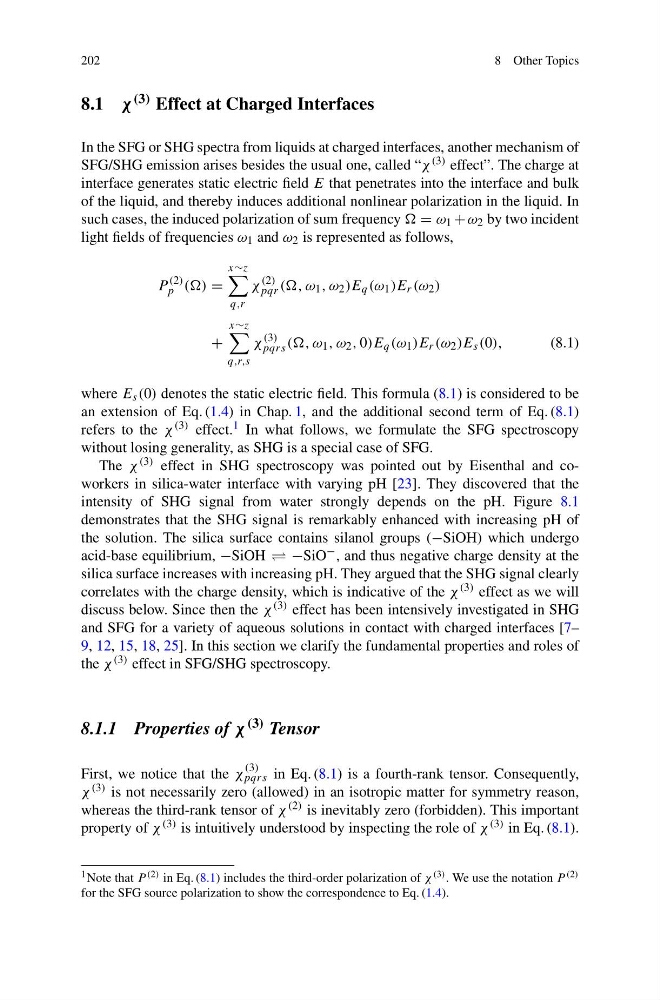
P
(2)
p (() =
x∼z
q,r
χ
(2)
pqr ((, ω 1 , ω 2 )E q (ω 1 )E r (ω 2 )
+
x∼z
q,r,s
χ
(3)
pqrs ((, ω 1 , ω 2 , 0)E q (ω 1 )E r (ω 2 )E s (0),
(8.1)
where E s (0) denotes the static electric field. This formula (8.1) is considered to be
an extension of Eq. (1.4) in Chap. 1, and the additional second term of Eq. (8.1)
refers to the χ (3) effect. 1 In what follows, we formulate the SFG spectroscopy
without losing generality, as SHG is a special case of SFG.
The χ (3) effect in SHG spectroscopy was pointed out by Eisenthal and coworkers in silica-water interface with varying pH [23]. They discovered that the
intensity of SHG signal from water strongly depends on the pH. Figure 8.1
demonstrates that the SHG signal is remarkably enhanced with increasing pH of
the solution. The silica surface contains silanol groups (−SiOH) which undergo
acid-base equilibrium, −SiOH −SiO
− , and thus negative charge density at the
silica surface increases with increasing pH. They argued that the SHG signal clearly
correlates with the charge density, which is indicative of the χ (3) effect as we will
discuss below. Since then the χ (3) effect has been intensively investigated in SHG
and SFG for a variety of aqueous solutions in contact with charged interfaces [7–
9, 12, 15, 18, 25]. In this section we clarify the fundamental properties and roles of
the χ (3) effect in SFG/SHG spectroscopy.
8.1.1 Properties of χ (3) Tensor
First, we notice that the χ
(3)
pqrs in Eq. (8.1) is a fourth-rank tensor. Consequently,
χ (3) is not necessarily zero (allowed) in an isotropic matter for symmetry reason,
whereas the third-rank tensor of χ (2) is inevitably zero (forbidden). This important
property of χ (3) is intuitively understood by inspecting the role of χ (3) in Eq. (8.1).
1 Note that P (2) in Eq. (8.1) includes the third-order polarization of χ (3) . We use the notation P (2)
for the SFG source polarization to show the correspondence to Eq. (1.4).
8 Other Topics
8.1 χ (3) Effect at Charged Interfaces
In the SFG or SHG spectra from liquids at charged interfaces, another mechanism of
SFG/SHG emission arises besides the usual one, called “χ (3) effect”. The charge at
interface generates static electric field E that penetrates into the interface and bulk
of the liquid, and thereby induces additional nonlinear polarization in the liquid. In
such cases, the induced polarization of sum frequency = ω 1 + ω 2 by two incident
light fields of frequencies ω 1 and ω 2 is represented as follows,
P
(2)
p (() =
x∼z
q,r
χ
(2)
pqr ((, ω 1 , ω 2 )E q (ω 1 )E r (ω 2 )
+
x∼z
q,r,s
χ
(3)
pqrs ((, ω 1 , ω 2 , 0)E q (ω 1 )E r (ω 2 )E s (0),
(8.1)
where E s (0) denotes the static electric field. This formula (8.1) is considered to be
an extension of Eq. (1.4) in Chap. 1, and the additional second term of Eq. (8.1)
refers to the χ (3) effect. 1 In what follows, we formulate the SFG spectroscopy
without losing generality, as SHG is a special case of SFG.
The χ (3) effect in SHG spectroscopy was pointed out by Eisenthal and coworkers in silica-water interface with varying pH [23]. They discovered that the
intensity of SHG signal from water strongly depends on the pH. Figure 8.1
demonstrates that the SHG signal is remarkably enhanced with increasing pH of
the solution. The silica surface contains silanol groups (−SiOH) which undergo
acid-base equilibrium, −SiOH −SiO
− , and thus negative charge density at the
silica surface increases with increasing pH. They argued that the SHG signal clearly
correlates with the charge density, which is indicative of the χ (3) effect as we will
discuss below. Since then the χ (3) effect has been intensively investigated in SHG
and SFG for a variety of aqueous solutions in contact with charged interfaces [7–
9, 12, 15, 18, 25]. In this section we clarify the fundamental properties and roles of
the χ (3) effect in SFG/SHG spectroscopy.
8.1.1 Properties of χ (3) Tensor
First, we notice that the χ
(3)
pqrs in Eq. (8.1) is a fourth-rank tensor. Consequently,
χ (3) is not necessarily zero (allowed) in an isotropic matter for symmetry reason,
whereas the third-rank tensor of χ (2) is inevitably zero (forbidden). This important
property of χ (3) is intuitively understood by inspecting the role of χ (3) in Eq. (8.1).
1 Note that P (2) in Eq. (8.1) includes the third-order polarization of χ (3) . We use the notation P (2)
for the SFG source polarization to show the correspondence to Eq. (1.4).