

7.4 Invariance to Molecular Origin
183
= χ ID
pqr ((, ω 1 , ω 2 )
+
⎛
⎝
molecules
l
z l α D0
l,pqr ((, ω 1 , ω 2 )δ(z b − z l )
⎞
⎠ f
β
p (()f
β
q (ω 1 )f
β
r (ω 2 )
+
∞
z b
dz
⎛
⎝
molecules
l
z l α D0
l,pqr ((, ω 1 , ω 2 )δ(z − z l )
⎞
⎠ ∂
∂z
f p (z, ,)f q (z, ω 1 )f r (z, ω 2 )
+ · · · ,
(7.114)
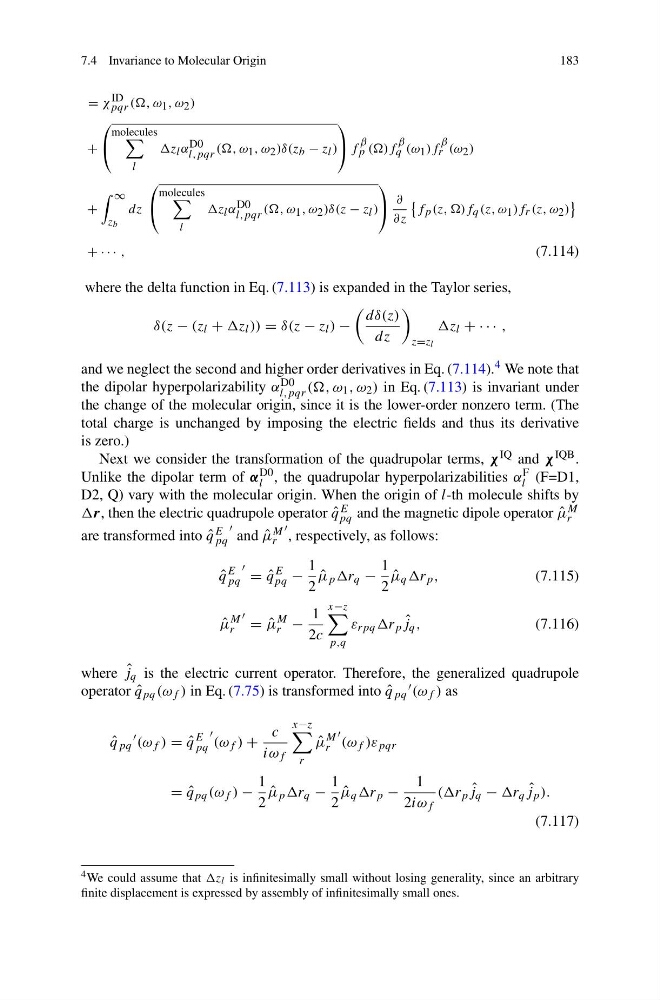
where the delta function in Eq. (7.113) is expanded in the Taylor series,
δ(z − (z l + z l )) = δ(z − z l ) −
dδ(z)
dz
z=z l
z l + · · · ,
and we neglect the second and higher order derivatives in Eq. (7.114). 4 We note that
the dipolar hyperpolarizability α D0
l,pqr ((, ω 1 , ω 2 ) in Eq. (7.113) is invariant under
the change of the molecular origin, since it is the lower-order nonzero term. (The
total charge is unchanged by imposing the electric fields and thus its derivative
is zero.)
Next we consider the transformation of the quadrupolar terms, χ IQ and χ IQB .
Unlike the dipolar term of α D0
l , the quadrupolar hyperpolarizabilities α F
l (F=D1,
D2, Q) vary with the molecular origin. When the origin of l-th molecule shifts by
r, then the electric quadrupole operator ˆ
q E
pq and the magnetic dipole operator ˆ
μ M
r
are transformed into ˆ
q E
pq
and ˆ
μ M
r
, respectively, as follows:
ˆ
q
E
pq
= ˆ
q
E
pq −
1
2
ˆ
μ p r q −
1
2
ˆ
μ q r p ,
(7.115)
ˆ
μ
M
r
= ˆ
μ
M
r −
1
2c
x−z
p,q
ε rpq r p ˆ
j q ,
(7.116)
where ˆ
j q is the electric current operator. Therefore, the generalized quadrupole
operator ˆ
q pq (ω f ) in Eq. (7.75) is transformed into ˆ
q pq
(ω f ) as
ˆ
q pq
(ω f ) = ˆ
q
E
pq
(ω f ) +
c
iω f
x−z
r
ˆ
μ
M
r
(ω f )ε pqr
= ˆ
q pq (ω f ) −
1
2
ˆ
μ p r q −
1
2
ˆ
μ q r p −
1
2iω f
((r p ˆ
j q − r q ˆ
j p ).
(7.117)
4 We could assume that z l is infinitesimally small without losing generality, since an arbitrary
finite displacement is expressed by assembly of infinitesimally small ones.
183
= χ ID
pqr ((, ω 1 , ω 2 )
+
⎛
⎝
molecules
l
z l α D0
l,pqr ((, ω 1 , ω 2 )δ(z b − z l )
⎞
⎠ f
β
p (()f
β
q (ω 1 )f
β
r (ω 2 )
+
∞
z b
dz
⎛
⎝
molecules
l
z l α D0
l,pqr ((, ω 1 , ω 2 )δ(z − z l )
⎞
⎠ ∂
∂z
f p (z, ,)f q (z, ω 1 )f r (z, ω 2 )
+ · · · ,
(7.114)
where the delta function in Eq. (7.113) is expanded in the Taylor series,
δ(z − (z l + z l )) = δ(z − z l ) −
dδ(z)
dz
z=z l
z l + · · · ,
and we neglect the second and higher order derivatives in Eq. (7.114). 4 We note that
the dipolar hyperpolarizability α D0
l,pqr ((, ω 1 , ω 2 ) in Eq. (7.113) is invariant under
the change of the molecular origin, since it is the lower-order nonzero term. (The
total charge is unchanged by imposing the electric fields and thus its derivative
is zero.)
Next we consider the transformation of the quadrupolar terms, χ IQ and χ IQB .
Unlike the dipolar term of α D0
l , the quadrupolar hyperpolarizabilities α F
l (F=D1,
D2, Q) vary with the molecular origin. When the origin of l-th molecule shifts by
r, then the electric quadrupole operator ˆ
q E
pq and the magnetic dipole operator ˆ
μ M
r
are transformed into ˆ
q E
pq
and ˆ
μ M
r
, respectively, as follows:
ˆ
q
E
pq
= ˆ
q
E
pq −
1
2
ˆ
μ p r q −
1
2
ˆ
μ q r p ,
(7.115)
ˆ
μ
M
r
= ˆ
μ
M
r −
1
2c
x−z
p,q
ε rpq r p ˆ
j q ,
(7.116)
where ˆ
j q is the electric current operator. Therefore, the generalized quadrupole
operator ˆ
q pq (ω f ) in Eq. (7.75) is transformed into ˆ
q pq
(ω f ) as
ˆ
q pq
(ω f ) = ˆ
q
E
pq
(ω f ) +
c
iω f
x−z
r
ˆ
μ
M
r
(ω f )ε pqr
= ˆ
q pq (ω f ) −
1
2
ˆ
μ p r q −
1
2
ˆ
μ q r p −
1
2iω f
((r p ˆ
j q − r q ˆ
j p ).
(7.117)
4 We could assume that z l is infinitesimally small without losing generality, since an arbitrary
finite displacement is expressed by assembly of infinitesimally small ones.