

182
7 Quadrupole Contributions from Interface and Bulk
χ
D0,res
pqr ((, ω 1 , ω 2 ) =
iω 2
k B T
∞
0
dt α pq (t)μ r cl exp(iω 2 t),
(7.109)
χ
D1,res
pqrs ((, ω 1 , ω 2 ) =
iω 2
k B T
∞
0
dt β
psq (t)μ r cl exp(iω 2 t),
(7.110)
χ
D2,res
pqrs ((, ω 1 , ω 2 ) =
iω 2
k B T
∞
0
dt α pq (t)q sr (ω 2 ) cl exp(iω 2 t),
(7.111)
χ
Q,res
pqrs ((, ω 1 , ω 2 ) =
iω 2
k B T
∞
0
dt β spq (t)μ r cl exp(iω 2 t),
(7.112)
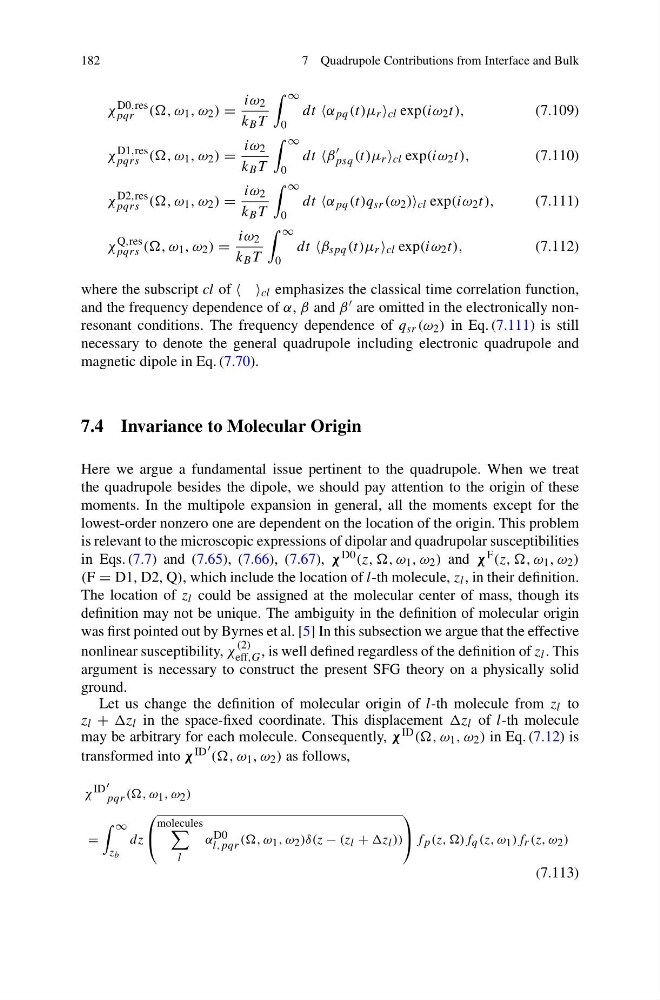
where the subscript cl of cl emphasizes the classical time correlation function,
and the frequency dependence of α, β and β are omitted in the electronically nonresonant conditions. The frequency dependence of q sr (ω 2 ) in Eq. (7.111) is still
necessary to denote the general quadrupole including electronic quadrupole and
magnetic dipole in Eq. (7.70).
7.4 Invariance to Molecular Origin
Here we argue a fundamental issue pertinent to the quadrupole. When we treat
the quadrupole besides the dipole, we should pay attention to the origin of these
moments. In the multipole expansion in general, all the moments except for the
lowest-order nonzero one are dependent on the location of the origin. This problem
is relevant to the microscopic expressions of dipolar and quadrupolar susceptibilities
in Eqs. (7.7) and (7.65), (7.66), (7.67), χ D0 (z, ,, ω 1 , ω 2 ) and χ F (z, ,, ω 1 , ω 2 )
(F = D1, D2, Q), which include the location of l-th molecule, z l , in their definition.
The location of z l could be assigned at the molecular center of mass, though its
definition may not be unique. The ambiguity in the definition of molecular origin
was first pointed out by Byrnes et al. [5] In this subsection we argue that the effective
nonlinear susceptibility, χ
(2)
eff,G , is well defined regardless of the definition of z l . This
argument is necessary to construct the present SFG theory on a physically solid
ground.
Let us change the definition of molecular origin of l-th molecule from z l to
z l + z l in the space-fixed coordinate. This displacement z l of l-th molecule
may be arbitrary for each molecule. Consequently, χ ID ((, ω 1 , ω 2 ) in Eq. (7.12) is
transformed into χ ID ((, ω 1 , ω 2 ) as follows,
χ ID
pqr ((, ω 1 , ω 2 )
=
∞
z b
dz
⎛
⎝
molecules
l
α D0
l,pqr ((, ω 1 , ω 2 )δ(z − (z l + z l ))
⎞
⎠ f p (z, ,)f q (z, ω 1 )f r (z, ω 2 )
(7.113)
7 Quadrupole Contributions from Interface and Bulk
χ
D0,res
pqr ((, ω 1 , ω 2 ) =
iω 2
k B T
∞
0
dt α pq (t)μ r cl exp(iω 2 t),
(7.109)
χ
D1,res
pqrs ((, ω 1 , ω 2 ) =
iω 2
k B T
∞
0
dt β
psq (t)μ r cl exp(iω 2 t),
(7.110)
χ
D2,res
pqrs ((, ω 1 , ω 2 ) =
iω 2
k B T
∞
0
dt α pq (t)q sr (ω 2 ) cl exp(iω 2 t),
(7.111)
χ
Q,res
pqrs ((, ω 1 , ω 2 ) =
iω 2
k B T
∞
0
dt β spq (t)μ r cl exp(iω 2 t),
(7.112)
where the subscript cl of cl emphasizes the classical time correlation function,
and the frequency dependence of α, β and β are omitted in the electronically nonresonant conditions. The frequency dependence of q sr (ω 2 ) in Eq. (7.111) is still
necessary to denote the general quadrupole including electronic quadrupole and
magnetic dipole in Eq. (7.70).
7.4 Invariance to Molecular Origin
Here we argue a fundamental issue pertinent to the quadrupole. When we treat
the quadrupole besides the dipole, we should pay attention to the origin of these
moments. In the multipole expansion in general, all the moments except for the
lowest-order nonzero one are dependent on the location of the origin. This problem
is relevant to the microscopic expressions of dipolar and quadrupolar susceptibilities
in Eqs. (7.7) and (7.65), (7.66), (7.67), χ D0 (z, ,, ω 1 , ω 2 ) and χ F (z, ,, ω 1 , ω 2 )
(F = D1, D2, Q), which include the location of l-th molecule, z l , in their definition.
The location of z l could be assigned at the molecular center of mass, though its
definition may not be unique. The ambiguity in the definition of molecular origin
was first pointed out by Byrnes et al. [5] In this subsection we argue that the effective
nonlinear susceptibility, χ
(2)
eff,G , is well defined regardless of the definition of z l . This
argument is necessary to construct the present SFG theory on a physically solid
ground.
Let us change the definition of molecular origin of l-th molecule from z l to
z l + z l in the space-fixed coordinate. This displacement z l of l-th molecule
may be arbitrary for each molecule. Consequently, χ ID ((, ω 1 , ω 2 ) in Eq. (7.12) is
transformed into χ ID ((, ω 1 , ω 2 ) as follows,
χ ID
pqr ((, ω 1 , ω 2 )
=
∞
z b
dz
⎛
⎝
molecules
l
α D0
l,pqr ((, ω 1 , ω 2 )δ(z − (z l + z l ))
⎞
⎠ f p (z, ,)f q (z, ω 1 )f r (z, ω 2 )
(7.113)