

184
7 Quadrupole Contributions from Interface and Bulk
By replacing ˆ
q(ω f ) in Eqs. (7.79), (7.80), (7.81) with the shifted operator ˆ
q (ω f ),
we obtain the transformed quadrupolar hyperpolarizabilities, α F
l . During the
derivation of α F
l , the matrix element of the current operator is represented using
the relation ˆ
j = d ˆ
μ/dt as
m| ˆ
j |n
=
m
d ˆ
μ
dt
n
=
i
¯
h
(E m − E n )
m| ˆ
μ|n
= iω mn
m| ˆ
μ|n
,
where the states m, n denote eigenstates of the whole system. Therefore, the matrix
element of ˆ
q pq
(ω f ) in Eq. (7.117) becomes
m| ˆ
q pq
(ω f )|n = =m| ˆ
q pq (ω f )|n
−
1
2
m| ˆ
μ p |nr q −
1
2
m| ˆ
μ q |nr p −
ω mn
2ω f
m| ˆ
μ q |nr p +
ω mn
2ω f
m| ˆ
μ p |nr q .
(7.118)
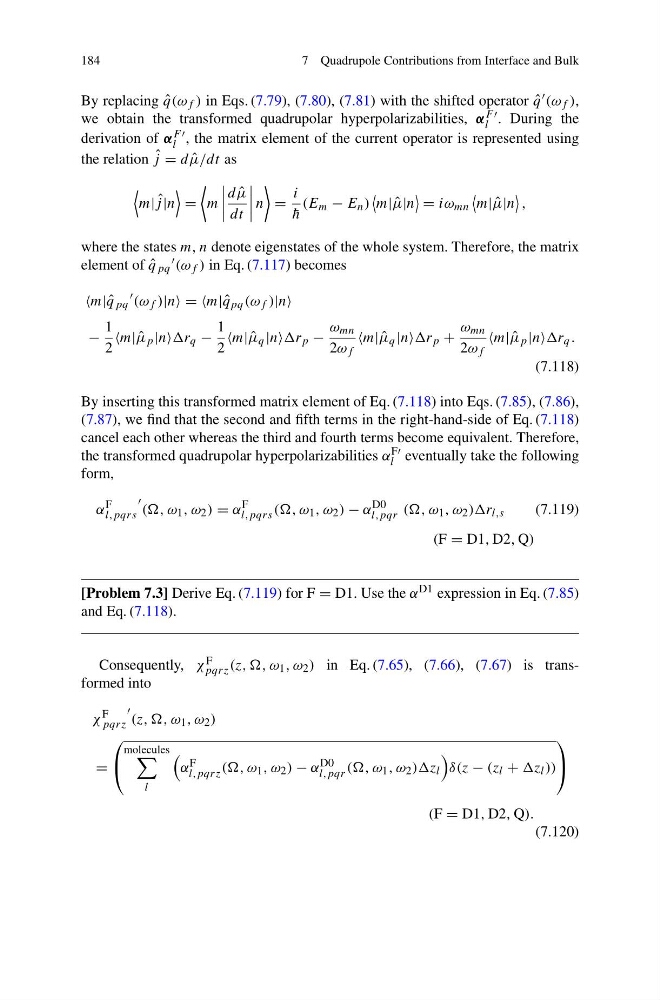
By inserting this transformed matrix element of Eq. (7.118) into Eqs. (7.85), (7.86),
(7.87), we find that the second and fifth terms in the right-hand-side of Eq. (7.118)
cancel each other whereas the third and fourth terms become equivalent. Therefore,
the transformed quadrupolar hyperpolarizabilities α F
l eventually take the following
form,
α
F
l,pqrs
((, ω 1 , ω 2 ) = α
F
l,pqrs ((, ω 1 , ω 2 ) − α
D0
l,pqr ((, ω 1 , ω 2 ))r l,s
(7.119)
(F = D1, D2, Q)
[Problem 7.3] Derive Eq. (7.119) for F = D1. Use the α D1 expression in Eq. (7.85)
and Eq. (7.118).
Consequently, χ F
pqrz (z, ,, ω 1 , ω 2 ) in Eq. (7.65), (7.66), (7.67) is transformed into
χ
F
pqrz
(z, ,, ω 1 , ω 2 )
=
⎛
⎝
molecules
l
α F
l,pqrz ((, ω 1 , ω 2 ) − α D0
l,pqr ((, ω 1 , ω 2 ))z l
δ(z − (z l + z l ))
⎞
⎠
(F = D1, D2, Q).
(7.120)
7 Quadrupole Contributions from Interface and Bulk
By replacing ˆ
q(ω f ) in Eqs. (7.79), (7.80), (7.81) with the shifted operator ˆ
q (ω f ),
we obtain the transformed quadrupolar hyperpolarizabilities, α F
l . During the
derivation of α F
l , the matrix element of the current operator is represented using
the relation ˆ
j = d ˆ
μ/dt as
m| ˆ
j |n
=
m
d ˆ
μ
dt
n
=
i
¯
h
(E m − E n )
m| ˆ
μ|n
= iω mn
m| ˆ
μ|n
,
where the states m, n denote eigenstates of the whole system. Therefore, the matrix
element of ˆ
q pq
(ω f ) in Eq. (7.117) becomes
m| ˆ
q pq
(ω f )|n = =m| ˆ
q pq (ω f )|n
−
1
2
m| ˆ
μ p |nr q −
1
2
m| ˆ
μ q |nr p −
ω mn
2ω f
m| ˆ
μ q |nr p +
ω mn
2ω f
m| ˆ
μ p |nr q .
(7.118)
By inserting this transformed matrix element of Eq. (7.118) into Eqs. (7.85), (7.86),
(7.87), we find that the second and fifth terms in the right-hand-side of Eq. (7.118)
cancel each other whereas the third and fourth terms become equivalent. Therefore,
the transformed quadrupolar hyperpolarizabilities α F
l eventually take the following
form,
α
F
l,pqrs
((, ω 1 , ω 2 ) = α
F
l,pqrs ((, ω 1 , ω 2 ) − α
D0
l,pqr ((, ω 1 , ω 2 ))r l,s
(7.119)
(F = D1, D2, Q)
[Problem 7.3] Derive Eq. (7.119) for F = D1. Use the α D1 expression in Eq. (7.85)
and Eq. (7.118).
Consequently, χ F
pqrz (z, ,, ω 1 , ω 2 ) in Eq. (7.65), (7.66), (7.67) is transformed into
χ
F
pqrz
(z, ,, ω 1 , ω 2 )
=
⎛
⎝
molecules
l
α F
l,pqrz ((, ω 1 , ω 2 ) − α D0
l,pqr ((, ω 1 , ω 2 ))z l
δ(z − (z l + z l ))
⎞
⎠
(F = D1, D2, Q).
(7.120)