

172
7 Quadrupole Contributions from Interface and Bulk
7.3 Microscopic Formulas of Quadrupolar Susceptibilities
We have discussed in the preceding Sect. 7.2 that the second-order response includes
the term of dipolar origin, χ D0 , as well as those of quadrupolar origin, χ D1 , χ D2 ,
χ Q . Microscopic formulas for the former χ D0 have been given in Chap. 3 on the
basis of quantum mechanical perturbation theory. In this section we provide the
formulas for the latter, quadrupolar susceptibilities, χ D1 , χ D2 , and χ Q [14]. These
quantities are formulated in two ways, on the basis of the energy representation and
the time-dependent representation, by extending the discussion in Chap. 3.
7.3.1 Perturbation Expressions
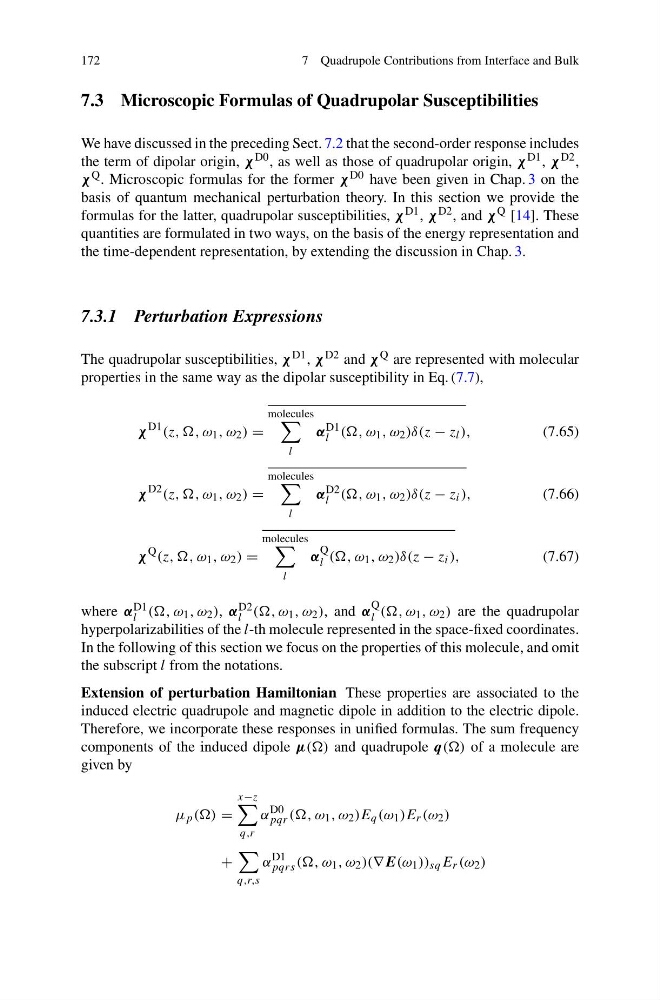
The quadrupolar susceptibilities, χ D1 , χ D2 and χ Q are represented with molecular
properties in the same way as the dipolar susceptibility in Eq. (7.7),
χ
D1 (z, ,, ω 1 , ω 2 ) =
molecules
l
α D1
l ((, ω 1 , ω 2 )δ(z − z l ),
(7.65)
χ
D2 (z, ,, ω 1 , ω 2 ) =
molecules
l
α D2
l ((, ω 1 , ω 2 )δ(z − z i ),
(7.66)
χ
Q (z, ,, ω 1 , ω 2 ) =
molecules
l
α
Q
l ((, ω 1 , ω 2 )δ(z − z i ),
(7.67)
where α D1
l ((, ω 1 , ω 2 ), α D2
l ((, ω 1 , ω 2 ), and α
Q
l ((, ω 1 , ω 2 ) are the quadrupolar
hyperpolarizabilities of the l-th molecule represented in the space-fixed coordinates.
In the following of this section we focus on the properties of this molecule, and omit
the subscript l from the notations.
Extension of perturbation Hamiltonian These properties are associated to the
induced electric quadrupole and magnetic dipole in addition to the electric dipole.
Therefore, we incorporate these responses in unified formulas. The sum frequency
components of the induced dipole μ(() and quadrupole q(() of a molecule are
given by
μ p (() =
x−z
q,r
α
D0
pqr ((, ω 1 , ω 2 )E q (ω 1 )E r (ω 2 )
+
q,r,s
α
D1
pqrs ((, ω 1 , ω 2 )(∇E(ω 1 )) sq E r (ω 2 )
7 Quadrupole Contributions from Interface and Bulk
7.3 Microscopic Formulas of Quadrupolar Susceptibilities
We have discussed in the preceding Sect. 7.2 that the second-order response includes
the term of dipolar origin, χ D0 , as well as those of quadrupolar origin, χ D1 , χ D2 ,
χ Q . Microscopic formulas for the former χ D0 have been given in Chap. 3 on the
basis of quantum mechanical perturbation theory. In this section we provide the
formulas for the latter, quadrupolar susceptibilities, χ D1 , χ D2 , and χ Q [14]. These
quantities are formulated in two ways, on the basis of the energy representation and
the time-dependent representation, by extending the discussion in Chap. 3.
7.3.1 Perturbation Expressions
The quadrupolar susceptibilities, χ D1 , χ D2 and χ Q are represented with molecular
properties in the same way as the dipolar susceptibility in Eq. (7.7),
χ
D1 (z, ,, ω 1 , ω 2 ) =
molecules
l
α D1
l ((, ω 1 , ω 2 )δ(z − z l ),
(7.65)
χ
D2 (z, ,, ω 1 , ω 2 ) =
molecules
l
α D2
l ((, ω 1 , ω 2 )δ(z − z i ),
(7.66)
χ
Q (z, ,, ω 1 , ω 2 ) =
molecules
l
α
Q
l ((, ω 1 , ω 2 )δ(z − z i ),
(7.67)
where α D1
l ((, ω 1 , ω 2 ), α D2
l ((, ω 1 , ω 2 ), and α
Q
l ((, ω 1 , ω 2 ) are the quadrupolar
hyperpolarizabilities of the l-th molecule represented in the space-fixed coordinates.
In the following of this section we focus on the properties of this molecule, and omit
the subscript l from the notations.
Extension of perturbation Hamiltonian These properties are associated to the
induced electric quadrupole and magnetic dipole in addition to the electric dipole.
Therefore, we incorporate these responses in unified formulas. The sum frequency
components of the induced dipole μ(() and quadrupole q(() of a molecule are
given by
μ p (() =
x−z
q,r
α
D0
pqr ((, ω 1 , ω 2 )E q (ω 1 )E r (ω 2 )
+
q,r,s
α
D1
pqrs ((, ω 1 , ω 2 )(∇E(ω 1 )) sq E r (ω 2 )