

7.2 Extended Nonlinear Susceptibility
161
+
q,r
f p (z, ,)χ
D2
pqrz (z, ,, ω 1 , ω 2 )f q (z, ω 1 )
∂f r (z, ω 2 )
∂z
−
q,r
f p (z, ,)
∂
∂z
χ
Q
pqrz (z, ,, ω 1 , ω 2 ) f q (z, ω 1 ) f r (z, ω 2 )
· L I,q (ω 1 )E
α
I,q (ω 1 ) exp
ik x (ω 1 )x − iω 1 t
· L I,r (ω 2 )E
α
I,r (ω 2 ) exp
ik x (ω 2 )x − iω 2 t
.
(7.26)
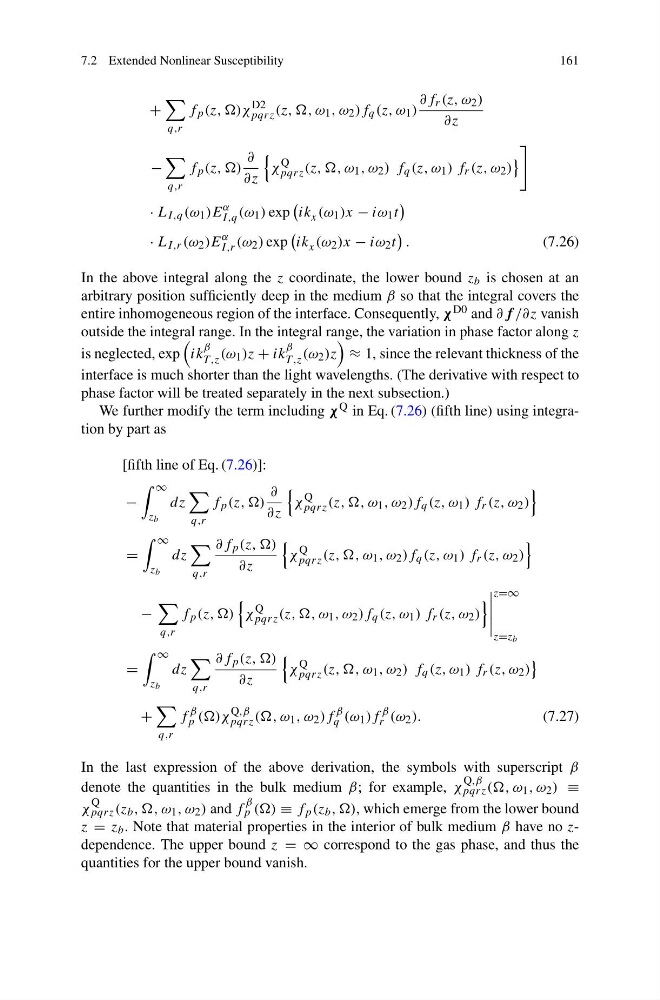
In the above integral along the z coordinate, the lower bound z b is chosen at an
arbitrary position sufficiently deep in the medium β so that the integral covers the
entire inhomogeneous region of the interface. Consequently, χ D0 and ∂f /∂z vanish
outside the integral range. In the integral range, the variation in phase factor along z
is neglected, exp
ik
β
T ,z (ω 1 )z + ik
β
T ,z (ω 2 )z
≈ 1, since the relevant thickness of the
interface is much shorter than the light wavelengths. (The derivative with respect to
phase factor will be treated separately in the next subsection.)
We further modify the term including χ Q in Eq. (7.26) (fifth line) using integration by part as
[fifth line of Eq. (7.26)]:
−
∞
z b
dz
q,r
f p (z, ,)
∂
∂z
χ
Q
pqrz (z, ,, ω 1 , ω 2 )f q (z, ω 1 ) f r (z, ω 2 )
=
∞
z b
dz
q,r
∂f p (z, ,)
∂z
χ
Q
pqrz (z, ,, ω 1 , ω 2 )f q (z, ω 1 ) f r (z, ω 2 )
−
q,r
f p (z, ,)
χ
Q
pqrz (z, ,, ω 1 , ω 2 )f q (z, ω 1 ) f r (z, ω 2 )
z=∞
z=z b
=
∞
z b
dz
q,r
∂f p (z, ,)
∂z
χ
Q
pqrz (z, ,, ω 1 , ω 2 ) f q (z, ω 1 ) f r (z, ω 2 )
+
q,r
f
β
p (()χ
Q,β
pqrz ((, ω 1 , ω 2 )f
β
q (ω 1 )f
β
r (ω 2 ).
(7.27)
In the last expression of the above derivation, the symbols with superscript β
denote the quantities in the bulk medium β; for example, χ
Q,β
pqrz ((, ω 1 , ω 2 ) ≡
χ
Q
pqrz (z b , ,, ω 1 , ω 2 ) and f
β
p (() ≡ f p (z b , ,), which emerge from the lower bound
z = z b . Note that material properties in the interior of bulk medium β have no zdependence. The upper bound z = ∞ correspond to the gas phase, and thus the
quantities for the upper bound vanish.
161
+
q,r
f p (z, ,)χ
D2
pqrz (z, ,, ω 1 , ω 2 )f q (z, ω 1 )
∂f r (z, ω 2 )
∂z
−
q,r
f p (z, ,)
∂
∂z
χ
Q
pqrz (z, ,, ω 1 , ω 2 ) f q (z, ω 1 ) f r (z, ω 2 )
· L I,q (ω 1 )E
α
I,q (ω 1 ) exp
ik x (ω 1 )x − iω 1 t
· L I,r (ω 2 )E
α
I,r (ω 2 ) exp
ik x (ω 2 )x − iω 2 t
.
(7.26)
In the above integral along the z coordinate, the lower bound z b is chosen at an
arbitrary position sufficiently deep in the medium β so that the integral covers the
entire inhomogeneous region of the interface. Consequently, χ D0 and ∂f /∂z vanish
outside the integral range. In the integral range, the variation in phase factor along z
is neglected, exp
ik
β
T ,z (ω 1 )z + ik
β
T ,z (ω 2 )z
≈ 1, since the relevant thickness of the
interface is much shorter than the light wavelengths. (The derivative with respect to
phase factor will be treated separately in the next subsection.)
We further modify the term including χ Q in Eq. (7.26) (fifth line) using integration by part as
[fifth line of Eq. (7.26)]:
−
∞
z b
dz
q,r
f p (z, ,)
∂
∂z
χ
Q
pqrz (z, ,, ω 1 , ω 2 )f q (z, ω 1 ) f r (z, ω 2 )
=
∞
z b
dz
q,r
∂f p (z, ,)
∂z
χ
Q
pqrz (z, ,, ω 1 , ω 2 )f q (z, ω 1 ) f r (z, ω 2 )
−
q,r
f p (z, ,)
χ
Q
pqrz (z, ,, ω 1 , ω 2 )f q (z, ω 1 ) f r (z, ω 2 )
z=∞
z=z b
=
∞
z b
dz
q,r
∂f p (z, ,)
∂z
χ
Q
pqrz (z, ,, ω 1 , ω 2 ) f q (z, ω 1 ) f r (z, ω 2 )
+
q,r
f
β
p (()χ
Q,β
pqrz ((, ω 1 , ω 2 )f
β
q (ω 1 )f
β
r (ω 2 ).
(7.27)
In the last expression of the above derivation, the symbols with superscript β
denote the quantities in the bulk medium β; for example, χ
Q,β
pqrz ((, ω 1 , ω 2 ) ≡
χ
Q
pqrz (z b , ,, ω 1 , ω 2 ) and f
β
p (() ≡ f p (z b , ,), which emerge from the lower bound
z = z b . Note that material properties in the interior of bulk medium β have no zdependence. The upper bound z = ∞ correspond to the gas phase, and thus the
quantities for the upper bound vanish.