

162
7 Quadrupole Contributions from Interface and Bulk
Consequently, P l in Eq. (7.26) is represented in the following form,
P
I
p =
q,r
χ
ID
pqr ((, ω 1 , ω 2 ) + χ
IQ
pqr ((, ω 1 , ω 2 ) + χ
IQB
pqr ((, ω 1 , ω 2 )
·L I,q (ω 1 )L I,r (ω 2 )E
α
I,q (ω 1 )E
α
I,r (ω 2 ),
(7.28)
where
χ
ID
pqr ((, ω 1 , ω 2 ) =
∞
z b
dz χ
D0
pqr (z, ,, ω 1 , ω 2 )f p (z, ,)f q (z, ω 1 )f r (z, ω 2 ),
(7.12)
χ
IQ
pqr ((, ω 1 , ω 2 ) =
∞
z b
dz
χ
D1
pqrz (z, ,, ω 1 , ω 2 )f p (z, ,)
∂f q (z, ω 1 )
∂z
f r (z, ω 2 )
+ χ
D2
pqrz (z, ,, ω 1 , ω 2 )f p (z, ,)f q (z, ω 1 )
∂f r (z, ω 2 )
∂z
+χ
Q
pqrz (z, ,, ω 1 , ω 2 )
∂f p (z, ,)
∂z
f q (z, ω 1 )f r (z, ω 2 )
,
(7.29)
χ
IQB
pqr ((, ω 1 , ω 2 ) = χ
Q,β
pqrz ((, ω 1 , ω 2 )f
β
p (()f
β
q (ω 1 )f
β
r (ω 2 )
(7.30)
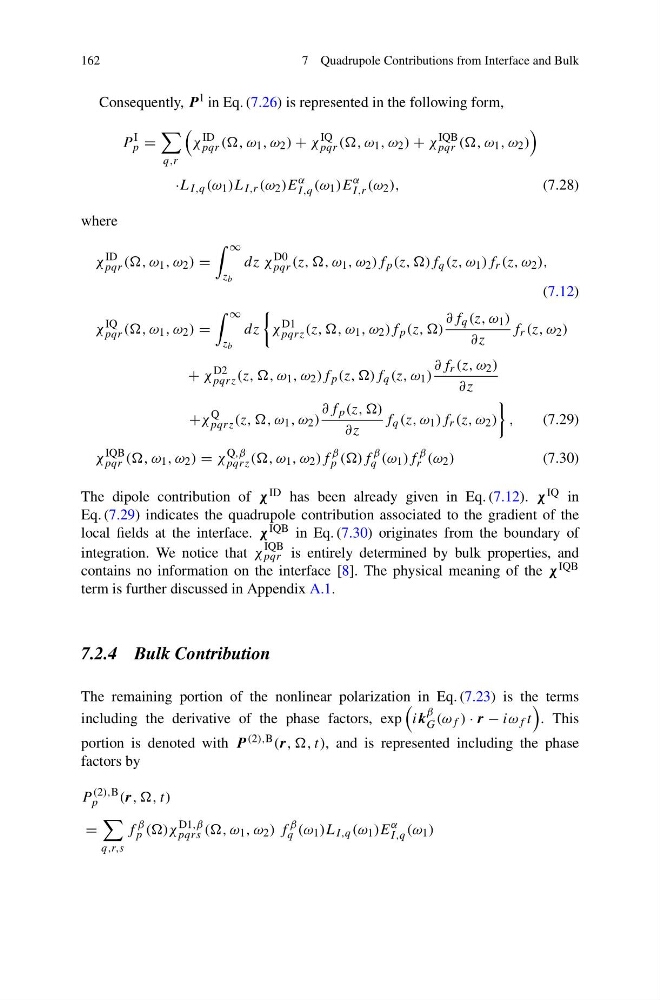
The dipole contribution of χ ID has been already given in Eq. (7.12). χ IQ in
Eq. (7.29) indicates the quadrupole contribution associated to the gradient of the
local fields at the interface. χ IQB in Eq. (7.30) originates from the boundary of
integration. We notice that χ
IQB
pqr is entirely determined by bulk properties, and
contains no information on the interface [8]. The physical meaning of the χ IQB
term is further discussed in Appendix A.1.
7.2.4 Bulk Contribution
The remaining portion of the nonlinear polarization in Eq. (7.23) is the terms
including the derivative of the phase factors, exp
ik
β
G (ω f ) · r − iω f t
. This
portion is denoted with P (2),B (r, ,, t), and is represented including the phase
factors by
P
(2),B
p
(r, ,, t)
=
q,r,s
f
β
p (()χ
D1,β
pqrs ((, ω 1 , ω 2 ) f
β
q (ω 1 )L I,q (ω 1 )E
α
I,q (ω 1 )
7 Quadrupole Contributions from Interface and Bulk
Consequently, P l in Eq. (7.26) is represented in the following form,
P
I
p =
q,r
χ
ID
pqr ((, ω 1 , ω 2 ) + χ
IQ
pqr ((, ω 1 , ω 2 ) + χ
IQB
pqr ((, ω 1 , ω 2 )
·L I,q (ω 1 )L I,r (ω 2 )E
α
I,q (ω 1 )E
α
I,r (ω 2 ),
(7.28)
where
χ
ID
pqr ((, ω 1 , ω 2 ) =
∞
z b
dz χ
D0
pqr (z, ,, ω 1 , ω 2 )f p (z, ,)f q (z, ω 1 )f r (z, ω 2 ),
(7.12)
χ
IQ
pqr ((, ω 1 , ω 2 ) =
∞
z b
dz
χ
D1
pqrz (z, ,, ω 1 , ω 2 )f p (z, ,)
∂f q (z, ω 1 )
∂z
f r (z, ω 2 )
+ χ
D2
pqrz (z, ,, ω 1 , ω 2 )f p (z, ,)f q (z, ω 1 )
∂f r (z, ω 2 )
∂z
+χ
Q
pqrz (z, ,, ω 1 , ω 2 )
∂f p (z, ,)
∂z
f q (z, ω 1 )f r (z, ω 2 )
,
(7.29)
χ
IQB
pqr ((, ω 1 , ω 2 ) = χ
Q,β
pqrz ((, ω 1 , ω 2 )f
β
p (()f
β
q (ω 1 )f
β
r (ω 2 )
(7.30)
The dipole contribution of χ ID has been already given in Eq. (7.12). χ IQ in
Eq. (7.29) indicates the quadrupole contribution associated to the gradient of the
local fields at the interface. χ IQB in Eq. (7.30) originates from the boundary of
integration. We notice that χ
IQB
pqr is entirely determined by bulk properties, and
contains no information on the interface [8]. The physical meaning of the χ IQB
term is further discussed in Appendix A.1.
7.2.4 Bulk Contribution
The remaining portion of the nonlinear polarization in Eq. (7.23) is the terms
including the derivative of the phase factors, exp
ik
β
G (ω f ) · r − iω f t
. This
portion is denoted with P (2),B (r, ,, t), and is represented including the phase
factors by
P
(2),B
p
(r, ,, t)
=
q,r,s
f
β
p (()χ
D1,β
pqrs ((, ω 1 , ω 2 ) f
β
q (ω 1 )L I,q (ω 1 )E
α
I,q (ω 1 )