

160
7 Quadrupole Contributions from Interface and Bulk
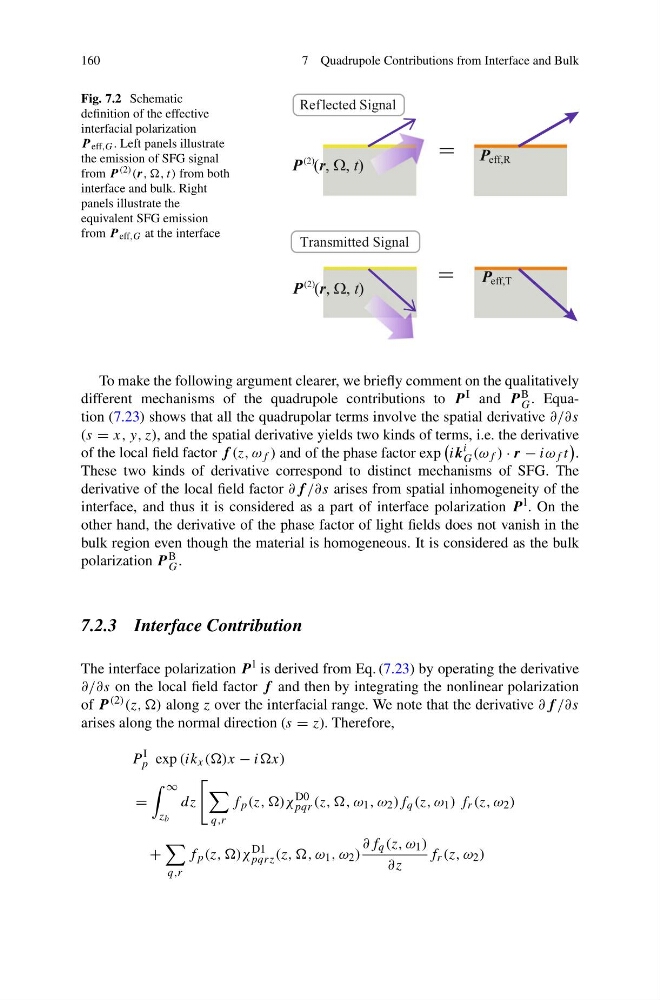
Fig. 7.2 Schematic
definition of the effective
interfacial polarization
P eff,G . Left panels illustrate
the emission of SFG signal
from P (2) (r, ,, t) from both
interface and bulk. Right
panels illustrate the
equivalent SFG emission
from P eff,G at the interface
=
=
P (r, , t)
(2)
P eff,R
P eff,T
P (r, , t)
(2)
Ref lected Signal
Transmitted Signal
To make the following argument clearer, we briefly comment on the qualitatively
different mechanisms of the quadrupole contributions to P I and P B
G . Equation (7.23) shows that all the quadrupolar terms involve the spatial derivative ∂/∂s
(s = x, y, z), and the spatial derivative yields two kinds of terms, i.e. the derivative
of the local field factor f (z, ω f ) and of the phase factor exp
ik
i
G (ω f ) · r − iω f t
.
These two kinds of derivative correspond to distinct mechanisms of SFG. The
derivative of the local field factor ∂f /∂s arises from spatial inhomogeneity of the
interface, and thus it is considered as a part of interface polarization P l . On the
other hand, the derivative of the phase factor of light fields does not vanish in the
bulk region even though the material is homogeneous. It is considered as the bulk
polarization P B
G .
7.2.3 Interface Contribution
The interface polarization P l is derived from Eq. (7.23) by operating the derivative
∂/∂s on the local field factor f and then by integrating the nonlinear polarization
of P (2) (z, ,) along z over the interfacial range. We note that the derivative ∂f /∂s
arises along the normal direction (s = z). Therefore,
P
I
p exp (ik x (()x − iix)
=
∞
z b
dz
q,r
f p (z, ,)χ
D0
pqr (z, ,, ω 1 , ω 2 )f q (z, ω 1 ) f r (z, ω 2 )
+
q,r
f p (z, ,)χ
D1
pqrz (z, ,, ω 1 , ω 2 )
∂f q (z, ω 1 )
∂z
f r (z, ω 2 )
7 Quadrupole Contributions from Interface and Bulk
Fig. 7.2 Schematic
definition of the effective
interfacial polarization
P eff,G . Left panels illustrate
the emission of SFG signal
from P (2) (r, ,, t) from both
interface and bulk. Right
panels illustrate the
equivalent SFG emission
from P eff,G at the interface
=
=
P (r, , t)
(2)
P eff,R
P eff,T
P (r, , t)
(2)
Ref lected Signal
Transmitted Signal
To make the following argument clearer, we briefly comment on the qualitatively
different mechanisms of the quadrupole contributions to P I and P B
G . Equation (7.23) shows that all the quadrupolar terms involve the spatial derivative ∂/∂s
(s = x, y, z), and the spatial derivative yields two kinds of terms, i.e. the derivative
of the local field factor f (z, ω f ) and of the phase factor exp
ik
i
G (ω f ) · r − iω f t
.
These two kinds of derivative correspond to distinct mechanisms of SFG. The
derivative of the local field factor ∂f /∂s arises from spatial inhomogeneity of the
interface, and thus it is considered as a part of interface polarization P l . On the
other hand, the derivative of the phase factor of light fields does not vanish in the
bulk region even though the material is homogeneous. It is considered as the bulk
polarization P B
G .
7.2.3 Interface Contribution
The interface polarization P l is derived from Eq. (7.23) by operating the derivative
∂/∂s on the local field factor f and then by integrating the nonlinear polarization
of P (2) (z, ,) along z over the interfacial range. We note that the derivative ∂f /∂s
arises along the normal direction (s = z). Therefore,
P
I
p exp (ik x (()x − iix)
=
∞
z b
dz
q,r
f p (z, ,)χ
D0
pqr (z, ,, ω 1 , ω 2 )f q (z, ω 1 ) f r (z, ω 2 )
+
q,r
f p (z, ,)χ
D1
pqrz (z, ,, ω 1 , ω 2 )
∂f q (z, ω 1 )
∂z
f r (z, ω 2 )