

7.2 Extended Nonlinear Susceptibility
159
−
q,r,s
f p (z, ,)
∂
∂s
χ
Q
pqrs (z, ,, ω 1 , ω 2 ) f q (z, ω 1 )L I,q (ω 1 )E α
I,q (ω 1 )
exp
ik
β
T (ω 1 ) · r − iω 1 t
f r (z, ω 2 )L I,r (ω 2 )E α
I,r (ω 2 ) exp
ik
β
T (ω 2 ) · r − iω 2 t
.
(7.23)
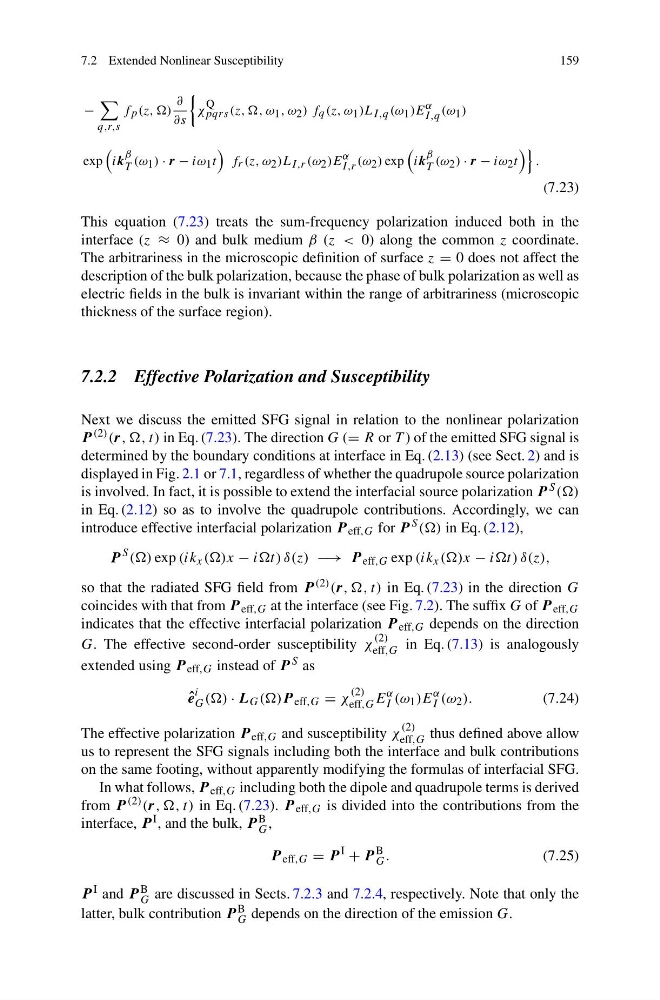
This equation (7.23) treats the sum-frequency polarization induced both in the
interface (z ≈ 0) and bulk medium β (z < 0) along the common z coordinate.
The arbitrariness in the microscopic definition of surface z = 0 does not affect the
description of the bulk polarization, because the phase of bulk polarization as well as
electric fields in the bulk is invariant within the range of arbitrariness (microscopic
thickness of the surface region).
7.2.2 Effective Polarization and Susceptibility
Next we discuss the emitted SFG signal in relation to the nonlinear polarization
P (2) (r, ,, t) in Eq. (7.23). The direction G (= R or T ) of the emitted SFG signal is
determined by the boundary conditions at interface in Eq. (2.13) (see Sect. 2) and is
displayed in Fig. 2.1 or 7.1, regardless of whether the quadrupole source polarization
is involved. In fact, it is possible to extend the interfacial source polarization P S (()
in Eq. (2.12) so as to involve the quadrupole contributions. Accordingly, we can
introduce effective interfacial polarization P eff,G for P S (() in Eq. (2.12),
P
S (() exp (ik x (()x − iit) δ(z) −→ P eff,G exp (ik x (()x − iit) δ(z),
so that the radiated SFG field from P (2) (r, ,, t) in Eq. (7.23) in the direction G
coincides with that from P eff,G at the interface (see Fig. 7.2). The suffix G of P eff,G
indicates that the effective interfacial polarization P eff,G depends on the direction
G. The effective second-order susceptibility χ
(2)
eff,G in Eq. (7.13) is analogously
extended using P eff,G instead of P S as
ˆ
e
i
G (() · L G (()P eff,G = χ
(2)
eff,G E
α
I (ω 1 )E
α
I (ω 2 ).
(7.24)
The effective polarization P eff,G and susceptibility χ
(2)
eff,G thus defined above allow
us to represent the SFG signals including both the interface and bulk contributions
on the same footing, without apparently modifying the formulas of interfacial SFG.
In what follows, P eff,G including both the dipole and quadrupole terms is derived
from P (2) (r, ,, t) in Eq. (7.23). P eff,G is divided into the contributions from the
interface, P I , and the bulk, P B
G ,
P eff,G = P
I
+ P
B
G .
(7.25)
P I and P B
G are discussed in Sects. 7.2.3 and 7.2.4, respectively. Note that only the
latter, bulk contribution P B
G depends on the direction of the emission G.
159
−
q,r,s
f p (z, ,)
∂
∂s
χ
Q
pqrs (z, ,, ω 1 , ω 2 ) f q (z, ω 1 )L I,q (ω 1 )E α
I,q (ω 1 )
exp
ik
β
T (ω 1 ) · r − iω 1 t
f r (z, ω 2 )L I,r (ω 2 )E α
I,r (ω 2 ) exp
ik
β
T (ω 2 ) · r − iω 2 t
.
(7.23)
This equation (7.23) treats the sum-frequency polarization induced both in the
interface (z ≈ 0) and bulk medium β (z < 0) along the common z coordinate.
The arbitrariness in the microscopic definition of surface z = 0 does not affect the
description of the bulk polarization, because the phase of bulk polarization as well as
electric fields in the bulk is invariant within the range of arbitrariness (microscopic
thickness of the surface region).
7.2.2 Effective Polarization and Susceptibility
Next we discuss the emitted SFG signal in relation to the nonlinear polarization
P (2) (r, ,, t) in Eq. (7.23). The direction G (= R or T ) of the emitted SFG signal is
determined by the boundary conditions at interface in Eq. (2.13) (see Sect. 2) and is
displayed in Fig. 2.1 or 7.1, regardless of whether the quadrupole source polarization
is involved. In fact, it is possible to extend the interfacial source polarization P S (()
in Eq. (2.12) so as to involve the quadrupole contributions. Accordingly, we can
introduce effective interfacial polarization P eff,G for P S (() in Eq. (2.12),
P
S (() exp (ik x (()x − iit) δ(z) −→ P eff,G exp (ik x (()x − iit) δ(z),
so that the radiated SFG field from P (2) (r, ,, t) in Eq. (7.23) in the direction G
coincides with that from P eff,G at the interface (see Fig. 7.2). The suffix G of P eff,G
indicates that the effective interfacial polarization P eff,G depends on the direction
G. The effective second-order susceptibility χ
(2)
eff,G in Eq. (7.13) is analogously
extended using P eff,G instead of P S as
ˆ
e
i
G (() · L G (()P eff,G = χ
(2)
eff,G E
α
I (ω 1 )E
α
I (ω 2 ).
(7.24)
The effective polarization P eff,G and susceptibility χ
(2)
eff,G thus defined above allow
us to represent the SFG signals including both the interface and bulk contributions
on the same footing, without apparently modifying the formulas of interfacial SFG.
In what follows, P eff,G including both the dipole and quadrupole terms is derived
from P (2) (r, ,, t) in Eq. (7.23). P eff,G is divided into the contributions from the
interface, P I , and the bulk, P B
G ,
P eff,G = P
I
+ P
B
G .
(7.25)
P I and P B
G are discussed in Sects. 7.2.3 and 7.2.4, respectively. Note that only the
latter, bulk contribution P B
G depends on the direction of the emission G.