

154
7 Quadrupole Contributions from Interface and Bulk
tensor,
f (z, ω f ) =
⎛
⎝
f x (z, ω f )
0
0
0
f y (z, ω f )
0
0
0
f z (z, ω f )
⎞
⎠ ,
(7.4)
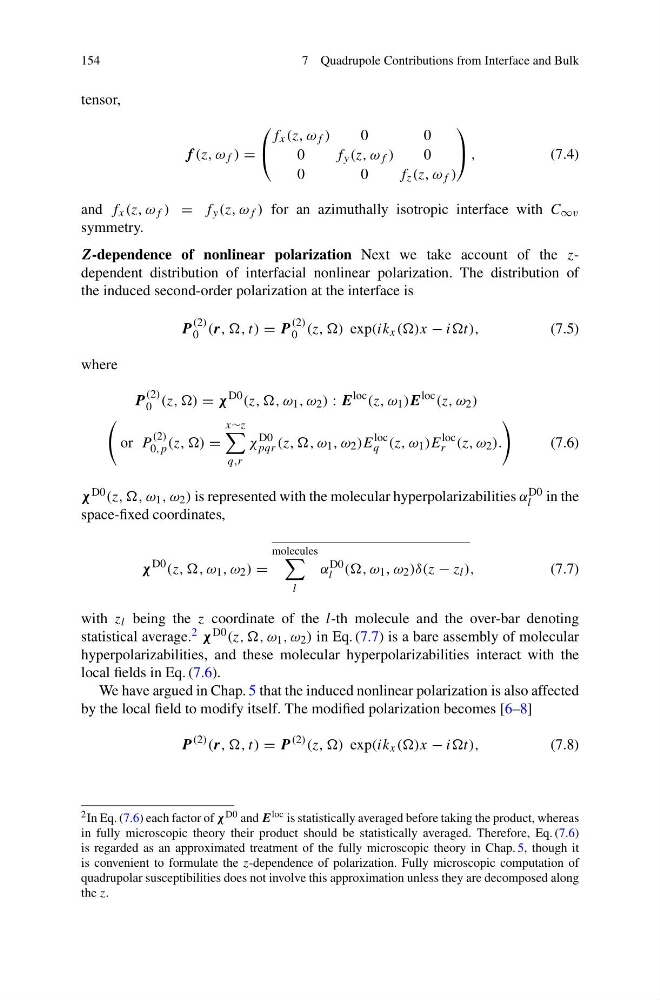
and f x (z, ω f ) = f y (z, ω f ) for an azimuthally isotropic interface with C ∞v
symmetry.
Z-dependence of nonlinear polarization Next we take account of the zdependent distribution of interfacial nonlinear polarization. The distribution of
the induced second-order polarization at the interface is
P
(2)
0 (r, ,, t) = P
(2)
0 (z, ,) exp(ik x (()x − iit),
(7.5)
where
P
(2)
0 (z, ,) = χ
D0 (z, ,, ω 1 , ω 2 ) : E
loc (z, ω 1 )E
loc (z, ω 2 )
or P
(2)
0,p (z, ,) =
x∼z
q,r
χ
D0
pqr (z, ,, ω 1 , ω 2 )E
loc
q (z, ω 1 )E
loc
r (z, ω 2 ).
(7.6)
χ D0 (z, ,, ω 1 , ω 2 ) is represented with the molecular hyperpolarizabilities α D0
l in the
space-fixed coordinates,
χ
D0 (z, ,, ω 1 , ω 2 ) =
molecules
l
α D0
l ((, ω 1 , ω 2 )δ(z − z l ),
(7.7)
with z l being the z coordinate of the l-th molecule and the over-bar denoting
statistical average. 2 χ D0 (z, ,, ω 1 , ω 2 ) in Eq. (7.7) is a bare assembly of molecular
hyperpolarizabilities, and these molecular hyperpolarizabilities interact with the
local fields in Eq. (7.6).
We have argued in Chap. 5 that the induced nonlinear polarization is also affected
by the local field to modify itself. The modified polarization becomes [6–8]
P
(2) (r, ,, t) = P
(2) (z, ,) exp(ik x (()x − iit),
(7.8)
2 In Eq. (7.6) each factor of χ D0 and E loc is statistically averaged before taking the product, whereas
in fully microscopic theory their product should be statistically averaged. Therefore, Eq. (7.6)
is regarded as an approximated treatment of the fully microscopic theory in Chap. 5, though it
is convenient to formulate the z-dependence of polarization. Fully microscopic computation of
quadrupolar susceptibilities does not involve this approximation unless they are decomposed along
the z.
7 Quadrupole Contributions from Interface and Bulk
tensor,
f (z, ω f ) =
⎛
⎝
f x (z, ω f )
0
0
0
f y (z, ω f )
0
0
0
f z (z, ω f )
⎞
⎠ ,
(7.4)
and f x (z, ω f ) = f y (z, ω f ) for an azimuthally isotropic interface with C ∞v
symmetry.
Z-dependence of nonlinear polarization Next we take account of the zdependent distribution of interfacial nonlinear polarization. The distribution of
the induced second-order polarization at the interface is
P
(2)
0 (r, ,, t) = P
(2)
0 (z, ,) exp(ik x (()x − iit),
(7.5)
where
P
(2)
0 (z, ,) = χ
D0 (z, ,, ω 1 , ω 2 ) : E
loc (z, ω 1 )E
loc (z, ω 2 )
or P
(2)
0,p (z, ,) =
x∼z
q,r
χ
D0
pqr (z, ,, ω 1 , ω 2 )E
loc
q (z, ω 1 )E
loc
r (z, ω 2 ).
(7.6)
χ D0 (z, ,, ω 1 , ω 2 ) is represented with the molecular hyperpolarizabilities α D0
l in the
space-fixed coordinates,
χ
D0 (z, ,, ω 1 , ω 2 ) =
molecules
l
α D0
l ((, ω 1 , ω 2 )δ(z − z l ),
(7.7)
with z l being the z coordinate of the l-th molecule and the over-bar denoting
statistical average. 2 χ D0 (z, ,, ω 1 , ω 2 ) in Eq. (7.7) is a bare assembly of molecular
hyperpolarizabilities, and these molecular hyperpolarizabilities interact with the
local fields in Eq. (7.6).
We have argued in Chap. 5 that the induced nonlinear polarization is also affected
by the local field to modify itself. The modified polarization becomes [6–8]
P
(2) (r, ,, t) = P
(2) (z, ,) exp(ik x (()x − iit),
(7.8)
2 In Eq. (7.6) each factor of χ D0 and E loc is statistically averaged before taking the product, whereas
in fully microscopic theory their product should be statistically averaged. Therefore, Eq. (7.6)
is regarded as an approximated treatment of the fully microscopic theory in Chap. 5, though it
is convenient to formulate the z-dependence of polarization. Fully microscopic computation of
quadrupolar susceptibilities does not involve this approximation unless they are decomposed along
the z.