

7.1 Beyond the Three-Layer Model
153
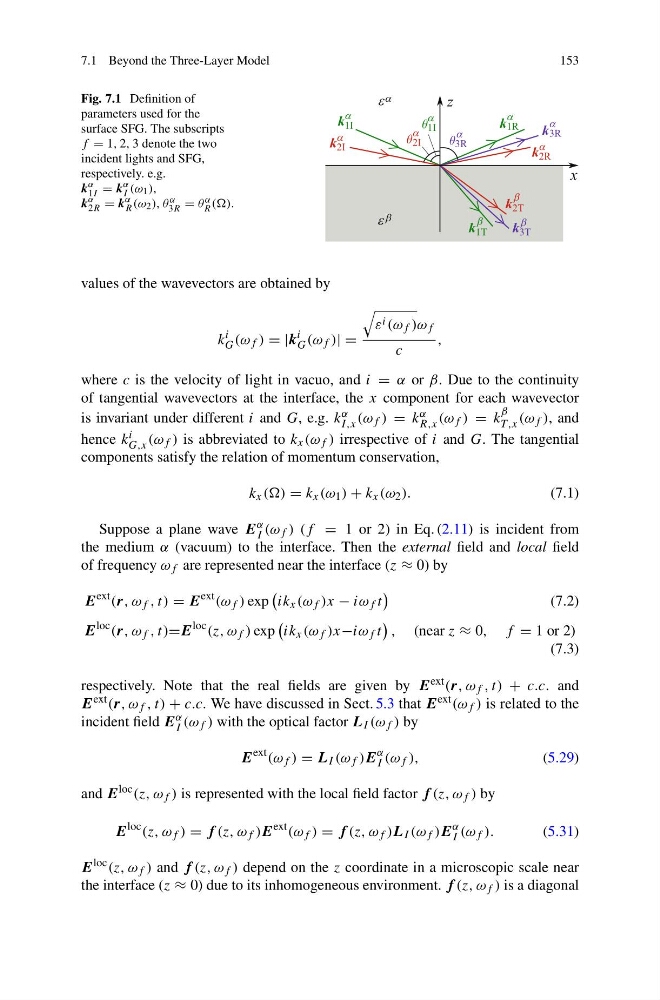
Fig. 7.1 Definition of
parameters used for the
surface SFG. The subscripts
f = 1, 2, 3 denote the two
incident lights and SFG,
respectively. e.g.
k
α
1I = k
α
I (ω 1 ),
k
α
2R = k
α
R (ω 2 ), θ α
3R = θ α
R (().
k
k
k
k
k
k
k
k
3R
3R
3T
1I
1I
1R
1T
2I
2I
2R
2T
x
z
values of the wavevectors are obtained by
k
i
G (ω f ) = |k
i
G (ω f )| =
ε i (ω f )ω f
c
,
where c is the velocity of light in vacuo, and i = α or β. Due to the continuity
of tangential wavevectors at the interface, the x component for each wavevector
is invariant under different i and G, e.g. k α
I,x (ω f ) = k α
R,x (ω f ) = k
β
T ,x (ω f ), and
hence k i
G,x (ω f ) is abbreviated to k x (ω f ) irrespective of i and G. The tangential
components satisfy the relation of momentum conservation,
k x (() = k x (ω 1 ) + k x (ω 2 ).
(7.1)
Suppose a plane wave E α
I (ω f ) (f = 1 or 2) in Eq. (2.11) is incident from
the medium α (vacuum) to the interface. Then the external field and local field
of frequency ω f are represented near the interface (z ≈ 0) by
E
ext (r, ω f , t) = E
ext (ω f ) exp
ik x (ω f )x − iω f t
(7.2)
E
loc (r, ω f , t)=E
loc (z, ω f ) exp
ik x (ω f )x−iω f t
, (near z ≈ 0, f = 1 or 2)
(7.3)
respectively. Note that the real fields are given by E ext (r, ω f , t) + c.c. and
E ext (r, ω f , t) + c.c. We have discussed in Sect. 5.3 that E ext (ω f ) is related to the
incident field E α
I (ω f ) with the optical factor L I (ω f ) by
E
ext (ω f ) = L I (ω f )E
α
I (ω f ),
(5.29)
and E loc (z, ω f ) is represented with the local field factor f (z, ω f ) by
E
loc (z, ω f ) = f (z, ω f )E
ext (ω f ) = f (z, ω f )L I (ω f )E
α
I (ω f ).
(5.31)
E loc (z, ω f ) and f (z, ω f ) depend on the z coordinate in a microscopic scale near
the interface (z ≈ 0) due to its inhomogeneous environment. f (z, ω f ) is a diagonal
153
Fig. 7.1 Definition of
parameters used for the
surface SFG. The subscripts
f = 1, 2, 3 denote the two
incident lights and SFG,
respectively. e.g.
k
α
1I = k
α
I (ω 1 ),
k
α
2R = k
α
R (ω 2 ), θ α
3R = θ α
R (().
k
k
k
k
k
k
k
k
3R
3R
3T
1I
1I
1R
1T
2I
2I
2R
2T
x
z
values of the wavevectors are obtained by
k
i
G (ω f ) = |k
i
G (ω f )| =
ε i (ω f )ω f
c
,
where c is the velocity of light in vacuo, and i = α or β. Due to the continuity
of tangential wavevectors at the interface, the x component for each wavevector
is invariant under different i and G, e.g. k α
I,x (ω f ) = k α
R,x (ω f ) = k
β
T ,x (ω f ), and
hence k i
G,x (ω f ) is abbreviated to k x (ω f ) irrespective of i and G. The tangential
components satisfy the relation of momentum conservation,
k x (() = k x (ω 1 ) + k x (ω 2 ).
(7.1)
Suppose a plane wave E α
I (ω f ) (f = 1 or 2) in Eq. (2.11) is incident from
the medium α (vacuum) to the interface. Then the external field and local field
of frequency ω f are represented near the interface (z ≈ 0) by
E
ext (r, ω f , t) = E
ext (ω f ) exp
ik x (ω f )x − iω f t
(7.2)
E
loc (r, ω f , t)=E
loc (z, ω f ) exp
ik x (ω f )x−iω f t
, (near z ≈ 0, f = 1 or 2)
(7.3)
respectively. Note that the real fields are given by E ext (r, ω f , t) + c.c. and
E ext (r, ω f , t) + c.c. We have discussed in Sect. 5.3 that E ext (ω f ) is related to the
incident field E α
I (ω f ) with the optical factor L I (ω f ) by
E
ext (ω f ) = L I (ω f )E
α
I (ω f ),
(5.29)
and E loc (z, ω f ) is represented with the local field factor f (z, ω f ) by
E
loc (z, ω f ) = f (z, ω f )E
ext (ω f ) = f (z, ω f )L I (ω f )E
α
I (ω f ).
(5.31)
E loc (z, ω f ) and f (z, ω f ) depend on the z coordinate in a microscopic scale near
the interface (z ≈ 0) due to its inhomogeneous environment. f (z, ω f ) is a diagonal