

146
6 Charge Response Kernel for Electronic Polarization
A.1.3 Formula of CRK
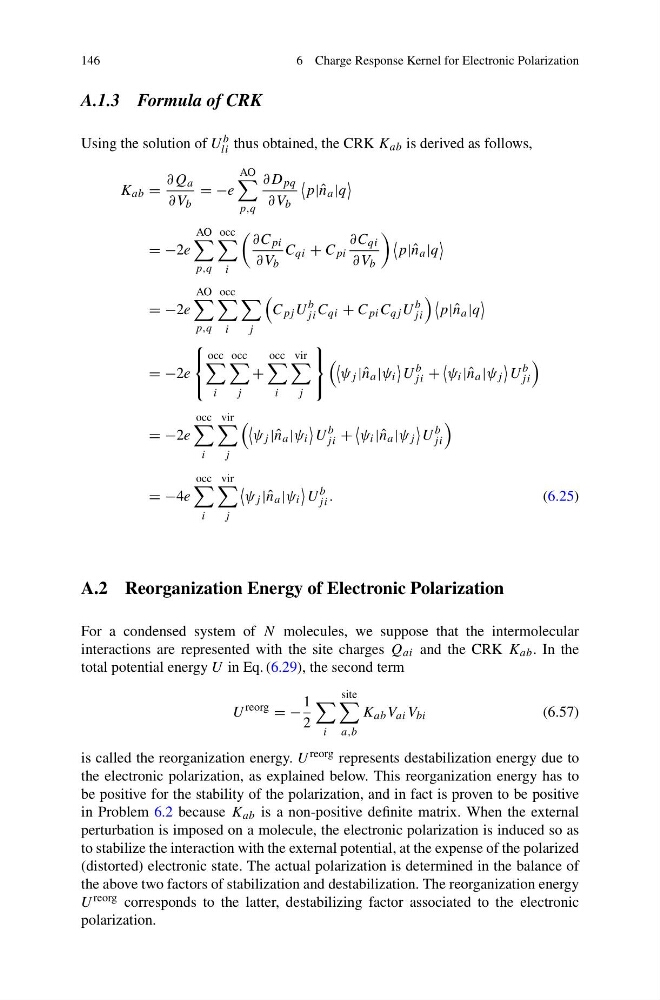
Using the solution of U b
li thus obtained, the CRK K ab is derived as follows,
K ab =
∂Q a
∂V b
= −e
AO
p,q
∂D pq
∂V b
p| ˆ
n a |q
= −2e
AO
p,q
occ
i
∂C pi
∂V b
C qi + C pi
∂C qi
∂V b
p| ˆ
n a |q
= −2e
AO
p,q
occ
i
j
C pj U
b
ji C qi + C pi C qj U
b
ji
p| ˆ
n a |q
= −2e
⎧
⎨
⎩
occ
i
occ
j
+
occ
i
vir
j
⎫
⎬
⎭
ψ j | ˆ
n a |ψ i
U
b
ji +
ψ i | ˆ
n a |ψ j
U
b
ji
= −2e
occ
i
vir
j
ψ j | ˆ
n a |ψ i
U
b
ji +
ψ i | ˆ
n a |ψ j
U
b
ji
= −4e
occ
i
vir
j
ψ j | ˆ
n a |ψ i
U
b
ji .
(6.25)
A.2 Reorganization Energy of Electronic Polarization
For a condensed system of N molecules, we suppose that the intermolecular
interactions are represented with the site charges Q ai and the CRK K ab . In the
total potential energy U in Eq. (6.29), the second term
U
reorg
= −
1
2
i
site
a,b
K ab V ai V bi
(6.57)
is called the reorganization energy. U reorg represents destabilization energy due to
the electronic polarization, as explained below. This reorganization energy has to
be positive for the stability of the polarization, and in fact is proven to be positive
in Problem 6.2 because K ab is a non-positive definite matrix. When the external
perturbation is imposed on a molecule, the electronic polarization is induced so as
to stabilize the interaction with the external potential, at the expense of the polarized
(distorted) electronic state. The actual polarization is determined in the balance of
the above two factors of stabilization and destabilization. The reorganization energy
U reorg corresponds to the latter, destabilizing factor associated to the electronic
polarization.
6 Charge Response Kernel for Electronic Polarization
A.1.3 Formula of CRK
Using the solution of U b
li thus obtained, the CRK K ab is derived as follows,
K ab =
∂Q a
∂V b
= −e
AO
p,q
∂D pq
∂V b
p| ˆ
n a |q
= −2e
AO
p,q
occ
i
∂C pi
∂V b
C qi + C pi
∂C qi
∂V b
p| ˆ
n a |q
= −2e
AO
p,q
occ
i
j
C pj U
b
ji C qi + C pi C qj U
b
ji
p| ˆ
n a |q
= −2e
⎧
⎨
⎩
occ
i
occ
j
+
occ
i
vir
j
⎫
⎬
⎭
ψ j | ˆ
n a |ψ i
U
b
ji +
ψ i | ˆ
n a |ψ j
U
b
ji
= −2e
occ
i
vir
j
ψ j | ˆ
n a |ψ i
U
b
ji +
ψ i | ˆ
n a |ψ j
U
b
ji
= −4e
occ
i
vir
j
ψ j | ˆ
n a |ψ i
U
b
ji .
(6.25)
A.2 Reorganization Energy of Electronic Polarization
For a condensed system of N molecules, we suppose that the intermolecular
interactions are represented with the site charges Q ai and the CRK K ab . In the
total potential energy U in Eq. (6.29), the second term
U
reorg
= −
1
2
i
site
a,b
K ab V ai V bi
(6.57)
is called the reorganization energy. U reorg represents destabilization energy due to
the electronic polarization, as explained below. This reorganization energy has to
be positive for the stability of the polarization, and in fact is proven to be positive
in Problem 6.2 because K ab is a non-positive definite matrix. When the external
perturbation is imposed on a molecule, the electronic polarization is induced so as
to stabilize the interaction with the external potential, at the expense of the polarized
(distorted) electronic state. The actual polarization is determined in the balance of
the above two factors of stabilization and destabilization. The reorganization energy
U reorg corresponds to the latter, destabilizing factor associated to the electronic
polarization.