

A.2 Reorganization Energy of Electronic Polarization
147
A.2.1 Derivation of Reorganization Energy
In this Appendix we derive the above formula of U reorg . The reorganization energy
is defined as the reversible work to polarize the molecule i. In the following
we treat the polarization of each molecule i separately, with no intermolecular
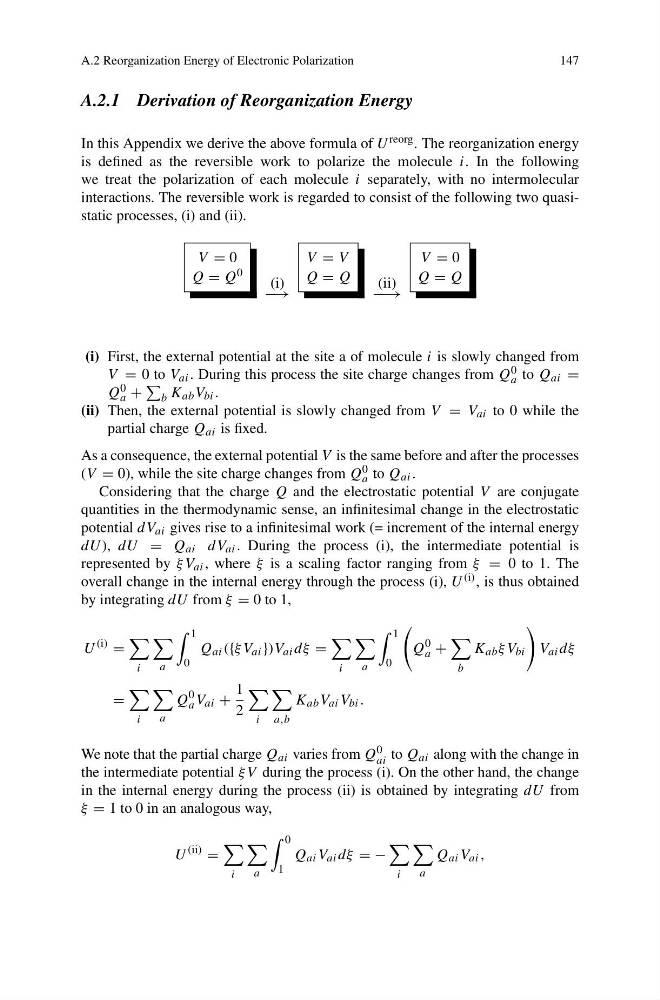
interactions. The reversible work is regarded to consist of the following two quasistatic processes, (i) and (ii).
V = 0
Q = Q 0
(i)
− −→
V = V
Q = Q
(ii)
− −→
V = 0
Q = Q
(i) First, the external potential at the site a of molecule i is slowly changed from
V = 0 to V ai . During this process the site charge changes from Q 0
a to Q ai =
Q 0
a +
b K ab V bi .
(ii) Then, the external potential is slowly changed from V = V ai to 0 while the
partial charge Q ai is fixed.
As a consequence, the external potential V is the same before and after the processes
(V = 0), while the site charge changes from Q 0
a to Q ai .
Considering that the charge Q and the electrostatic potential V are conjugate
quantities in the thermodynamic sense, an infinitesimal change in the electrostatic
potential dV ai gives rise to a infinitesimal work (= increment of the internal energy
dU ), dU = Q ai dV ai . During the process (i), the intermediate potential is
represented by ξV ai , where ξ is a scaling factor ranging from ξ = 0 to 1. The
overall change in the internal energy through the process (i), U (i) , is thus obtained
by integrating dU from ξ = 0 to 1,
U
(i)
=
i
a
1
0
Q ai ({ξV ai })V ai dξ =
i
a
1
0
Q
0
a +
b
K ab ξV bi
V ai dξ
=
i
a
Q
0
a V ai +
1
2
i
a,b
K ab V ai V bi .
We note that the partial charge Q ai varies from Q 0
ai to Q ai along with the change in
the intermediate potential ξV during the process (i). On the other hand, the change
in the internal energy during the process (ii) is obtained by integrating dU from
ξ = 1 to 0 in an analogous way,
U
(ii)
=
i
a
0
1
Q ai V ai dξ = −
i
a
Q ai V ai ,
147
A.2.1 Derivation of Reorganization Energy
In this Appendix we derive the above formula of U reorg . The reorganization energy
is defined as the reversible work to polarize the molecule i. In the following
we treat the polarization of each molecule i separately, with no intermolecular
interactions. The reversible work is regarded to consist of the following two quasistatic processes, (i) and (ii).
V = 0
Q = Q 0
(i)
− −→
V = V
Q = Q
(ii)
− −→
V = 0
Q = Q
(i) First, the external potential at the site a of molecule i is slowly changed from
V = 0 to V ai . During this process the site charge changes from Q 0
a to Q ai =
Q 0
a +
b K ab V bi .
(ii) Then, the external potential is slowly changed from V = V ai to 0 while the
partial charge Q ai is fixed.
As a consequence, the external potential V is the same before and after the processes
(V = 0), while the site charge changes from Q 0
a to Q ai .
Considering that the charge Q and the electrostatic potential V are conjugate
quantities in the thermodynamic sense, an infinitesimal change in the electrostatic
potential dV ai gives rise to a infinitesimal work (= increment of the internal energy
dU ), dU = Q ai dV ai . During the process (i), the intermediate potential is
represented by ξV ai , where ξ is a scaling factor ranging from ξ = 0 to 1. The
overall change in the internal energy through the process (i), U (i) , is thus obtained
by integrating dU from ξ = 0 to 1,
U
(i)
=
i
a
1
0
Q ai ({ξV ai })V ai dξ =
i
a
1
0
Q
0
a +
b
K ab ξV bi
V ai dξ
=
i
a
Q
0
a V ai +
1
2
i
a,b
K ab V ai V bi .
We note that the partial charge Q ai varies from Q 0
ai to Q ai along with the change in
the intermediate potential ξV during the process (i). On the other hand, the change
in the internal energy during the process (ii) is obtained by integrating dU from
ξ = 1 to 0 in an analogous way,
U
(ii)
=
i
a
0
1
Q ai V ai dξ = −
i
a
Q ai V ai ,