

A.1 Derivation of CRK from CPHF Equation
145
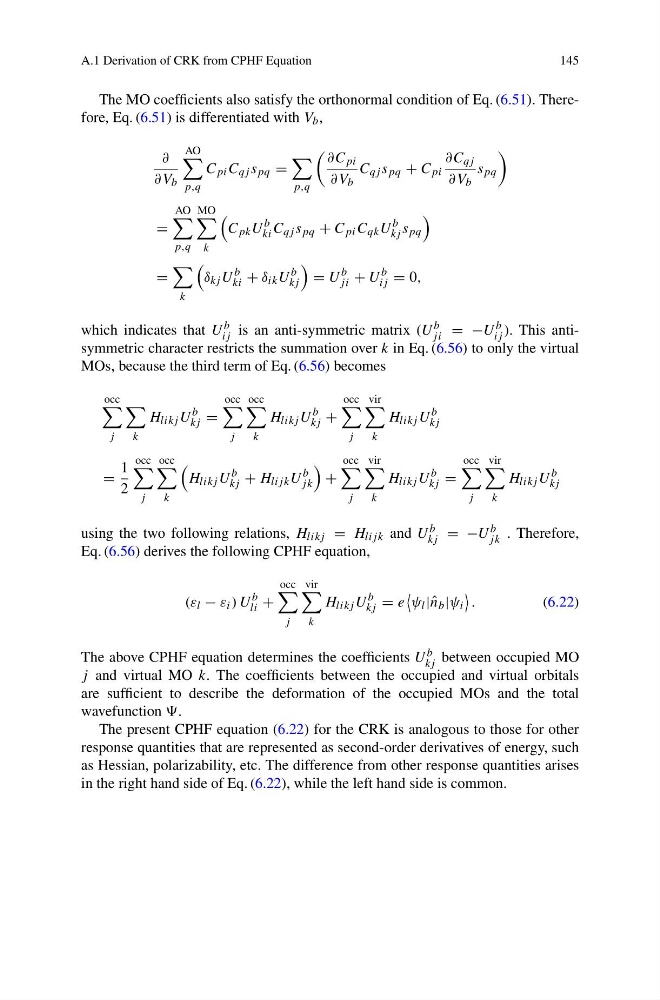
The MO coefficients also satisfy the orthonormal condition of Eq. (6.51). Therefore, Eq. (6.51) is differentiated with V b ,
∂
∂V b
AO
p,q
C pi C qj s pq =
p,q
∂C pi
∂V b
C qj s pq + C pi
∂C qj
∂V b
s pq
=
AO
p,q
MO
k
C pk U
b
ki C qj s pq + C pi C qk U
b
kj s pq
=
k
δ kj U
b
ki + δ ik U
b
kj
= U
b
ji + U
b
ij = 0,
which indicates that U b
ij is an anti-symmetric matrix (U b
ji = −U b
ij ). This antisymmetric character restricts the summation over k in Eq. (6.56) to only the virtual
MOs, because the third term of Eq. (6.56) becomes
occ
j
k
H likj U
b
kj =
occ
j
occ
k
H likj U
b
kj +
occ
j
vir
k
H likj U
b
kj
=
1
2
occ
j
occ
k
H likj U
b
kj + H lij k U
b
jk
+
occ
j
vir
k
H likj U
b
kj =
occ
j
vir
k
H likj U
b
kj
using the two following relations, H likj = H lij k and U b
kj = −U b
jk . Therefore,
Eq. (6.56) derives the following CPHF equation,
(ε l − ε i ) U
b
li +
occ
j
vir
k
H likj U
b
kj = e
ψ l | ˆ
n b |ψ i
.
(6.22)
The above CPHF equation determines the coefficients U b
kj between occupied MO
j and virtual MO k. The coefficients between the occupied and virtual orbitals
are sufficient to describe the deformation of the occupied MOs and the total
wavefunction .
The present CPHF equation (6.22) for the CRK is analogous to those for other
response quantities that are represented as second-order derivatives of energy, such
as Hessian, polarizability, etc. The difference from other response quantities arises
in the right hand side of Eq. (6.22), while the left hand side is common.
145
The MO coefficients also satisfy the orthonormal condition of Eq. (6.51). Therefore, Eq. (6.51) is differentiated with V b ,
∂
∂V b
AO
p,q
C pi C qj s pq =
p,q
∂C pi
∂V b
C qj s pq + C pi
∂C qj
∂V b
s pq
=
AO
p,q
MO
k
C pk U
b
ki C qj s pq + C pi C qk U
b
kj s pq
=
k
δ kj U
b
ki + δ ik U
b
kj
= U
b
ji + U
b
ij = 0,
which indicates that U b
ij is an anti-symmetric matrix (U b
ji = −U b
ij ). This antisymmetric character restricts the summation over k in Eq. (6.56) to only the virtual
MOs, because the third term of Eq. (6.56) becomes
occ
j
k
H likj U
b
kj =
occ
j
occ
k
H likj U
b
kj +
occ
j
vir
k
H likj U
b
kj
=
1
2
occ
j
occ
k
H likj U
b
kj + H lij k U
b
jk
+
occ
j
vir
k
H likj U
b
kj =
occ
j
vir
k
H likj U
b
kj
using the two following relations, H likj = H lij k and U b
kj = −U b
jk . Therefore,
Eq. (6.56) derives the following CPHF equation,
(ε l − ε i ) U
b
li +
occ
j
vir
k
H likj U
b
kj = e
ψ l | ˆ
n b |ψ i
.
(6.22)
The above CPHF equation determines the coefficients U b
kj between occupied MO
j and virtual MO k. The coefficients between the occupied and virtual orbitals
are sufficient to describe the deformation of the occupied MOs and the total
wavefunction .
The present CPHF equation (6.22) for the CRK is analogous to those for other
response quantities that are represented as second-order derivatives of energy, such
as Hessian, polarizability, etc. The difference from other response quantities arises
in the right hand side of Eq. (6.22), while the left hand side is common.