

96
4 Two Computational Schemes of χ (2)
Finally, we make the following three notes on the above derivation of the classical
analogue.
Note 1. In actual application to interpret vibrational spectra, we are interested
in the frequency dependence of χ (2) (ω 2 ). In such cases, the second term of
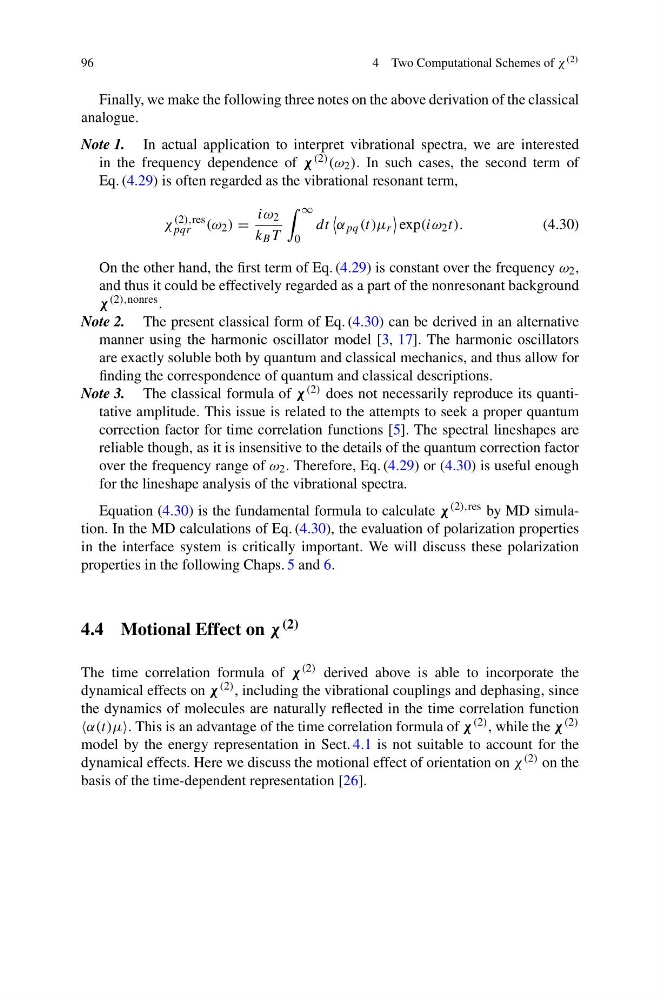
Eq. (4.29) is often regarded as the vibrational resonant term,
χ
(2),res
pqr (ω 2 ) =
iω 2
k B T
∞
0
dt
α pq (t)μ r
exp(iω 2 t).
(4.30)
On the other hand, the first term of Eq. (4.29) is constant over the frequency ω 2 ,
and thus it could be effectively regarded as a part of the nonresonant background
χ (2),nonres .
Note 2. The present classical form of Eq. (4.30) can be derived in an alternative
manner using the harmonic oscillator model [3, 17]. The harmonic oscillators
are exactly soluble both by quantum and classical mechanics, and thus allow for
finding the correspondence of quantum and classical descriptions.
Note 3. The classical formula of χ (2) does not necessarily reproduce its quantitative amplitude. This issue is related to the attempts to seek a proper quantum
correction factor for time correlation functions [5]. The spectral lineshapes are
reliable though, as it is insensitive to the details of the quantum correction factor
over the frequency range of ω 2 . Therefore, Eq. (4.29) or (4.30) is useful enough
for the lineshape analysis of the vibrational spectra.
Equation (4.30) is the fundamental formula to calculate χ (2),res by MD simulation. In the MD calculations of Eq. (4.30), the evaluation of polarization properties
in the interface system is critically important. We will discuss these polarization
properties in the following Chaps. 5 and 6.
4.4 Motional Effect on χ (2)
The time correlation formula of χ (2) derived above is able to incorporate the
dynamical effects on χ (2) , including the vibrational couplings and dephasing, since
the dynamics of molecules are naturally reflected in the time correlation function
α(t)μ. This is an advantage of the time correlation formula of χ (2) , while the χ (2)
model by the energy representation in Sect. 4.1 is not suitable to account for the
dynamical effects. Here we discuss the motional effect of orientation on χ (2) on the
basis of the time-dependent representation [26].
4 Two Computational Schemes of χ (2)
Finally, we make the following three notes on the above derivation of the classical
analogue.
Note 1. In actual application to interpret vibrational spectra, we are interested
in the frequency dependence of χ (2) (ω 2 ). In such cases, the second term of
Eq. (4.29) is often regarded as the vibrational resonant term,
χ
(2),res
pqr (ω 2 ) =
iω 2
k B T
∞
0
dt
α pq (t)μ r
exp(iω 2 t).
(4.30)
On the other hand, the first term of Eq. (4.29) is constant over the frequency ω 2 ,
and thus it could be effectively regarded as a part of the nonresonant background
χ (2),nonres .
Note 2. The present classical form of Eq. (4.30) can be derived in an alternative
manner using the harmonic oscillator model [3, 17]. The harmonic oscillators
are exactly soluble both by quantum and classical mechanics, and thus allow for
finding the correspondence of quantum and classical descriptions.
Note 3. The classical formula of χ (2) does not necessarily reproduce its quantitative amplitude. This issue is related to the attempts to seek a proper quantum
correction factor for time correlation functions [5]. The spectral lineshapes are
reliable though, as it is insensitive to the details of the quantum correction factor
over the frequency range of ω 2 . Therefore, Eq. (4.29) or (4.30) is useful enough
for the lineshape analysis of the vibrational spectra.
Equation (4.30) is the fundamental formula to calculate χ (2),res by MD simulation. In the MD calculations of Eq. (4.30), the evaluation of polarization properties
in the interface system is critically important. We will discuss these polarization
properties in the following Chaps. 5 and 6.
4.4 Motional Effect on χ (2)
The time correlation formula of χ (2) derived above is able to incorporate the
dynamical effects on χ (2) , including the vibrational couplings and dephasing, since
the dynamics of molecules are naturally reflected in the time correlation function
α(t)μ. This is an advantage of the time correlation formula of χ (2) , while the χ (2)
model by the energy representation in Sect. 4.1 is not suitable to account for the
dynamical effects. Here we discuss the motional effect of orientation on χ (2) on the
basis of the time-dependent representation [26].