

441
15 FtIR Imaging of tissues: techniques and methods of Analysis
where d is the diameter of the particle, n is the real refractive index and λ is wavelength.
15.4.3 Multiplicative Signal Correction
the first types of approaches applied to correct spectra using modelling methods
were multiplicative Signal Correction also termed multivariate Scatter Correction
(mSC) [70]. mSC is a chemometric method that models for the effect of light scattering. the method was originally developed for applications of near-IR spectroscopy in food science [71]. In mSC, each spectrum is regressed in a set of related
samples. In mSC a mean (or reference spectrum) is used to estimate the intercept
and slope of an estimated regression equation [72]. Subtracting the intercept and
dividing by the slope corrects each spectrum. the mSC will only work providing
there are negligible differences between the reference and corrected spectrum or
alternatively if the regression analysis is performed on a region devoid of chemical
information and thus only influenced by multiplicative light scattering [72].
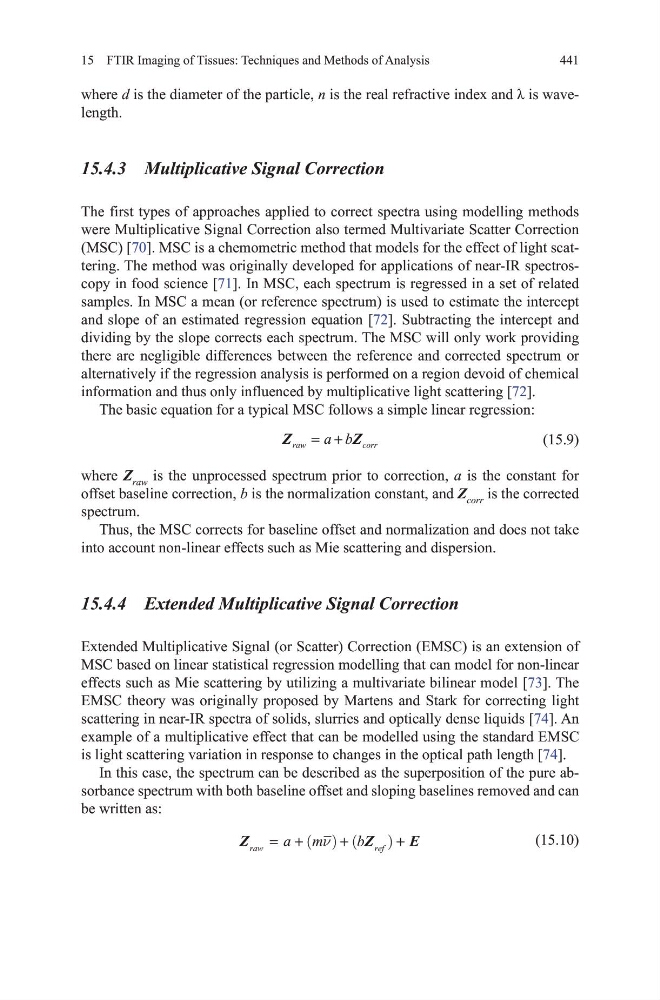
the basic equation for a typical mSC follows a simple linear regression:
Z
Z
raw
c orr
a b
= +
(15.9)
where Z raw is the unprocessed spectrum prior to correction, a is the constant for
offset baseline correction, b is the normalization constant, and Z corr is the corrected
spectrum.
thus, the mSC corrects for baseline offset and normalization and does not take
into account non-linear effects such as mie scattering and dispersion.
15.4.4 Extended Multiplicative Signal Correction
Extended multiplicative Signal (or Scatter) Correction (EmSC) is an extension of
mSC based on linear statistical regression modelling that can model for non-linear
effects such as mie scattering by utilizing a multivariate bilinear model [73]. the
EmSC theory was originally proposed by martens and Stark for correcting light
scattering in near-IR spectra of solids, slurries and optically dense liquids [74]. An
example of a multiplicative effect that can be modelled using the standard EmSC
is light scattering variation in response to changes in the optical path length [74].
In this case, the spectrum can be described as the superposition of the pure absorbance spectrum with both baseline offset and sloping baselines removed and can
be written as:
Z
Z
E
raw
r ef
a m
b
= +
+
+
( ) (
)
ν
(15.10)
15 FtIR Imaging of tissues: techniques and methods of Analysis
where d is the diameter of the particle, n is the real refractive index and λ is wavelength.
15.4.3 Multiplicative Signal Correction
the first types of approaches applied to correct spectra using modelling methods
were multiplicative Signal Correction also termed multivariate Scatter Correction
(mSC) [70]. mSC is a chemometric method that models for the effect of light scattering. the method was originally developed for applications of near-IR spectroscopy in food science [71]. In mSC, each spectrum is regressed in a set of related
samples. In mSC a mean (or reference spectrum) is used to estimate the intercept
and slope of an estimated regression equation [72]. Subtracting the intercept and
dividing by the slope corrects each spectrum. the mSC will only work providing
there are negligible differences between the reference and corrected spectrum or
alternatively if the regression analysis is performed on a region devoid of chemical
information and thus only influenced by multiplicative light scattering [72].
the basic equation for a typical mSC follows a simple linear regression:
Z
Z
raw
c orr
a b
= +
(15.9)
where Z raw is the unprocessed spectrum prior to correction, a is the constant for
offset baseline correction, b is the normalization constant, and Z corr is the corrected
spectrum.
thus, the mSC corrects for baseline offset and normalization and does not take
into account non-linear effects such as mie scattering and dispersion.
15.4.4 Extended Multiplicative Signal Correction
Extended multiplicative Signal (or Scatter) Correction (EmSC) is an extension of
mSC based on linear statistical regression modelling that can model for non-linear
effects such as mie scattering by utilizing a multivariate bilinear model [73]. the
EmSC theory was originally proposed by martens and Stark for correcting light
scattering in near-IR spectra of solids, slurries and optically dense liquids [74]. An
example of a multiplicative effect that can be modelled using the standard EmSC
is light scattering variation in response to changes in the optical path length [74].
In this case, the spectrum can be described as the superposition of the pure absorbance spectrum with both baseline offset and sloping baselines removed and can
be written as:
Z
Z
E
raw
r ef
a m
b
= +
+
+
( ) (
)
ν
(15.10)