

442
K. malek et al.
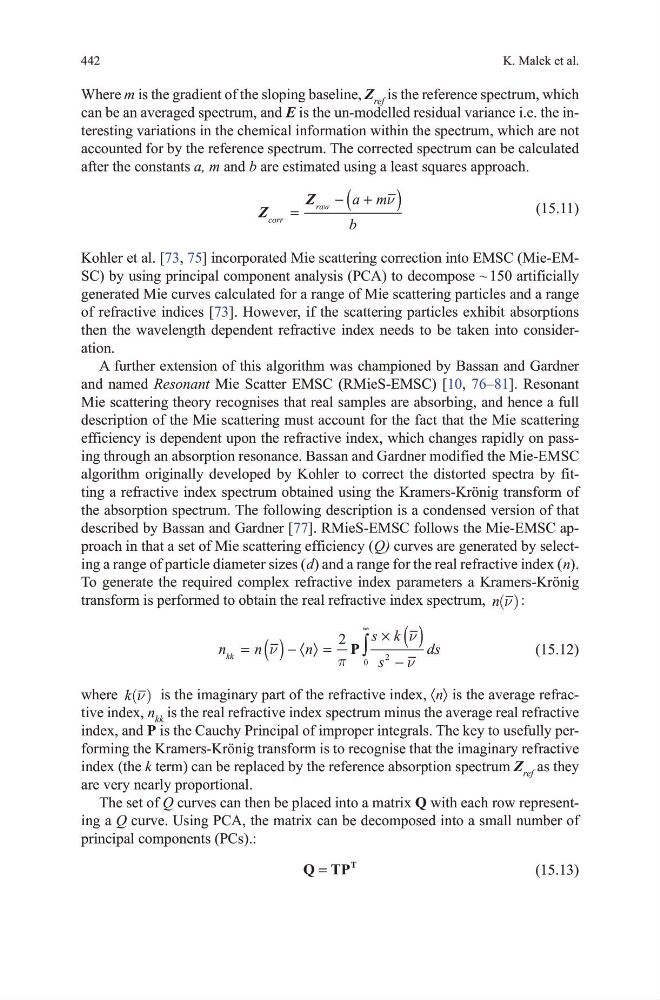
Where m is the gradient of the sloping baseline, Z ref is the reference spectrum, which
can be an averaged spectrum, and E is the un-modelled residual variance i.e. the interesting variations in the chemical information within the spectrum, which are not
accounted for by the reference spectrum. the corrected spectrum can be calculated
after the constants a, m and b are estimated using a least squares approach.
Z
Z
corr
raw
a m
b
=
− +
(
)
ν
(15.11)
Kohler et al. [73, 75] incorporated mie scattering correction into EmSC (mie-EmSC) by using principal component analysis (PCA) to decompose ~ 150 artificially
generated mie curves calculated for a range of mie scattering particles and a range
of refractive indices [73]. however, if the scattering particles exhibit absorptions
then the wavelength dependent refractive index needs to be taken into consideration.
A further extension of this algorithm was championed by Bassan and gardner
and named Resonant mie Scatter EmSC (RmieS-EmSC) [10, 76–81]. Resonant
mie scattering theory recognises that real samples are absorbing, and hence a full
description of the mie scattering must account for the fact that the mie scattering
efficiency is dependent upon the refractive index, which changes rapidly on passing through an absorption resonance. Bassan and gardner modified the mie-EmSC
algorithm originally developed by Kohler to correct the distorted spectra by fitting a refractive index spectrum obtained using the Kramers-Krönig transform of
the absorption spectrum. the following description is a condensed version of that
described by Bassan and gardner [77]. RmieS-EmSC follows the mie-EmSC approach in that a set of mie scattering efficiency ( Q) curves are generated by selecting a range of particle diameter sizes ( d) and a range for the real refractive index ( n).
to generate the required complex refractive index parameters a Kramers-Krönig
transform is performed to obtain the real refractive index spectrum, n( )
ν :
n
n
n
s k
s
ds
kk
= ( ) − 〈 〉 =
× ( )
−
∫
∞
ν
π
ν
ν
2
0
2
P
(15.12)
where k( )
ν is the imaginary part of the refractive index, 〈n〉 is the average refractive index, n kk is the real refractive index spectrum minus the average real refractive
index, and P is the Cauchy Principal of improper integrals. the key to usefully performing the Kramers-Krönig transform is to recognise that the imaginary refractive
index (the k term) can be replaced by the reference absorption spectrum Z ref as they
are very nearly proportional.
the set of Q curves can then be placed into a matrix Q with each row representing a Q curve. using PCA, the matrix can be decomposed into a small number of
principal components (PCs).:
Q TP
T
=
(15.13)
K. malek et al.
Where m is the gradient of the sloping baseline, Z ref is the reference spectrum, which
can be an averaged spectrum, and E is the un-modelled residual variance i.e. the interesting variations in the chemical information within the spectrum, which are not
accounted for by the reference spectrum. the corrected spectrum can be calculated
after the constants a, m and b are estimated using a least squares approach.
Z
Z
corr
raw
a m
b
=
− +
(
)
ν
(15.11)
Kohler et al. [73, 75] incorporated mie scattering correction into EmSC (mie-EmSC) by using principal component analysis (PCA) to decompose ~ 150 artificially
generated mie curves calculated for a range of mie scattering particles and a range
of refractive indices [73]. however, if the scattering particles exhibit absorptions
then the wavelength dependent refractive index needs to be taken into consideration.
A further extension of this algorithm was championed by Bassan and gardner
and named Resonant mie Scatter EmSC (RmieS-EmSC) [10, 76–81]. Resonant
mie scattering theory recognises that real samples are absorbing, and hence a full
description of the mie scattering must account for the fact that the mie scattering
efficiency is dependent upon the refractive index, which changes rapidly on passing through an absorption resonance. Bassan and gardner modified the mie-EmSC
algorithm originally developed by Kohler to correct the distorted spectra by fitting a refractive index spectrum obtained using the Kramers-Krönig transform of
the absorption spectrum. the following description is a condensed version of that
described by Bassan and gardner [77]. RmieS-EmSC follows the mie-EmSC approach in that a set of mie scattering efficiency ( Q) curves are generated by selecting a range of particle diameter sizes ( d) and a range for the real refractive index ( n).
to generate the required complex refractive index parameters a Kramers-Krönig
transform is performed to obtain the real refractive index spectrum, n( )
ν :
n
n
n
s k
s
ds
kk
= ( ) − 〈 〉 =
× ( )
−
∫
∞
ν
π
ν
ν
2
0
2
P
(15.12)
where k( )
ν is the imaginary part of the refractive index, 〈n〉 is the average refractive index, n kk is the real refractive index spectrum minus the average real refractive
index, and P is the Cauchy Principal of improper integrals. the key to usefully performing the Kramers-Krönig transform is to recognise that the imaginary refractive
index (the k term) can be replaced by the reference absorption spectrum Z ref as they
are very nearly proportional.
the set of Q curves can then be placed into a matrix Q with each row representing a Q curve. using PCA, the matrix can be decomposed into a small number of
principal components (PCs).:
Q TP
T
=
(15.13)