

414
h. Chon and J. Choo
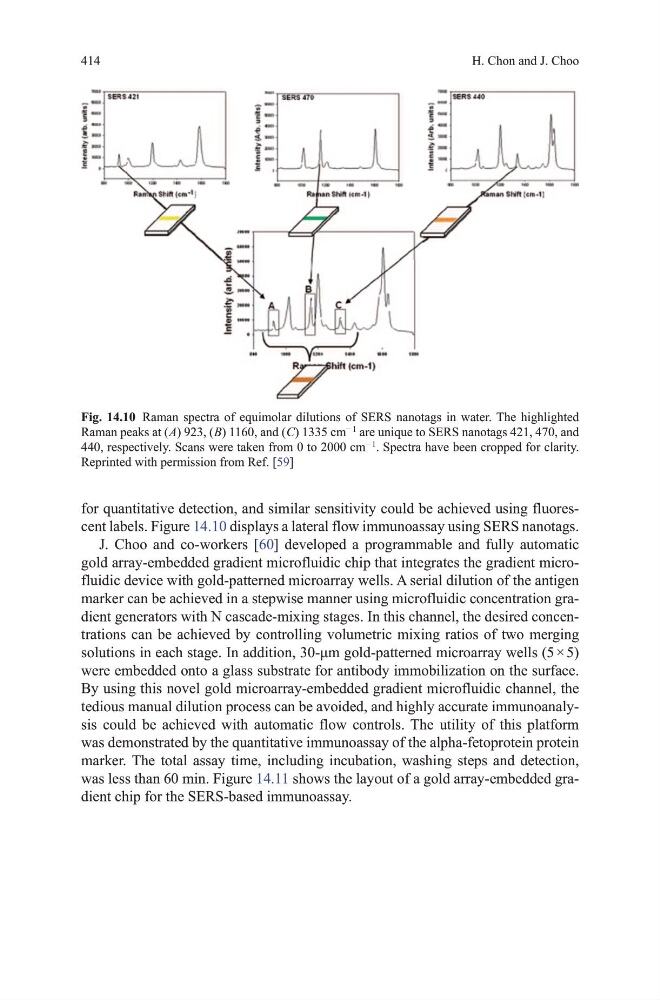
for quantitative detection, and similar sensitivity could be achieved using fluorescent labels. Figure 14.10 displays a lateral flow immunoassay using SERS nanotags.
J. Choo and co-workers [60] developed a programmable and fully automatic
gold array-embedded gradient microfluidic chip that integrates the gradient microfluidic device with gold-patterned microarray wells. A serial dilution of the antigen
marker can be achieved in a stepwise manner using microfluidic concentration gradient generators with N cascade-mixing stages. In this channel, the desired concentrations can be achieved by controlling volumetric mixing ratios of two merging
solutions in each stage. In addition, 30-μm gold-patterned microarray wells (5 × 5)
were embedded onto a glass substrate for antibody immobilization on the surface.
By using this novel gold microarray-embedded gradient microfluidic channel, the
tedious manual dilution process can be avoided, and highly accurate immunoanalysis could be achieved with automatic flow controls. the utility of this platform
was demonstrated by the quantitative immunoassay of the alpha-fetoprotein protein
marker. the total assay time, including incubation, washing steps and detection,
was less than 60 min. Figure 14.11 shows the layout of a gold array-embedded gradient chip for the SERS-based immunoassay.
Fig. 14.10 Raman spectra of equimolar dilutions of SERS nanotags in water. the highlighted
Raman peaks at ( A) 923, ( B) 1160, and ( C) 1335 cm
− 1
are unique to SERS nanotags 421, 470, and
440, respectively. Scans were taken from 0 to 2000 cm
− 1
. Spectra have been cropped for clarity.
Reprinted with permission from Ref. [59]
h. Chon and J. Choo
for quantitative detection, and similar sensitivity could be achieved using fluorescent labels. Figure 14.10 displays a lateral flow immunoassay using SERS nanotags.
J. Choo and co-workers [60] developed a programmable and fully automatic
gold array-embedded gradient microfluidic chip that integrates the gradient microfluidic device with gold-patterned microarray wells. A serial dilution of the antigen
marker can be achieved in a stepwise manner using microfluidic concentration gradient generators with N cascade-mixing stages. In this channel, the desired concentrations can be achieved by controlling volumetric mixing ratios of two merging
solutions in each stage. In addition, 30-μm gold-patterned microarray wells (5 × 5)
were embedded onto a glass substrate for antibody immobilization on the surface.
By using this novel gold microarray-embedded gradient microfluidic channel, the
tedious manual dilution process can be avoided, and highly accurate immunoanalysis could be achieved with automatic flow controls. the utility of this platform
was demonstrated by the quantitative immunoassay of the alpha-fetoprotein protein
marker. the total assay time, including incubation, washing steps and detection,
was less than 60 min. Figure 14.11 shows the layout of a gold array-embedded gradient chip for the SERS-based immunoassay.
Fig. 14.10 Raman spectra of equimolar dilutions of SERS nanotags in water. the highlighted
Raman peaks at ( A) 923, ( B) 1160, and ( C) 1335 cm
− 1
are unique to SERS nanotags 421, 470, and
440, respectively. Scans were taken from 0 to 2000 cm
− 1
. Spectra have been cropped for clarity.
Reprinted with permission from Ref. [59]