

415
14 Quantitative Analysis of disease Biomarkers using …
14.6 Summary
during the past two decades, there has been growing interest in the biomedical
application of SERS spectroscopy. In particular, SERS-based immunoassays are
a potential clinical tool for highly sensitive and reproducible multiple biomarker
detection. In this chapter, three different types of the SERS assay platforms using (i) gold-patterned substrates, (ii) various kinds of microbead substrates, and
(iii) a microfluidic device were described. In the ELISA-based immunoassay, the
Lod is 1–10 ng/mL, whereas it is 1–10 pg/mL for the SERS-based assay. these
Lod values demonstrate that the detection sensitivity was increased by two or three
orders of magnitude compared to a conventional ELISA. Furthermore, this SERSbased immunoassay technique has additional advantages, including low reagent
consumption, short incubation time, wider concentration dynamic range, and cost
savings compared to the conventional ELISA technique. the SERS-based immunoassay technique can be used for highly sensitive analysis of multiple biomarkers. By using proper antibody-functionalized SERS-coding nanoprobes, the optical
signals for specific immunocomplexes can be amplified and analyzed by this novel
technique. As a result, this SERS-based immunoassay is expected to be a powerful
clinical tool for early disease diagnosis.
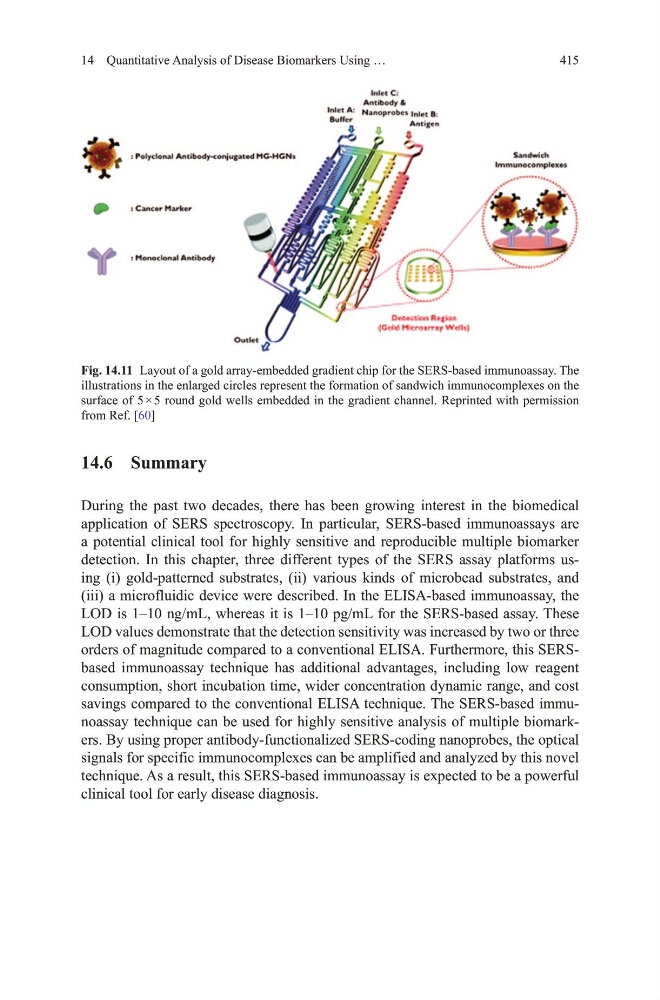
Fig. 14.11 Layout of a gold array-embedded gradient chip for the SERS-based immunoassay. the
illustrations in the enlarged circles represent the formation of sandwich immunocomplexes on the
surface of 5 × 5 round gold wells embedded in the gradient channel. Reprinted with permission
from Ref. [60]
14 Quantitative Analysis of disease Biomarkers using …
14.6 Summary
during the past two decades, there has been growing interest in the biomedical
application of SERS spectroscopy. In particular, SERS-based immunoassays are
a potential clinical tool for highly sensitive and reproducible multiple biomarker
detection. In this chapter, three different types of the SERS assay platforms using (i) gold-patterned substrates, (ii) various kinds of microbead substrates, and
(iii) a microfluidic device were described. In the ELISA-based immunoassay, the
Lod is 1–10 ng/mL, whereas it is 1–10 pg/mL for the SERS-based assay. these
Lod values demonstrate that the detection sensitivity was increased by two or three
orders of magnitude compared to a conventional ELISA. Furthermore, this SERSbased immunoassay technique has additional advantages, including low reagent
consumption, short incubation time, wider concentration dynamic range, and cost
savings compared to the conventional ELISA technique. the SERS-based immunoassay technique can be used for highly sensitive analysis of multiple biomarkers. By using proper antibody-functionalized SERS-coding nanoprobes, the optical
signals for specific immunocomplexes can be amplified and analyzed by this novel
technique. As a result, this SERS-based immunoassay is expected to be a powerful
clinical tool for early disease diagnosis.
Fig. 14.11 Layout of a gold array-embedded gradient chip for the SERS-based immunoassay. the
illustrations in the enlarged circles represent the formation of sandwich immunocomplexes on the
surface of 5 × 5 round gold wells embedded in the gradient channel. Reprinted with permission
from Ref. [60]