

413
14 Quantitative Analysis of disease Biomarkers using …
flow and homogeneous mixing conditions are maintained in a microfluidic channel
[55–57].
J. Choo and co-workers [58] developed a SERS-based gradient optofluidic sensor
for the fast and reproducible immunoassay. In this work, a novel microfluidic sensor
with functional internal structures has been designed and fabricated. this sensor is
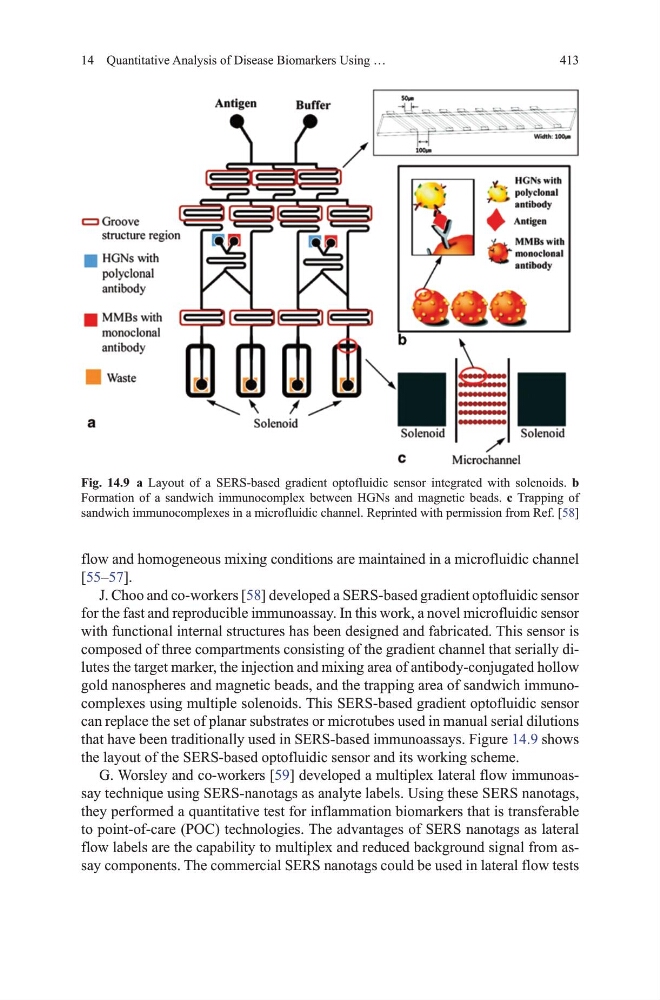
composed of three compartments consisting of the gradient channel that serially dilutes the target marker, the injection and mixing area of antibody-conjugated hollow
gold nanospheres and magnetic beads, and the trapping area of sandwich immunocomplexes using multiple solenoids. this SERS-based gradient optofluidic sensor
can replace the set of planar substrates or microtubes used in manual serial dilutions
that have been traditionally used in SERS-based immunoassays. Figure 14.9 shows
the layout of the SERS-based optofluidic sensor and its working scheme.
g. Worsley and co-workers [59] developed a multiplex lateral flow immunoassay technique using SERS-nanotags as analyte labels. using these SERS nanotags,
they performed a quantitative test for inflammation biomarkers that is transferable
to point-of-care (PoC) technologies. the advantages of SERS nanotags as lateral
flow labels are the capability to multiplex and reduced background signal from assay components. the commercial SERS nanotags could be used in lateral flow tests
Fig. 14.9 a Layout of a SERS-based gradient optofluidic sensor integrated with solenoids. b
Formation of a sandwich immunocomplex between hgNs and magnetic beads. c trapping of
sandwich immunocomplexes in a microfluidic channel. Reprinted with permission from Ref. [58]
14 Quantitative Analysis of disease Biomarkers using …
flow and homogeneous mixing conditions are maintained in a microfluidic channel
[55–57].
J. Choo and co-workers [58] developed a SERS-based gradient optofluidic sensor
for the fast and reproducible immunoassay. In this work, a novel microfluidic sensor
with functional internal structures has been designed and fabricated. this sensor is
composed of three compartments consisting of the gradient channel that serially dilutes the target marker, the injection and mixing area of antibody-conjugated hollow
gold nanospheres and magnetic beads, and the trapping area of sandwich immunocomplexes using multiple solenoids. this SERS-based gradient optofluidic sensor
can replace the set of planar substrates or microtubes used in manual serial dilutions
that have been traditionally used in SERS-based immunoassays. Figure 14.9 shows
the layout of the SERS-based optofluidic sensor and its working scheme.
g. Worsley and co-workers [59] developed a multiplex lateral flow immunoassay technique using SERS-nanotags as analyte labels. using these SERS nanotags,
they performed a quantitative test for inflammation biomarkers that is transferable
to point-of-care (PoC) technologies. the advantages of SERS nanotags as lateral
flow labels are the capability to multiplex and reduced background signal from assay components. the commercial SERS nanotags could be used in lateral flow tests
Fig. 14.9 a Layout of a SERS-based gradient optofluidic sensor integrated with solenoids. b
Formation of a sandwich immunocomplex between hgNs and magnetic beads. c trapping of
sandwich immunocomplexes in a microfluidic channel. Reprinted with permission from Ref. [58]