

412
h. Chon and J. Choo
14.5 SERS-Based Immunoassay Using lab-on-a-chip
In many cases, a SERS-based immunoassay using planar gold substrates or microbeads has some issues because it is awkward to optimize the experimental conditions, such as the manual washing steps using a micropipet, changing the substrate
condition for an optimal SERS measurement and the inhomogeneous distribution
of sandwich immunocomplexes immobilized on the microtube wall or the planar
substrate. In addition, various concentrations of a specific target marker should be
manually prepared for quantitative analysis. this time-consuming process makes
the substrate- or microtube-based immunoassay less attractive. Recently, SERSbased microfluidic sensors have been developed to resolve this problem. using
this platform, a highly accurate and reproducible analysis is possible if continuous
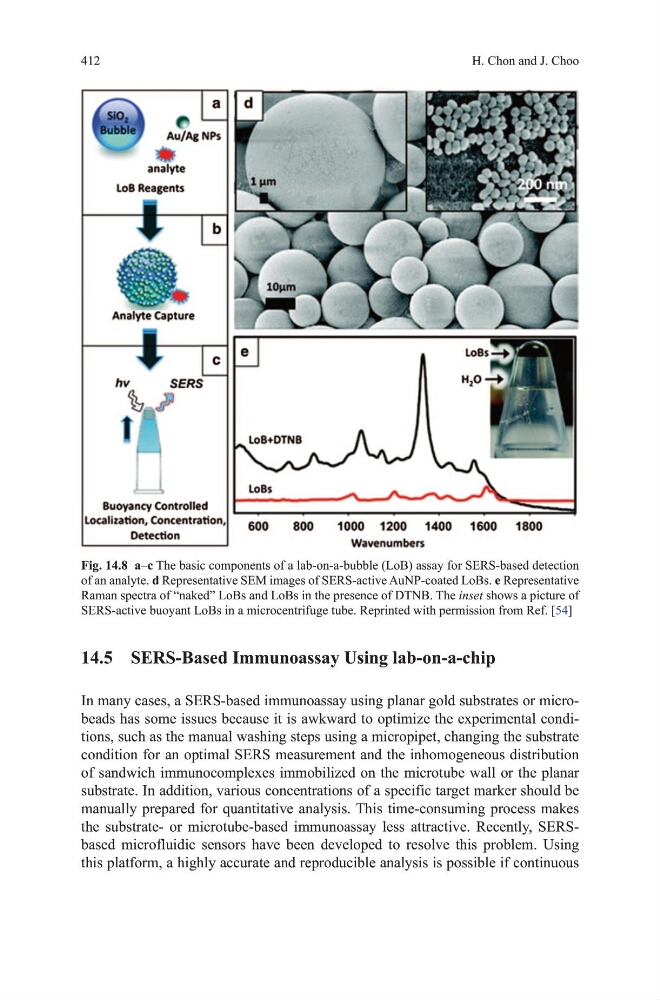
Fig. 14.8 a–c the basic components of a lab-on-a-bubble (LoB) assay for SERS-based detection
of an analyte. d Representative SEm images of SERS-active AuNP-coated LoBs. e Representative
Raman spectra of “naked” LoBs and LoBs in the presence of dtNB. the inset shows a picture of
SERS-active buoyant LoBs in a microcentrifuge tube. Reprinted with permission from Ref. [54]
h. Chon and J. Choo
14.5 SERS-Based Immunoassay Using lab-on-a-chip
In many cases, a SERS-based immunoassay using planar gold substrates or microbeads has some issues because it is awkward to optimize the experimental conditions, such as the manual washing steps using a micropipet, changing the substrate
condition for an optimal SERS measurement and the inhomogeneous distribution
of sandwich immunocomplexes immobilized on the microtube wall or the planar
substrate. In addition, various concentrations of a specific target marker should be
manually prepared for quantitative analysis. this time-consuming process makes
the substrate- or microtube-based immunoassay less attractive. Recently, SERSbased microfluidic sensors have been developed to resolve this problem. using
this platform, a highly accurate and reproducible analysis is possible if continuous
Fig. 14.8 a–c the basic components of a lab-on-a-bubble (LoB) assay for SERS-based detection
of an analyte. d Representative SEm images of SERS-active AuNP-coated LoBs. e Representative
Raman spectra of “naked” LoBs and LoBs in the presence of dtNB. the inset shows a picture of
SERS-active buoyant LoBs in a microcentrifuge tube. Reprinted with permission from Ref. [54]