

410
h. Chon and J. Choo
aptamer-conjugated gold nanoparticles. taking advantage of SERS hot spots and
the optical property of gold nanorods, a novel SERS aptasensor was proposed based
on nanoparticle-nanorod junctions to detect human α-thrombin in human blood serum. the simulation and experiments revealed that the strong electromagnetic coupling resonance at the junction of these probes could be used to construct highly
sensitive SERS aptasensors. Figure 14.6 shows a schematic representation of the
SERS-based immunoassay using particle-rod junctions.
J. Choo and co-workers [52] performed a simultaneous detection of dual cancer
markers in blood serum using a SERS-based sandwich immunoassay between hollow gold nanospheres and magnetic beads. For this purpose, two different Raman
reporter-labelled gold nanoprobe and magnetic bead sets were prepared. the simultaneous detection of CEA and AFP cancer markers in blood serum was achieved under a single excitation wavelength. this novel immunoassay shows a simultaneous
multiple-marker detection using reliable, sharp, and easily distinguishable SERS
peaks. the immunoassay results for human clinical sera also show high accuracy
and sensitivity. overall, this study demonstrates a promising future for a functional
nanoprobe-based SERS detection technique for a simultaneous immunoassay of
multiple disease markers. Figure 14.7 displays a scheme of the SERS-based duplex
immunoassay.
more recently, K. t. Carron and co-workers [53, 54] introduced a new class of
SERS materials consisting of gold nanoparticles coated onto hollow, buoyant silica
microspheres. these materials allow for a new molecular assay designated as a
lab-on-a-bubble (LoB). these serve as a convenient platform for the detection of
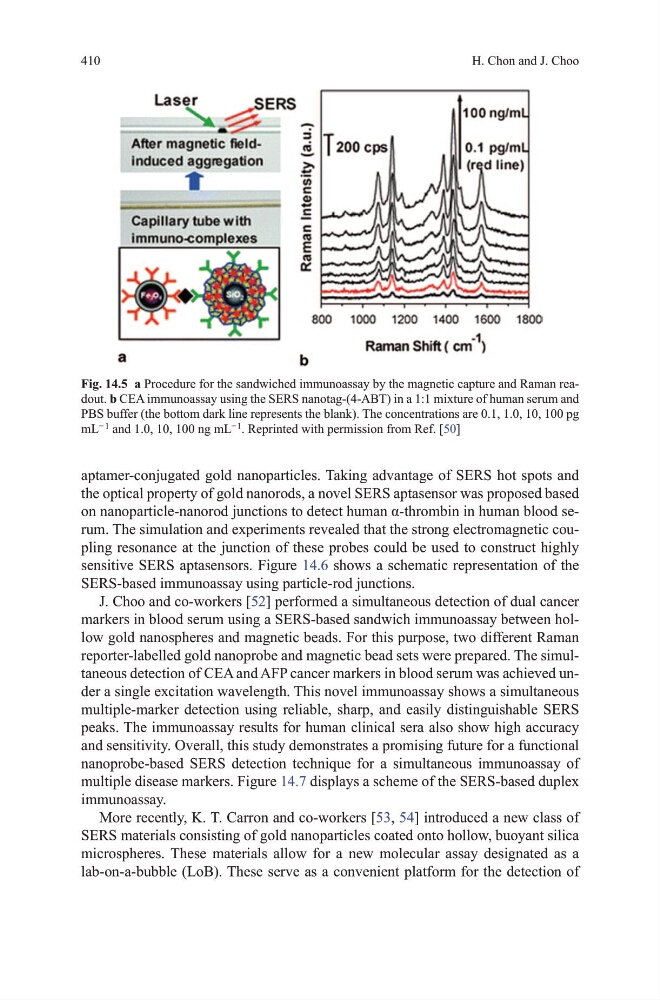
Fig. 14.5 a Procedure for the sandwiched immunoassay by the magnetic capture and Raman readout. b CEA immunoassay using the SERS nanotag-(4-ABt) in a 1:1 mixture of human serum and
PBS buffer (the bottom dark line represents the blank). the concentrations are 0.1, 1.0, 10, 100 pg
mL
− 1
and 1.0, 10, 100 ng mL
− 1
. Reprinted with permission from Ref. [50]
h. Chon and J. Choo
aptamer-conjugated gold nanoparticles. taking advantage of SERS hot spots and
the optical property of gold nanorods, a novel SERS aptasensor was proposed based
on nanoparticle-nanorod junctions to detect human α-thrombin in human blood serum. the simulation and experiments revealed that the strong electromagnetic coupling resonance at the junction of these probes could be used to construct highly
sensitive SERS aptasensors. Figure 14.6 shows a schematic representation of the
SERS-based immunoassay using particle-rod junctions.
J. Choo and co-workers [52] performed a simultaneous detection of dual cancer
markers in blood serum using a SERS-based sandwich immunoassay between hollow gold nanospheres and magnetic beads. For this purpose, two different Raman
reporter-labelled gold nanoprobe and magnetic bead sets were prepared. the simultaneous detection of CEA and AFP cancer markers in blood serum was achieved under a single excitation wavelength. this novel immunoassay shows a simultaneous
multiple-marker detection using reliable, sharp, and easily distinguishable SERS
peaks. the immunoassay results for human clinical sera also show high accuracy
and sensitivity. overall, this study demonstrates a promising future for a functional
nanoprobe-based SERS detection technique for a simultaneous immunoassay of
multiple disease markers. Figure 14.7 displays a scheme of the SERS-based duplex
immunoassay.
more recently, K. t. Carron and co-workers [53, 54] introduced a new class of
SERS materials consisting of gold nanoparticles coated onto hollow, buoyant silica
microspheres. these materials allow for a new molecular assay designated as a
lab-on-a-bubble (LoB). these serve as a convenient platform for the detection of
Fig. 14.5 a Procedure for the sandwiched immunoassay by the magnetic capture and Raman readout. b CEA immunoassay using the SERS nanotag-(4-ABt) in a 1:1 mixture of human serum and
PBS buffer (the bottom dark line represents the blank). the concentrations are 0.1, 1.0, 10, 100 pg
mL
− 1
and 1.0, 10, 100 ng mL
− 1
. Reprinted with permission from Ref. [50]