

A. Rygula and P. Miskowiec
282
harvesting and (2) photoprotectors against oxidative damages [12]. It has been established that their antioxidant activity and the ability of quenching of singlet oxygen is related to the structure, precisely to conjugated double-bond system. many
diseases, such as cancer and strokes, involve oxidative processes mediated by free
radicals. Carotenoids, by their antioxidant effect, can show benefits in such diseases; however, this function is not completely demonstrated in vivo [11].
In conjugated polyenes group, one can separate the subgroup of psittacofulvins
or parrodienes. these pigments are widely distributed in corals mollusc, pearls and
parrots’ plumage [13–15].
Quinones are more widely distributed than the other natural pigments (with the
exception of carotenoids and melanins) [6]. According to their structure, they can be
divided into benzoquinones, naphthoquinones and anthraquinones. one of the most
popular benzoquinoid dyes is carthamine, whilst the representative examples for
naphtoquinones are juglon and lawson received from green walnut shell (Juglandaceae family) and henna ( Lawsonia inermis L.), respectively. the biggest group
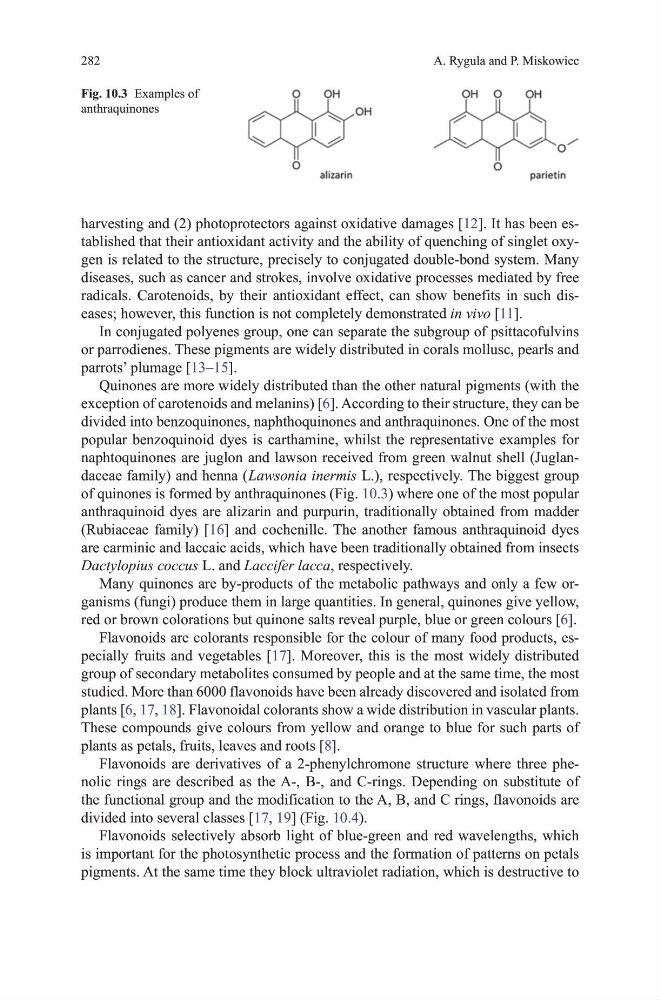
of quinones is formed by anthraquinones (Fig. 10.3) where one of the most popular
anthraquinoid dyes are alizarin and purpurin, traditionally obtained from madder
(Rubiaceae family) [16] and cochenille. the another famous anthraquinoid dyes
are carminic and laccaic acids, which have been traditionally obtained from insects
Dactylopius coccus L. and Laccifer lacca, respectively.
many quinones are by-products of the metabolic pathways and only a few organisms (fungi) produce them in large quantities. In general, quinones give yellow,
red or brown colorations but quinone salts reveal purple, blue or green colours [6].
Flavonoids are colorants responsible for the colour of many food products, especially fruits and vegetables [17]. moreover, this is the most widely distributed
group of secondary metabolites consumed by people and at the same time, the most
studied. more than 6000 flavonoids have been already discovered and isolated from
plants [6, 17, 18]. Flavonoidal colorants show a wide distribution in vascular plants.
these compounds give colours from yellow and orange to blue for such parts of
plants as petals, fruits, leaves and roots [8].
Flavonoids are derivatives of a 2-phenylchromone structure where three phenolic rings are described as the A-, B-, and C-rings. depending on substitute of
the functional group and the modification to the A, B, and C rings, flavonoids are
divided into several classes [17, 19] (Fig. 10.4).
Flavonoids selectively absorb light of blue-green and red wavelengths, which
is important for the photosynthetic process and the formation of patterns on petals
pigments. At the same time they block ultraviolet radiation, which is destructive to
Fig. 10.3 Examples of
anthraquinones
282
harvesting and (2) photoprotectors against oxidative damages [12]. It has been established that their antioxidant activity and the ability of quenching of singlet oxygen is related to the structure, precisely to conjugated double-bond system. many
diseases, such as cancer and strokes, involve oxidative processes mediated by free
radicals. Carotenoids, by their antioxidant effect, can show benefits in such diseases; however, this function is not completely demonstrated in vivo [11].
In conjugated polyenes group, one can separate the subgroup of psittacofulvins
or parrodienes. these pigments are widely distributed in corals mollusc, pearls and
parrots’ plumage [13–15].
Quinones are more widely distributed than the other natural pigments (with the
exception of carotenoids and melanins) [6]. According to their structure, they can be
divided into benzoquinones, naphthoquinones and anthraquinones. one of the most
popular benzoquinoid dyes is carthamine, whilst the representative examples for
naphtoquinones are juglon and lawson received from green walnut shell (Juglandaceae family) and henna ( Lawsonia inermis L.), respectively. the biggest group
of quinones is formed by anthraquinones (Fig. 10.3) where one of the most popular
anthraquinoid dyes are alizarin and purpurin, traditionally obtained from madder
(Rubiaceae family) [16] and cochenille. the another famous anthraquinoid dyes
are carminic and laccaic acids, which have been traditionally obtained from insects
Dactylopius coccus L. and Laccifer lacca, respectively.
many quinones are by-products of the metabolic pathways and only a few organisms (fungi) produce them in large quantities. In general, quinones give yellow,
red or brown colorations but quinone salts reveal purple, blue or green colours [6].
Flavonoids are colorants responsible for the colour of many food products, especially fruits and vegetables [17]. moreover, this is the most widely distributed
group of secondary metabolites consumed by people and at the same time, the most
studied. more than 6000 flavonoids have been already discovered and isolated from
plants [6, 17, 18]. Flavonoidal colorants show a wide distribution in vascular plants.
these compounds give colours from yellow and orange to blue for such parts of
plants as petals, fruits, leaves and roots [8].
Flavonoids are derivatives of a 2-phenylchromone structure where three phenolic rings are described as the A-, B-, and C-rings. depending on substitute of
the functional group and the modification to the A, B, and C rings, flavonoids are
divided into several classes [17, 19] (Fig. 10.4).
Flavonoids selectively absorb light of blue-green and red wavelengths, which
is important for the photosynthetic process and the formation of patterns on petals
pigments. At the same time they block ultraviolet radiation, which is destructive to
Fig. 10.3 Examples of
anthraquinones