

10 Chemometric Analysis of Raman and IR Spectra of Natural Dyes
281
process and it is well known that many species accumulate colorants e.g. flavonoids
in the reproductive organs. Likewise animals are attracted by fruit colour, and after
the consumption the seeds are dispersed through the excrement [4].
the concentration of natural dyes in plants is generally low and it varies depending on species and pigment. For anthocyanins these amounts are about 0.1–
5 g/100 g dry matter [9], whilst for lycopene and β-carotene the mean levels are
between 4.5–6.3 and 0.8–1.6 mg/100 g of fresh matter, respectively [10]. What is
important, a lot of dyes, especially flavonoids and anthraquinones, occurs in plant
tissues in the form of glycosides, where molecule of dye is bound to carbohydrate
moiety e.g. glucose.
the natural pigments can be divided according to the structural characteristics
and here this classification will be applied [8]. only the most important pigment
groups in regard of application of vibrational spectroscopy techniques are discussed
below.
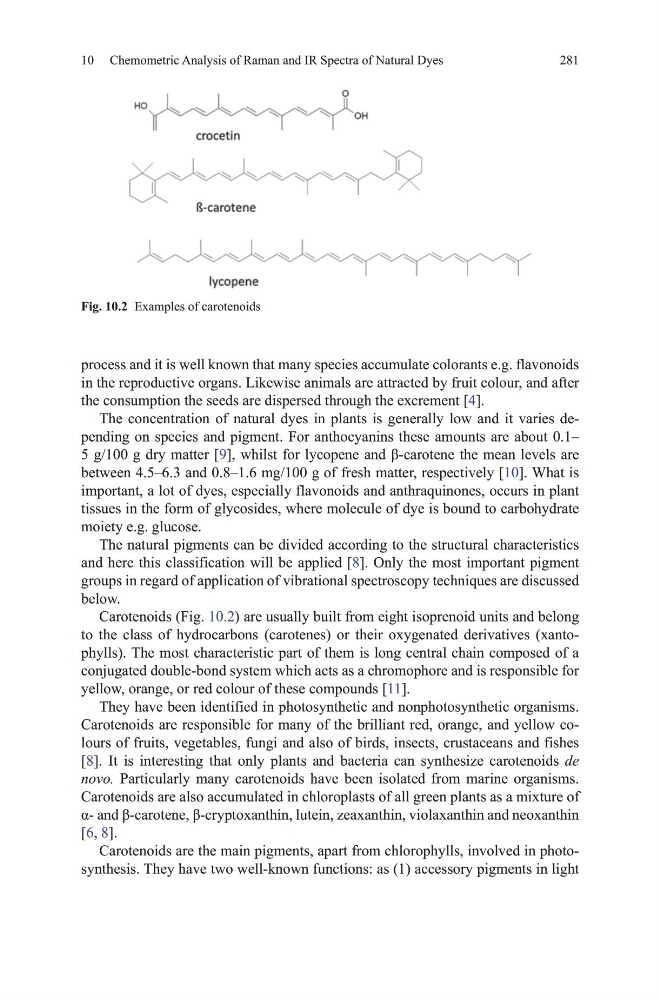
Carotenoids (Fig. 10.2) are usually built from eight isoprenoid units and belong
to the class of hydrocarbons (carotenes) or their oxygenated derivatives (xantophylls). the most characteristic part of them is long central chain composed of a
conjugated double-bond system which acts as a chromophore and is responsible for
yellow, orange, or red colour of these compounds [11].
they have been identified in photosynthetic and nonphotosynthetic organisms.
Carotenoids are responsible for many of the brilliant red, orange, and yellow colours of fruits, vegetables, fungi and also of birds, insects, crustaceans and fishes
[8]. It is interesting that only plants and bacteria can synthesize carotenoids de
novo. Particularly many carotenoids have been isolated from marine organisms.
Carotenoids are also accumulated in chloroplasts of all green plants as a mixture of
α- and β-carotene, β-cryptoxanthin, lutein, zeaxanthin, violaxanthin and neoxanthin
[6, 8].
Carotenoids are the main pigments, apart from chlorophylls, involved in photosynthesis. they have two well-known functions: as (1) accessory pigments in light
Fig. 10.2 Examples of carotenoids
281
process and it is well known that many species accumulate colorants e.g. flavonoids
in the reproductive organs. Likewise animals are attracted by fruit colour, and after
the consumption the seeds are dispersed through the excrement [4].
the concentration of natural dyes in plants is generally low and it varies depending on species and pigment. For anthocyanins these amounts are about 0.1–
5 g/100 g dry matter [9], whilst for lycopene and β-carotene the mean levels are
between 4.5–6.3 and 0.8–1.6 mg/100 g of fresh matter, respectively [10]. What is
important, a lot of dyes, especially flavonoids and anthraquinones, occurs in plant
tissues in the form of glycosides, where molecule of dye is bound to carbohydrate
moiety e.g. glucose.
the natural pigments can be divided according to the structural characteristics
and here this classification will be applied [8]. only the most important pigment
groups in regard of application of vibrational spectroscopy techniques are discussed
below.
Carotenoids (Fig. 10.2) are usually built from eight isoprenoid units and belong
to the class of hydrocarbons (carotenes) or their oxygenated derivatives (xantophylls). the most characteristic part of them is long central chain composed of a
conjugated double-bond system which acts as a chromophore and is responsible for
yellow, orange, or red colour of these compounds [11].
they have been identified in photosynthetic and nonphotosynthetic organisms.
Carotenoids are responsible for many of the brilliant red, orange, and yellow colours of fruits, vegetables, fungi and also of birds, insects, crustaceans and fishes
[8]. It is interesting that only plants and bacteria can synthesize carotenoids de
novo. Particularly many carotenoids have been isolated from marine organisms.
Carotenoids are also accumulated in chloroplasts of all green plants as a mixture of
α- and β-carotene, β-cryptoxanthin, lutein, zeaxanthin, violaxanthin and neoxanthin
[6, 8].
Carotenoids are the main pigments, apart from chlorophylls, involved in photosynthesis. they have two well-known functions: as (1) accessory pigments in light
Fig. 10.2 Examples of carotenoids