

10 Chemometric Analysis of Raman and IR Spectra of Natural Dyes
283
nucleic acids and proteins [20, 21]. moreover, it has been clearly established that
flavonoids in natural products (e.g. grape, soybean, peanut, wine, tea) have a good
antioxidant activity and pharmacological effects [21, 22 and refs cited therein].
due to the ability of forming different chemical structures depending on ph,
anthocyanins are one of the most frequently studied class of flavonoids. the most
stable form exists at acidic ph level (ph = 1) and is known as the oxonium or flavylium cation, giving bright orange–red to violet colour. In neutral ph (ph = 7),
anthocyanin gives blue–green colour and the most abundant form is quinoidal base.
In ph = 4.5 anthocyanins exist in the chalcone and/or hemiketal forms which are
colourless [17]. due to this acid-base equilibrium, the most of red and blue colours
occurred in plants are produced by water-soluble anthocyanin pigments, which are
located in vacuoles [23].
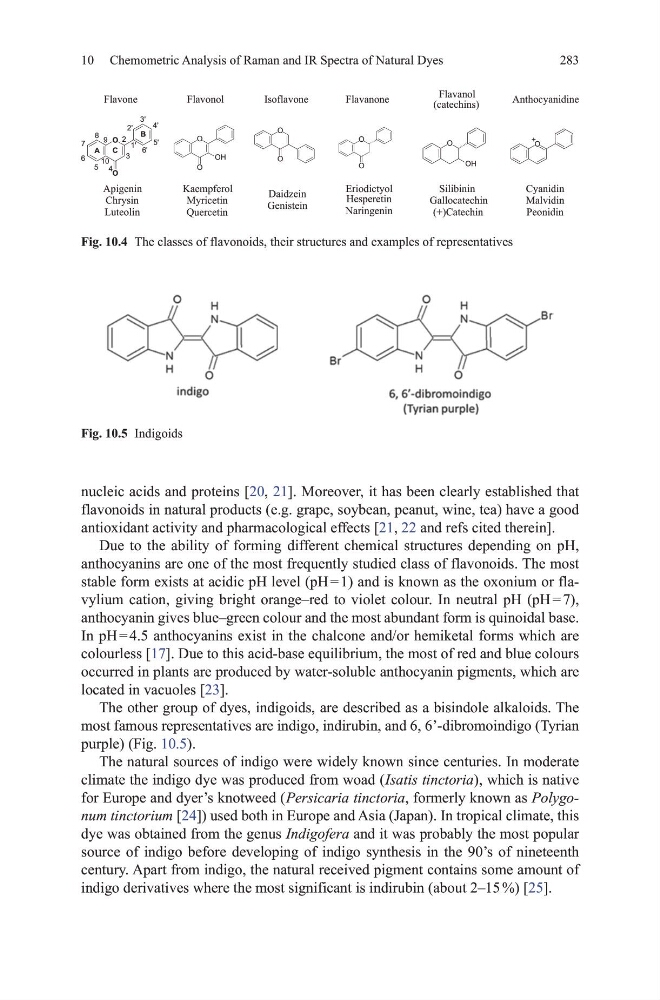
the other group of dyes, indigoids, are described as a bisindole alkaloids. the
most famous representatives are indigo, indirubin, and 6, 6’-dibromoindigo (tyrian
purple) (Fig. 10.5).
the natural sources of indigo were widely known since centuries. In moderate
climate the indigo dye was produced from woad ( Isatis tinctoria), which is native
for Europe and dyer’s knotweed ( Persicaria tinctoria, formerly known as Polygonum tinctorium [24]) used both in Europe and Asia (Japan). In tropical climate, this
dye was obtained from the genus Indigofera and it was probably the most popular
source of indigo before developing of indigo synthesis in the 90’s of nineteenth
century. Apart from indigo, the natural received pigment contains some amount of
indigo derivatives where the most significant is indirubin (about 2–15 %) [25].
)ODYRQH
)ODYRQRO
,VRIODYRQH
)ODYDQRQH
)ODYDQRO
FDWHFKLQV
$QWKRF\DQLGLQH
$SLJHQLQ
&KU\VLQ
/XWHROLQ
.DHPSIHURO
0\ULFHWLQ
4XHUFHWLQ
'DLG]HLQ
*HQLVWHLQ
(ULRGLFW\RO
+HVSHUHWLQ
1DULQJHQLQ
6LOLELQLQ
*DOORFDWHFKLQ
&DWHFKLQ
&\DQLGLQ
0DOYLGLQ
3HRQLGLQ
2
2
$
%
&
2
2
2+
2
2
2
2
2
2+
2
Fig. 10.4 the classes of flavonoids, their structures and examples of representatives
Fig. 10.5 Indigoids
283
nucleic acids and proteins [20, 21]. moreover, it has been clearly established that
flavonoids in natural products (e.g. grape, soybean, peanut, wine, tea) have a good
antioxidant activity and pharmacological effects [21, 22 and refs cited therein].
due to the ability of forming different chemical structures depending on ph,
anthocyanins are one of the most frequently studied class of flavonoids. the most
stable form exists at acidic ph level (ph = 1) and is known as the oxonium or flavylium cation, giving bright orange–red to violet colour. In neutral ph (ph = 7),
anthocyanin gives blue–green colour and the most abundant form is quinoidal base.
In ph = 4.5 anthocyanins exist in the chalcone and/or hemiketal forms which are
colourless [17]. due to this acid-base equilibrium, the most of red and blue colours
occurred in plants are produced by water-soluble anthocyanin pigments, which are
located in vacuoles [23].
the other group of dyes, indigoids, are described as a bisindole alkaloids. the
most famous representatives are indigo, indirubin, and 6, 6’-dibromoindigo (tyrian
purple) (Fig. 10.5).
the natural sources of indigo were widely known since centuries. In moderate
climate the indigo dye was produced from woad ( Isatis tinctoria), which is native
for Europe and dyer’s knotweed ( Persicaria tinctoria, formerly known as Polygonum tinctorium [24]) used both in Europe and Asia (Japan). In tropical climate, this
dye was obtained from the genus Indigofera and it was probably the most popular
source of indigo before developing of indigo synthesis in the 90’s of nineteenth
century. Apart from indigo, the natural received pigment contains some amount of
indigo derivatives where the most significant is indirubin (about 2–15 %) [25].
)ODYRQH
)ODYRQRO
,VRIODYRQH
)ODYDQRQH
)ODYDQRO
FDWHFKLQV
$QWKRF\DQLGLQH
$SLJHQLQ
&KU\VLQ
/XWHROLQ
.DHPSIHURO
0\ULFHWLQ
4XHUFHWLQ
'DLG]HLQ
*HQLVWHLQ
(ULRGLFW\RO
+HVSHUHWLQ
1DULQJHQLQ
6LOLELQLQ
*DOORFDWHFKLQ
&DWHFKLQ
&\DQLGLQ
0DOYLGLQ
3HRQLGLQ
2
2
$
%
&
2
2
2+
2
2
2
2
2
2+
2
Fig. 10.4 the classes of flavonoids, their structures and examples of representatives
Fig. 10.5 Indigoids