

232
B. Czarnik-Matusewicz and Y.M. Jung
which affects the interaction between urea dimers and water molecules and leads to
the variations at 1,563 cm
−1
. As the urea concentration increases to 2 m, the structure of the water changes from the interaction with the urea dimers. Consequently,
the water–β-lg interaction weakens and the hydrophobic forces that hold the β-lg
molecules in the native state are reduced. during this water-mediated stage, the secondary structure of β-lg is not modified, as shown by the PCA results. At the next
stage, above 3 m, the denaturation mechanism has changed into the direct, ureamediated process. The expanded structure of β-lg opens through direct interaction
with urea associates, and most of the C = o groups are hydrogen bonded, but some
of them are also free. Because they experience different influences from the polar
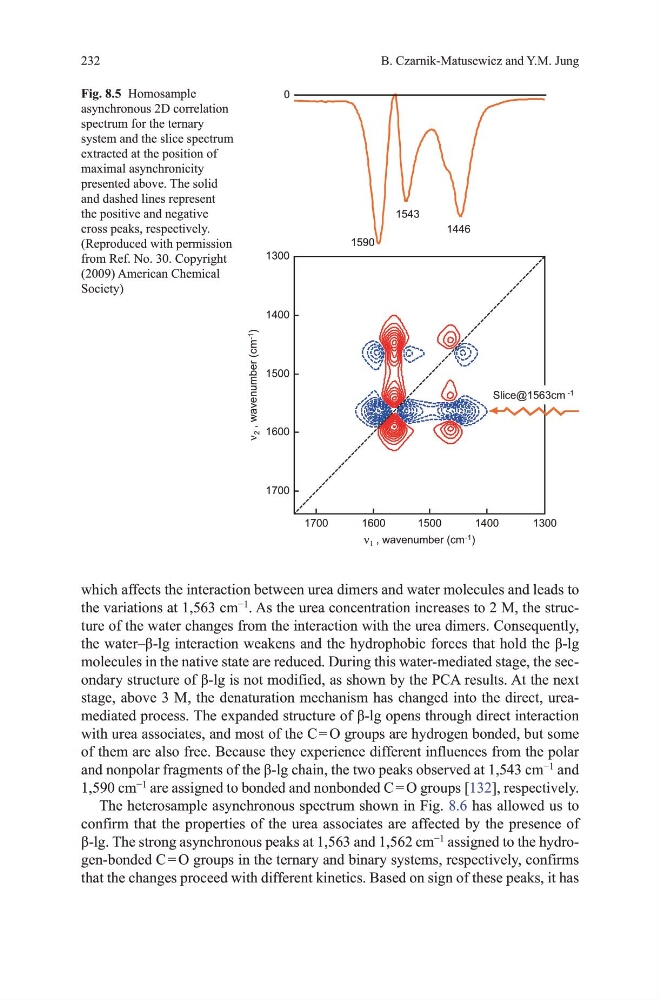
and nonpolar fragments of the β-lg chain, the two peaks observed at 1,543 cm
−1
and
1,590 cm
−1
are assigned to bonded and nonbonded C = o groups [132], respectively.
the heterosample asynchronous spectrum shown in Fig. 8.6 has allowed us to
confirm that the properties of the urea associates are affected by the presence of
β-lg. The strong asynchronous peaks at 1,563 and 1,562 cm
−1
assigned to the hydrogen-bonded C = o groups in the ternary and binary systems, respectively, confirms
that the changes proceed with different kinetics. Based on sign of these peaks, it has
1300
1400
1500
1600
1700
1300
1400
1500
1600
1700
ν
2 , wavenumber (cm -1
)
ν 1 , wavenumber (cm -1 )
0
1590
1446
1543
Slice@1563cm -1
Fig. 8.5 homosample
asynchronous 2d correlation
spectrum for the ternary
system and the slice spectrum
extracted at the position of
maximal asynchronicity
presented above. the solid
and dashed lines represent
the positive and negative
cross peaks, respectively.
(Reproduced with permission
from Ref. No. 30. Copyright
(2009) American Chemical
Society)
B. Czarnik-Matusewicz and Y.M. Jung
which affects the interaction between urea dimers and water molecules and leads to
the variations at 1,563 cm
−1
. As the urea concentration increases to 2 m, the structure of the water changes from the interaction with the urea dimers. Consequently,
the water–β-lg interaction weakens and the hydrophobic forces that hold the β-lg
molecules in the native state are reduced. during this water-mediated stage, the secondary structure of β-lg is not modified, as shown by the PCA results. At the next
stage, above 3 m, the denaturation mechanism has changed into the direct, ureamediated process. The expanded structure of β-lg opens through direct interaction
with urea associates, and most of the C = o groups are hydrogen bonded, but some
of them are also free. Because they experience different influences from the polar
and nonpolar fragments of the β-lg chain, the two peaks observed at 1,543 cm
−1
and
1,590 cm
−1
are assigned to bonded and nonbonded C = o groups [132], respectively.
the heterosample asynchronous spectrum shown in Fig. 8.6 has allowed us to
confirm that the properties of the urea associates are affected by the presence of
β-lg. The strong asynchronous peaks at 1,563 and 1,562 cm
−1
assigned to the hydrogen-bonded C = o groups in the ternary and binary systems, respectively, confirms
that the changes proceed with different kinetics. Based on sign of these peaks, it has
1300
1400
1500
1600
1700
1300
1400
1500
1600
1700
ν
2 , wavenumber (cm -1
)
ν 1 , wavenumber (cm -1 )
0
1590
1446
1543
Slice@1563cm -1
Fig. 8.5 homosample
asynchronous 2d correlation
spectrum for the ternary
system and the slice spectrum
extracted at the position of
maximal asynchronicity
presented above. the solid
and dashed lines represent
the positive and negative
cross peaks, respectively.
(Reproduced with permission
from Ref. No. 30. Copyright
(2009) American Chemical
Society)