

231
8 Two-Dimensional Mid-Infrared Correlation Spectroscopy in Protein Research
changes for the two bands has indicated the concentration-controlled involvement
of the C = O groups in the interactions with the β-lg molecules. When the binary
and ternary sets of spectra were combined into one matrix and subjected to PCA,
more details about the differences in the urea–water interaction caused by β-lg were
obtained. the resulting plot of the scores (PC1 vs. PC2) from this PCA analysis are
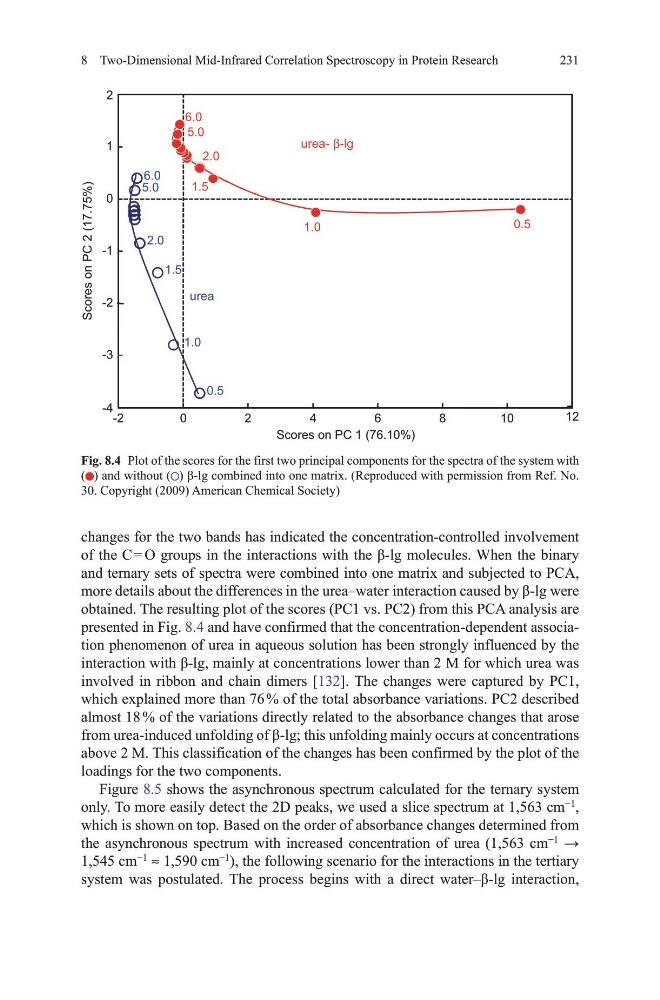
presented in Fig. 8.4 and have confirmed that the concentration-dependent association phenomenon of urea in aqueous solution has been strongly influenced by the
interaction with β-lg, mainly at concentrations lower than 2 M for which urea was
involved in ribbon and chain dimers [132]. the changes were captured by PC1,
which explained more than 76 % of the total absorbance variations. PC2 described
almost 18 % of the variations directly related to the absorbance changes that arose
from urea-induced unfolding of β-lg; this unfolding mainly occurs at concentrations
above 2 m. this classification of the changes has been confirmed by the plot of the
loadings for the two components.
Figure 8.5 shows the asynchronous spectrum calculated for the ternary system
only. to more easily detect the 2d peaks, we used a slice spectrum at 1,563 cm
−1
,
which is shown on top. Based on the order of absorbance changes determined from
the asynchronous spectrum with increased concentration of urea (1,563 cm
−1
→
1,545 cm
−1
≈ 1,590 cm
−1
), the following scenario for the interactions in the tertiary
system was postulated. The process begins with a direct water–β-lg interaction,
-2
0
2
4
6
8
10
12
-4
-3
-2
-1
0
1
2
Scores on PC 1 (76.10%)
Scores on PC 2 (17.75%)
2.0
6.0
5.0
1.5
urea- β-lg
urea
0.5
1.0
1.5
6.0
1.0
0.5
2.0
5.0
Fig. 8.4 Plot of the scores for the first two principal components for the spectra of the system with
( ) and without ( ) β-lg combined into one matrix. (Reproduced with permission from Ref. No.
30. Copyright (2009) American Chemical Society)
8 Two-Dimensional Mid-Infrared Correlation Spectroscopy in Protein Research
changes for the two bands has indicated the concentration-controlled involvement
of the C = O groups in the interactions with the β-lg molecules. When the binary
and ternary sets of spectra were combined into one matrix and subjected to PCA,
more details about the differences in the urea–water interaction caused by β-lg were
obtained. the resulting plot of the scores (PC1 vs. PC2) from this PCA analysis are
presented in Fig. 8.4 and have confirmed that the concentration-dependent association phenomenon of urea in aqueous solution has been strongly influenced by the
interaction with β-lg, mainly at concentrations lower than 2 M for which urea was
involved in ribbon and chain dimers [132]. the changes were captured by PC1,
which explained more than 76 % of the total absorbance variations. PC2 described
almost 18 % of the variations directly related to the absorbance changes that arose
from urea-induced unfolding of β-lg; this unfolding mainly occurs at concentrations
above 2 m. this classification of the changes has been confirmed by the plot of the
loadings for the two components.
Figure 8.5 shows the asynchronous spectrum calculated for the ternary system
only. to more easily detect the 2d peaks, we used a slice spectrum at 1,563 cm
−1
,
which is shown on top. Based on the order of absorbance changes determined from
the asynchronous spectrum with increased concentration of urea (1,563 cm
−1
→
1,545 cm
−1
≈ 1,590 cm
−1
), the following scenario for the interactions in the tertiary
system was postulated. The process begins with a direct water–β-lg interaction,
-2
0
2
4
6
8
10
12
-4
-3
-2
-1
0
1
2
Scores on PC 1 (76.10%)
Scores on PC 2 (17.75%)
2.0
6.0
5.0
1.5
urea- β-lg
urea
0.5
1.0
1.5
6.0
1.0
0.5
2.0
5.0
Fig. 8.4 Plot of the scores for the first two principal components for the spectra of the system with
( ) and without ( ) β-lg combined into one matrix. (Reproduced with permission from Ref. No.
30. Copyright (2009) American Chemical Society)