

230
B. Czarnik-Matusewicz and Y.M. Jung
obtained from the two measurements have confirmed the high sensitivity of the
amide I band to the changes in the secondary structure and the low sensitivity of
the amide B/amide II combination band located in the near-IR range to the changes. more information has been found in the C–h stretching/bending combination
bands; the properties of these bands correlated with the interaction between bromoethanol and β-lg during the transition of β-lg from β-sheet to α-helix conformation
by two parallel pathways.
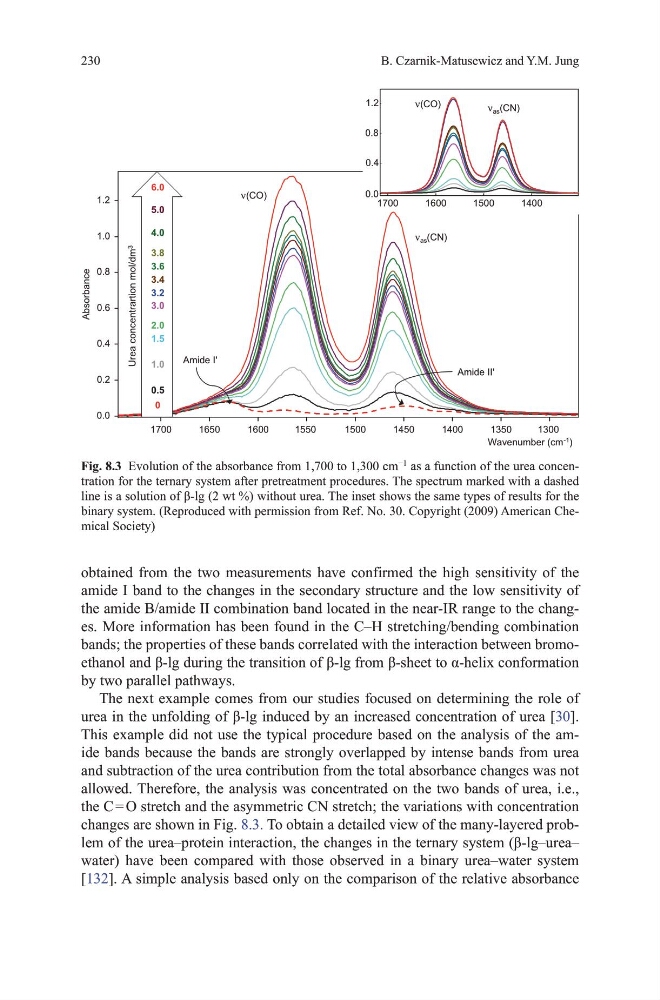
the next example comes from our studies focused on determining the role of
urea in the unfolding of β-lg induced by an increased concentration of urea [30].
this example did not use the typical procedure based on the analysis of the amide bands because the bands are strongly overlapped by intense bands from urea
and subtraction of the urea contribution from the total absorbance changes was not
allowed. therefore, the analysis was concentrated on the two bands of urea, i.e.,
the C = o stretch and the asymmetric CN stretch; the variations with concentration
changes are shown in Fig. 8.3. to obtain a detailed view of the many-layered problem of the urea–protein interaction, the changes in the ternary system (β-lg–urea–
water) have been compared with those observed in a binary urea–water system
[132]. A simple analysis based only on the comparison of the relative absorbance
ν as (CN)
1700
1650
1600
1550
1500
1450
1400
1350
1300
0.0
0.2
0.4
0.6
0.8
1.0
1.2
ν(CO)
Amide I'
Wavenumber (cm -1 )
Absorbance
6.0
5.0
4.0
3.8
3.6
3.4
3.2
3.0
2.0
1.5
1.0
0.5
0
Urea concentrartion mol/dm 3
Amide II'
0.0
0.4
0.8
1.2
1700
1600
1500
1400
ν as (CN)
ν(CO)
Fig. 8.3 Evolution of the absorbance from 1,700 to 1,300 cm
−1
as a function of the urea concentration for the ternary system after pretreatment procedures. the spectrum marked with a dashed
line is a solution of β-lg (2 wt %) without urea. The inset shows the same types of results for the
binary system. (Reproduced with permission from Ref. No. 30. Copyright (2009) American Chemical Society)
B. Czarnik-Matusewicz and Y.M. Jung
obtained from the two measurements have confirmed the high sensitivity of the
amide I band to the changes in the secondary structure and the low sensitivity of
the amide B/amide II combination band located in the near-IR range to the changes. more information has been found in the C–h stretching/bending combination
bands; the properties of these bands correlated with the interaction between bromoethanol and β-lg during the transition of β-lg from β-sheet to α-helix conformation
by two parallel pathways.
the next example comes from our studies focused on determining the role of
urea in the unfolding of β-lg induced by an increased concentration of urea [30].
this example did not use the typical procedure based on the analysis of the amide bands because the bands are strongly overlapped by intense bands from urea
and subtraction of the urea contribution from the total absorbance changes was not
allowed. therefore, the analysis was concentrated on the two bands of urea, i.e.,
the C = o stretch and the asymmetric CN stretch; the variations with concentration
changes are shown in Fig. 8.3. to obtain a detailed view of the many-layered problem of the urea–protein interaction, the changes in the ternary system (β-lg–urea–
water) have been compared with those observed in a binary urea–water system
[132]. A simple analysis based only on the comparison of the relative absorbance
ν as (CN)
1700
1650
1600
1550
1500
1450
1400
1350
1300
0.0
0.2
0.4
0.6
0.8
1.0
1.2
ν(CO)
Amide I'
Wavenumber (cm -1 )
Absorbance
6.0
5.0
4.0
3.8
3.6
3.4
3.2
3.0
2.0
1.5
1.0
0.5
0
Urea concentrartion mol/dm 3
Amide II'
0.0
0.4
0.8
1.2
1700
1600
1500
1400
ν as (CN)
ν(CO)
Fig. 8.3 Evolution of the absorbance from 1,700 to 1,300 cm
−1
as a function of the urea concentration for the ternary system after pretreatment procedures. the spectrum marked with a dashed
line is a solution of β-lg (2 wt %) without urea. The inset shows the same types of results for the
binary system. (Reproduced with permission from Ref. No. 30. Copyright (2009) American Chemical Society)