

206
R. Fausto and N. Kuş
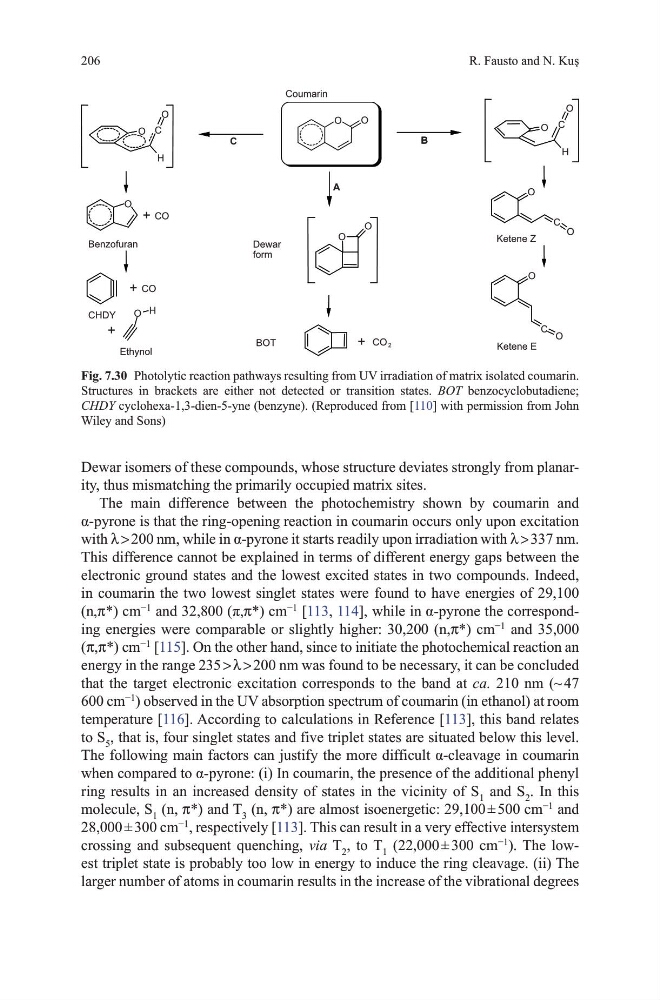
dewar isomers of these compounds, whose structure deviates strongly from planarity, thus mismatching the primarily occupied matrix sites.
the main difference between the photochemistry shown by coumarin and
α-pyrone is that the ring-opening reaction in coumarin occurs only upon excitation
with λ > 200 nm, while in α-pyrone it starts readily upon irradiation with λ > 337 nm.
this difference cannot be explained in terms of different energy gaps between the
electronic ground states and the lowest excited states in two compounds. Indeed,
in coumarin the two lowest singlet states were found to have energies of 29,100
(n,π*) cm
−1
and 32,800 (π,π*) cm
−1
[113, 114], while in α-pyrone the corresponding energies were comparable or slightly higher: 30,200 (n,π*) cm
−1
and 35,000
(π,π*) cm
−1
[115]. on the other hand, since to initiate the photochemical reaction an
energy in the range 235 > λ > 200 nm was found to be necessary, it can be concluded
that the target electronic excitation corresponds to the band at ca. 210 nm (~ 47
600 cm
−1
) observed in the uv absorption spectrum of coumarin (in ethanol) at room
temperature [116]. According to calculations in Reference [113], this band relates
to S 5 , that is, four singlet states and five triplet states are situated below this level.
The following main factors can justify the more difficult α-cleavage in coumarin
when compared to α-pyrone: (i) In coumarin, the presence of the additional phenyl
ring results in an increased density of states in the vicinity of S 1 and S 2 . In this
molecule, S 1 (n, π*) and t 3 (n, π*) are almost isoenergetic: 29,100 ± 500 cm
−1
and
28,000 ± 300 cm
−1
, respectively [113]. this can result in a very effective intersystem
crossing and subsequent quenching, via t 2 , to t 1 (22,000 ± 300 cm
−1
). the lowest triplet state is probably too low in energy to induce the ring cleavage. (ii) the
larger number of atoms in coumarin results in the increase of the vibrational degrees
O
C O
C
O
O
H
O
O
C
O
O
H
O
O
C O
O H
C
B
A
Coumarin
+ CO 2
BOT
Benzofuran
Ketene Z
O
O
Dewar
form
+ CO
Ketene E
+ CO
+
Ethynol
CHDY
B
Fig. 7.30 Photolytic reaction pathways resulting from uv irradiation of matrix isolated coumarin.
Structures in brackets are either not detected or transition states. BOT benzocyclobutadiene;
CHDY cyclohexa-1,3-dien-5-yne (benzyne). (Reproduced from [110] with permission from John
Wiley and Sons)
R. Fausto and N. Kuş
dewar isomers of these compounds, whose structure deviates strongly from planarity, thus mismatching the primarily occupied matrix sites.
the main difference between the photochemistry shown by coumarin and
α-pyrone is that the ring-opening reaction in coumarin occurs only upon excitation
with λ > 200 nm, while in α-pyrone it starts readily upon irradiation with λ > 337 nm.
this difference cannot be explained in terms of different energy gaps between the
electronic ground states and the lowest excited states in two compounds. Indeed,
in coumarin the two lowest singlet states were found to have energies of 29,100
(n,π*) cm
−1
and 32,800 (π,π*) cm
−1
[113, 114], while in α-pyrone the corresponding energies were comparable or slightly higher: 30,200 (n,π*) cm
−1
and 35,000
(π,π*) cm
−1
[115]. on the other hand, since to initiate the photochemical reaction an
energy in the range 235 > λ > 200 nm was found to be necessary, it can be concluded
that the target electronic excitation corresponds to the band at ca. 210 nm (~ 47
600 cm
−1
) observed in the uv absorption spectrum of coumarin (in ethanol) at room
temperature [116]. According to calculations in Reference [113], this band relates
to S 5 , that is, four singlet states and five triplet states are situated below this level.
The following main factors can justify the more difficult α-cleavage in coumarin
when compared to α-pyrone: (i) In coumarin, the presence of the additional phenyl
ring results in an increased density of states in the vicinity of S 1 and S 2 . In this
molecule, S 1 (n, π*) and t 3 (n, π*) are almost isoenergetic: 29,100 ± 500 cm
−1
and
28,000 ± 300 cm
−1
, respectively [113]. this can result in a very effective intersystem
crossing and subsequent quenching, via t 2 , to t 1 (22,000 ± 300 cm
−1
). the lowest triplet state is probably too low in energy to induce the ring cleavage. (ii) the
larger number of atoms in coumarin results in the increase of the vibrational degrees
O
C O
C
O
O
H
O
O
C
O
O
H
O
O
C O
O H
C
B
A
Coumarin
+ CO 2
BOT
Benzofuran
Ketene Z
O
O
Dewar
form
+ CO
Ketene E
+ CO
+
Ethynol
CHDY
B
Fig. 7.30 Photolytic reaction pathways resulting from uv irradiation of matrix isolated coumarin.
Structures in brackets are either not detected or transition states. BOT benzocyclobutadiene;
CHDY cyclohexa-1,3-dien-5-yne (benzyne). (Reproduced from [110] with permission from John
Wiley and Sons)