

7 Biologically Relevant Molecules Studied in Low Temperature Inert Matrices
207
of freedom that can serve as intermediate states for the intramolecular processes
of non-radiative dissipation of energy. (iii) In α-pyrone, the ring-opening reaction
results in the increase of the number of double bonds, which is a stabilizing factor
in terms of the electronic π-system. on the other hand, in coumarin the opening of
the pyrone ring reduces the aromaticity of the neighboring phenyl ring (the relative energies of the open-ring molecules relatively to the closed-ring counterparts
are equal to ca. 75 kJ mol
−1
in α-pyrone and ca. 140 kJ mol
−1
in coumarin [110]).
(iv) Competitive photolysis processes are more important in coumarin. Indeed, the
present experimental data indicate that, along with the ring-opening reaction, the
decarboxylation (through the dewar isomerization) and decarbonylation reactions
do also occur. In α-pyrone, because the ring-opening reaction occurs at lower excitation energies than the isomerization to the dewar form, these competing mechanisms are not operative (or not efficient enough).
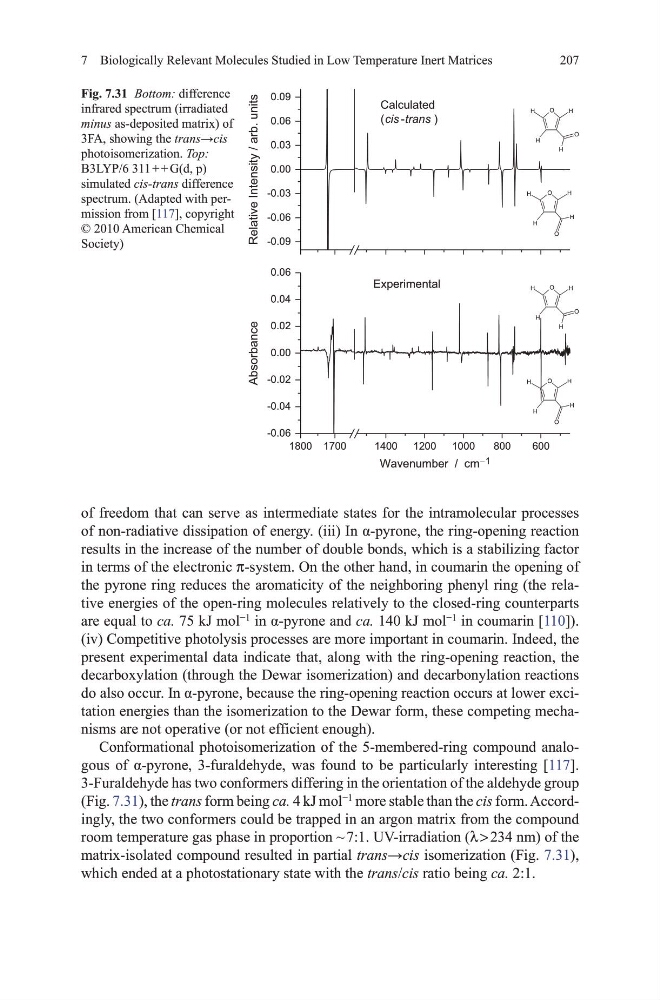
Conformational photoisomerization of the 5-membered-ring compound analogous of α-pyrone, 3-furaldehyde, was found to be particularly interesting [117].
3-Furaldehyde has two conformers differing in the orientation of the aldehyde group
(Fig. 7.31), the trans form being ca. 4 kJ mol
−1
more stable than the cis form. Accordingly, the two conformers could be trapped in an argon matrix from the compound
room temperature gas phase in proportion ~ 7:1. uv-irradiation (λ > 234 nm) of the
matrix-isolated compound resulted in partial trans→cis isomerization (Fig. 7.31),
which ended at a photostationary state with the trans/cis ratio being ca. 2:1.
1800 1700
1400
1200
1000
800
600
-0.06
-0.04
-0.02
0.00
0.02
0.04
0.06
-0.09
-0.06
-0.03
0.00
0.03
0.06
0.09
Absorbance
Wavenumber / cm −1
Experimental
Relative Intensity / arb. units
Calculated
(cis -trans )
O
H
H
H
O
H
O
H
H
H
O
H
O
H
H
H
O
H
O
H
H
H
O
H
Fig. 7.31 Bottom: difference
infrared spectrum (irradiated
minus as-deposited matrix) of
3FA, showing the trans→cis
photoisomerization. Top:
B3LYP/6 311 + + g(d, p)
simulated cis-trans difference
spectrum. (Adapted with permission from [117], copyright
© 2010 American Chemical
Society)
207
of freedom that can serve as intermediate states for the intramolecular processes
of non-radiative dissipation of energy. (iii) In α-pyrone, the ring-opening reaction
results in the increase of the number of double bonds, which is a stabilizing factor
in terms of the electronic π-system. on the other hand, in coumarin the opening of
the pyrone ring reduces the aromaticity of the neighboring phenyl ring (the relative energies of the open-ring molecules relatively to the closed-ring counterparts
are equal to ca. 75 kJ mol
−1
in α-pyrone and ca. 140 kJ mol
−1
in coumarin [110]).
(iv) Competitive photolysis processes are more important in coumarin. Indeed, the
present experimental data indicate that, along with the ring-opening reaction, the
decarboxylation (through the dewar isomerization) and decarbonylation reactions
do also occur. In α-pyrone, because the ring-opening reaction occurs at lower excitation energies than the isomerization to the dewar form, these competing mechanisms are not operative (or not efficient enough).
Conformational photoisomerization of the 5-membered-ring compound analogous of α-pyrone, 3-furaldehyde, was found to be particularly interesting [117].
3-Furaldehyde has two conformers differing in the orientation of the aldehyde group
(Fig. 7.31), the trans form being ca. 4 kJ mol
−1
more stable than the cis form. Accordingly, the two conformers could be trapped in an argon matrix from the compound
room temperature gas phase in proportion ~ 7:1. uv-irradiation (λ > 234 nm) of the
matrix-isolated compound resulted in partial trans→cis isomerization (Fig. 7.31),
which ended at a photostationary state with the trans/cis ratio being ca. 2:1.
1800 1700
1400
1200
1000
800
600
-0.06
-0.04
-0.02
0.00
0.02
0.04
0.06
-0.09
-0.06
-0.03
0.00
0.03
0.06
0.09
Absorbance
Wavenumber / cm −1
Experimental
Relative Intensity / arb. units
Calculated
(cis -trans )
O
H
H
H
O
H
O
H
H
H
O
H
O
H
H
H
O
H
O
H
H
H
O
H
Fig. 7.31 Bottom: difference
infrared spectrum (irradiated
minus as-deposited matrix) of
3FA, showing the trans→cis
photoisomerization. Top:
B3LYP/6 311 + + g(d, p)
simulated cis-trans difference
spectrum. (Adapted with permission from [117], copyright
© 2010 American Chemical
Society)