

7 Biologically Relevant Molecules Studied in Low Temperature Inert Matrices
205
ring aldehyde-ketene was observed as the main product, being rapidly produced
upon uv irradiation (λ = 313 nm) of the matrix. the IR bands assigned to the aldehyde-ketene were first interpreted on the basis of coexistence in the matrix of four
isomers of the molecule, all exhibiting the Z orientation at the double C = C bond.
The second photoproduct, the Dewar isomer of α-pyrone, was found to be generated very slowly under the used experimental conditions, a significant amount of
the dewar isomer being only observed after prolonged irradiation. upon more energetic uv irradiation (λ > ~ 200 nm), the matrix-isolated dewar isomer was found
to decompose, with evolution of Co 2 and creation of anti-aromatic cyclobutadiene
[12, 13, 108] (see Fig. 7.1).
More recently, the photochemistry of α-pyrone isolated in low temperature inert
matrices was reinvestigated in our laboratory [14]. As expected, both the ring opening reaction leading to conjugated ketene photoproducts and valence isomerization
to the dewar form were observed, with the first type photochemistry dominating.
however, the new experimental studies received support from extensive high-level
theoretical calculations, not available at the time of the original studies on this compound. this advantage permitted to reveal some new facets in the photochemistry
of α-pyrone. For example, photoproduction of the Z as well as E forms of the conjugated ketene was spectroscopically proven for the first time.
Several substituted α-pyrones, including some coumarins, were subsequentely
studied [109–112]. It was shown that the dewar isomer formation is much more
effective in the case of the 4,6-dimethyl-α-pyrone, while the α-cleavage photoreaction, leading to the aldehyde-ketene, proceeds easier for unsubstituted α-pyrone [14,
109]. upon uv-irradiation (λ > 200 nm) of coumarin isolated in solid argon, three
main photoreactions were observed (Fig. 7.30): (a) decarboxylation of the compound and formation of benzocyclobutadiene and Co 2 , with dewar coumarin as
intermediate; (b) ring-opening to its isomeric conjugated ketene; and (c) decarbonylation, leading to formation of a benzofuran/Co complex. Further decomposition
of benzofuran to produce ethynol was also suggested [110]. on the other hand, in
3-acetamido-coumarin [111] only the ring-opening isomerization to the open ring
ketene and the decarbonylation reactions were observed, while no photochemical
production of the dewar isomer occurs. this last result, follows the trend observed
for 2-pyrone-3-carboxylate [112] and seems to be a quite general rule for matrixisolated α-pyrones and coumarins bearing relatively volumous substituents at the
position 3 of the pyrone ring, as a consequence of the unfavorable relaxation of
the matrix around the guest molecule that would be required to accommodate the
O
O
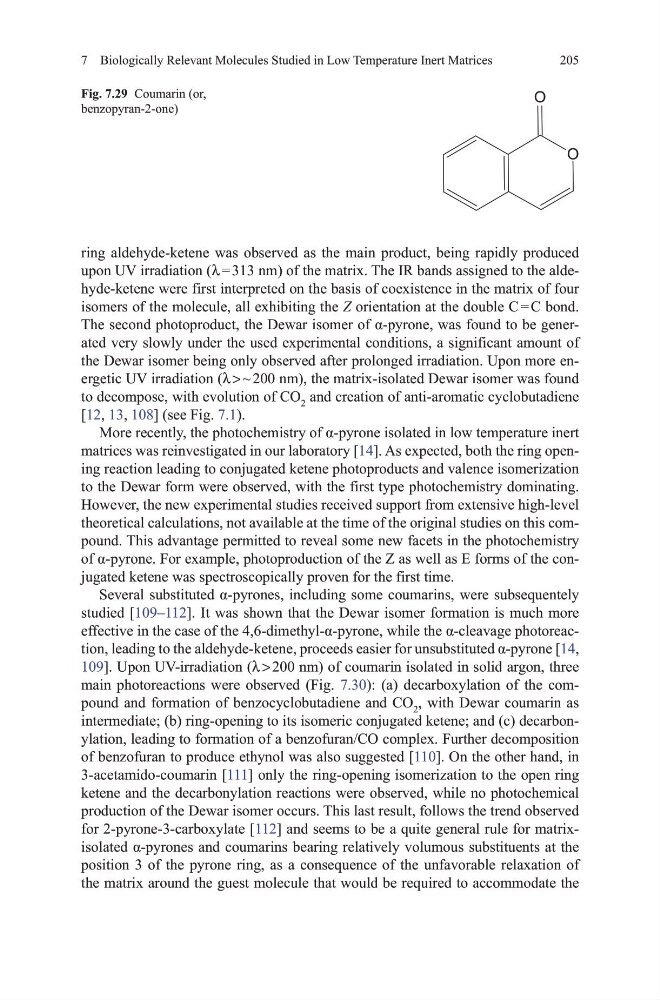
Fig. 7.29 Coumarin (or,
benzopyran-2-one)
205
ring aldehyde-ketene was observed as the main product, being rapidly produced
upon uv irradiation (λ = 313 nm) of the matrix. the IR bands assigned to the aldehyde-ketene were first interpreted on the basis of coexistence in the matrix of four
isomers of the molecule, all exhibiting the Z orientation at the double C = C bond.
The second photoproduct, the Dewar isomer of α-pyrone, was found to be generated very slowly under the used experimental conditions, a significant amount of
the dewar isomer being only observed after prolonged irradiation. upon more energetic uv irradiation (λ > ~ 200 nm), the matrix-isolated dewar isomer was found
to decompose, with evolution of Co 2 and creation of anti-aromatic cyclobutadiene
[12, 13, 108] (see Fig. 7.1).
More recently, the photochemistry of α-pyrone isolated in low temperature inert
matrices was reinvestigated in our laboratory [14]. As expected, both the ring opening reaction leading to conjugated ketene photoproducts and valence isomerization
to the dewar form were observed, with the first type photochemistry dominating.
however, the new experimental studies received support from extensive high-level
theoretical calculations, not available at the time of the original studies on this compound. this advantage permitted to reveal some new facets in the photochemistry
of α-pyrone. For example, photoproduction of the Z as well as E forms of the conjugated ketene was spectroscopically proven for the first time.
Several substituted α-pyrones, including some coumarins, were subsequentely
studied [109–112]. It was shown that the dewar isomer formation is much more
effective in the case of the 4,6-dimethyl-α-pyrone, while the α-cleavage photoreaction, leading to the aldehyde-ketene, proceeds easier for unsubstituted α-pyrone [14,
109]. upon uv-irradiation (λ > 200 nm) of coumarin isolated in solid argon, three
main photoreactions were observed (Fig. 7.30): (a) decarboxylation of the compound and formation of benzocyclobutadiene and Co 2 , with dewar coumarin as
intermediate; (b) ring-opening to its isomeric conjugated ketene; and (c) decarbonylation, leading to formation of a benzofuran/Co complex. Further decomposition
of benzofuran to produce ethynol was also suggested [110]. on the other hand, in
3-acetamido-coumarin [111] only the ring-opening isomerization to the open ring
ketene and the decarbonylation reactions were observed, while no photochemical
production of the dewar isomer occurs. this last result, follows the trend observed
for 2-pyrone-3-carboxylate [112] and seems to be a quite general rule for matrixisolated α-pyrones and coumarins bearing relatively volumous substituents at the
position 3 of the pyrone ring, as a consequence of the unfavorable relaxation of
the matrix around the guest molecule that would be required to accommodate the
O
O
Fig. 7.29 Coumarin (or,
benzopyran-2-one)