

204
R. Fausto and N. Kuş
7.6 Coumarins
Coumarin is the name given to the basic structural unit present in a large group of
heterocyclic oxygen compounds that possess the benzopyran-2-one nucleus ( i.e.,
fused phenyl and α-pyrone rings; Fig. 7.29). they are of considerable biological and
medical interest, showing important physiological effects ( e.g., anti-coagulant, antihIv, anti-tumor, anti-hypertension, anti-arrhythmia and anti-osteoporosis activities)
and weak toxicity [97–101]. Natural products like esculetin, fraxetin, daphnetin and
other related coumarin derivatives are also recognized to possess anti-inflammatory
as well as antioxidant activities [102, 103].
Being structurally rigid, the coumarin moiety is not particularly challenging for
structural studies. on the other hand, its photochemistry is rather versatile and has
been the subject of many studies, in particular because these compounds are very
efficient light emitters [104–107].
the photochemistry of coumarins is very much related with that of their
heterocyclic ring fragment. As mentioned before, the α-pyrone ring exhibits a very
interesting photochemistry. Unsubstituted α-pyrone was indeed one of the first
heterocyclic compounds isolated in low temperature inert matrices in the early
1970s of the twentieth century [12, 13, 108]. In those studies, the isomeric open
K
K
2200
2180
2160
2140
2120
2100
0
150
300
450
600
2200
2180
2160
2140
2120
2100
0
150
300
450
600
2200 2180 2160 2140 2120 2100 2080 2060
0.00
0.05
0.10
0.15
0.20
0.25
Ketene (form I)
Ketene (form II)
Wavenumber/ cm
-1
as-deposited
irradiated (15 min.)
irradiated (18 h)
2200
2100 1550
1500
1450
1400
0
20
40
60
80
100
2200
2100 1550
1500
1450
1400
0
50
100
150
200
250
2200
2100 1550
1500
1450
1400
0.0
0.2
0.4
0.6
Triclosan
IR Intensity/ km mol
-1
Ketene (form I)
Absorbance
Wavenumber/ cm
-1
as-deposited
irradiated (λ = 290 nm)
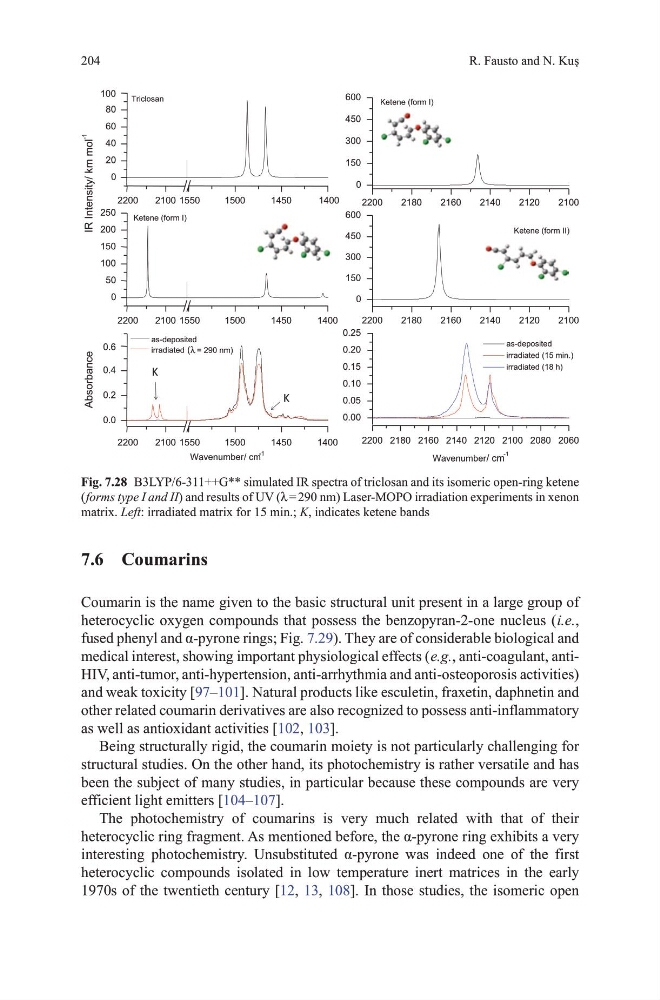
Fig. 7.28 B3LYP/6-311++g** simulated IR spectra of triclosan and its isomeric open-ring ketene
( forms type I and II) and results of uv (λ = 290 nm) Laser-moPo irradiation experiments in xenon
matrix. Left: irradiated matrix for 15 min.; K, indicates ketene bands
R. Fausto and N. Kuş
7.6 Coumarins
Coumarin is the name given to the basic structural unit present in a large group of
heterocyclic oxygen compounds that possess the benzopyran-2-one nucleus ( i.e.,
fused phenyl and α-pyrone rings; Fig. 7.29). they are of considerable biological and
medical interest, showing important physiological effects ( e.g., anti-coagulant, antihIv, anti-tumor, anti-hypertension, anti-arrhythmia and anti-osteoporosis activities)
and weak toxicity [97–101]. Natural products like esculetin, fraxetin, daphnetin and
other related coumarin derivatives are also recognized to possess anti-inflammatory
as well as antioxidant activities [102, 103].
Being structurally rigid, the coumarin moiety is not particularly challenging for
structural studies. on the other hand, its photochemistry is rather versatile and has
been the subject of many studies, in particular because these compounds are very
efficient light emitters [104–107].
the photochemistry of coumarins is very much related with that of their
heterocyclic ring fragment. As mentioned before, the α-pyrone ring exhibits a very
interesting photochemistry. Unsubstituted α-pyrone was indeed one of the first
heterocyclic compounds isolated in low temperature inert matrices in the early
1970s of the twentieth century [12, 13, 108]. In those studies, the isomeric open
K
K
2200
2180
2160
2140
2120
2100
0
150
300
450
600
2200
2180
2160
2140
2120
2100
0
150
300
450
600
2200 2180 2160 2140 2120 2100 2080 2060
0.00
0.05
0.10
0.15
0.20
0.25
Ketene (form I)
Ketene (form II)
Wavenumber/ cm
-1
as-deposited
irradiated (15 min.)
irradiated (18 h)
2200
2100 1550
1500
1450
1400
0
20
40
60
80
100
2200
2100 1550
1500
1450
1400
0
50
100
150
200
250
2200
2100 1550
1500
1450
1400
0.0
0.2
0.4
0.6
Triclosan
IR Intensity/ km mol
-1
Ketene (form I)
Absorbance
Wavenumber/ cm
-1
as-deposited
irradiated (λ = 290 nm)
Fig. 7.28 B3LYP/6-311++g** simulated IR spectra of triclosan and its isomeric open-ring ketene
( forms type I and II) and results of uv (λ = 290 nm) Laser-moPo irradiation experiments in xenon
matrix. Left: irradiated matrix for 15 min.; K, indicates ketene bands