

7 Biologically Relevant Molecules Studied in Low Temperature Inert Matrices
203
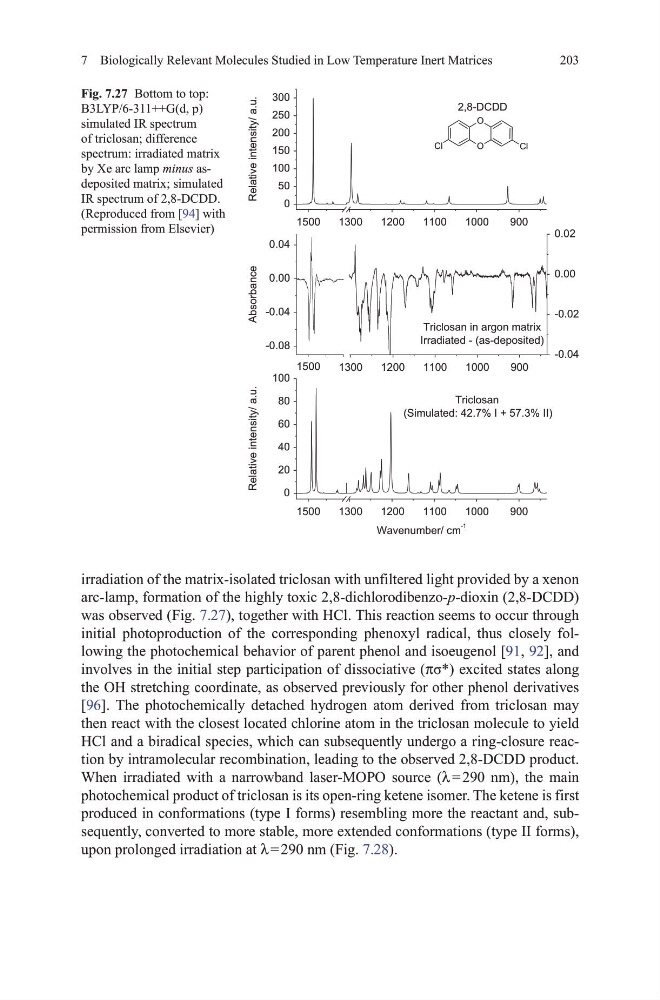
irradiation of the matrix-isolated triclosan with unfiltered light provided by a xenon
arc-lamp, formation of the highly toxic 2,8-dichlorodibenzo-p-dioxin (2,8-dCdd)
was observed (Fig. 7.27), together with hCl. this reaction seems to occur through
initial photoproduction of the corresponding phenoxyl radical, thus closely following the photochemical behavior of parent phenol and isoeugenol [91, 92], and
involves in the initial step participation of dissociative (πσ*) excited states along
the oh stretching coordinate, as observed previously for other phenol derivatives
[96]. the photochemically detached hydrogen atom derived from triclosan may
then react with the closest located chlorine atom in the triclosan molecule to yield
hCl and a biradical species, which can subsequently undergo a ring-closure reaction by intramolecular recombination, leading to the observed 2,8-dCdd product.
When irradiated with a narrowband laser-moPo source (λ = 290 nm), the main
photochemical product of triclosan is its open-ring ketene isomer. the ketene is first
produced in conformations (type I forms) resembling more the reactant and, subsequently, converted to more stable, more extended conformations (type II forms),
upon prolonged irradiation at λ = 290 nm (Fig. 7.28).
1500
1300
1200
1100
1000
900
0
50
100
150
200
250
300
1500
1300
1200
1100
1000
900
0
20
40
60
80
100
1300
1200
1100
1000
900
-0.04
-0.02
0.00
0.02
Cl
O
O
Cl
Relative intensity/ a.u.
2,8-DCDD
-0.08
-0.04
0.00
0.04
Absorbance
Triclosan in argon matrix
Irradiated - (as-deposited)
Relative intensity/ a.u.
Wavenumber/ cm
-1
Triclosan
(Simulated: 42.7% I + 57.3% II)
1500
Fig. 7.27 Bottom to top:
B3LYP/6-311++g(d, p)
simulated IR spectrum
of triclosan; difference
spectrum: irradiated matrix
by Xe arc lamp minus asdeposited matrix; simulated
IR spectrum of 2,8-dCdd.
(Reproduced from [94] with
permission from Elsevier)
203
irradiation of the matrix-isolated triclosan with unfiltered light provided by a xenon
arc-lamp, formation of the highly toxic 2,8-dichlorodibenzo-p-dioxin (2,8-dCdd)
was observed (Fig. 7.27), together with hCl. this reaction seems to occur through
initial photoproduction of the corresponding phenoxyl radical, thus closely following the photochemical behavior of parent phenol and isoeugenol [91, 92], and
involves in the initial step participation of dissociative (πσ*) excited states along
the oh stretching coordinate, as observed previously for other phenol derivatives
[96]. the photochemically detached hydrogen atom derived from triclosan may
then react with the closest located chlorine atom in the triclosan molecule to yield
hCl and a biradical species, which can subsequently undergo a ring-closure reaction by intramolecular recombination, leading to the observed 2,8-dCdd product.
When irradiated with a narrowband laser-moPo source (λ = 290 nm), the main
photochemical product of triclosan is its open-ring ketene isomer. the ketene is first
produced in conformations (type I forms) resembling more the reactant and, subsequently, converted to more stable, more extended conformations (type II forms),
upon prolonged irradiation at λ = 290 nm (Fig. 7.28).
1500
1300
1200
1100
1000
900
0
50
100
150
200
250
300
1500
1300
1200
1100
1000
900
0
20
40
60
80
100
1300
1200
1100
1000
900
-0.04
-0.02
0.00
0.02
Cl
O
O
Cl
Relative intensity/ a.u.
2,8-DCDD
-0.08
-0.04
0.00
0.04
Absorbance
Triclosan in argon matrix
Irradiated - (as-deposited)
Relative intensity/ a.u.
Wavenumber/ cm
-1
Triclosan
(Simulated: 42.7% I + 57.3% II)
1500
Fig. 7.27 Bottom to top:
B3LYP/6-311++g(d, p)
simulated IR spectrum
of triclosan; difference
spectrum: irradiated matrix
by Xe arc lamp minus asdeposited matrix; simulated
IR spectrum of 2,8-dCdd.
(Reproduced from [94] with
permission from Elsevier)