

202
R. Fausto and N. Kuş
a prefulvene isomer (4, in Fig. 7.24) was detected. the formation of the phenoxyl
radical is particularly relevant, since this species is known to be involved in the
phenol-induced toxicity [93].
In the case of triclosan, two types of photochemistries were observed, depending on
the experimental conditions [94, 95]. triclosan was shown to exist in two conformers
(Fig. 7.26), which in the matrices were found to be present in a proportion similar to
that predicted for the room temperature gas phase (I:II = 0.75). upon broadband uv
Fig. 7.26 Conformers of triclosan
phenol
Absorbance
2200
2000
1800
1600
(1)
(2)
(6)
(7)
(5)
Relative Intensity
Wavenumber / cm
−1
a
b
(6)
phenol -
d 5
*
Absorbance
2200
2000
1800
1600
Relative Intensity
Wavenumber / cm
−1
c
d
(1)
(2)
(6)
(7)
(5)
(6)
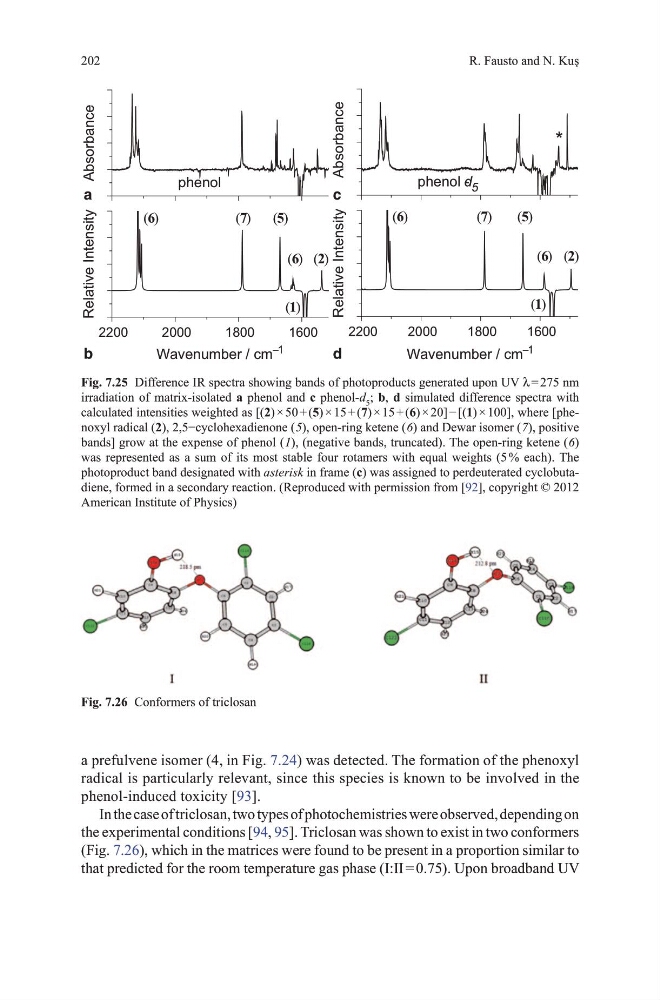
Fig. 7.25 difference IR spectra showing bands of photoproducts generated upon uv λ = 275 nm
irradiation of matrix-isolated a phenol and c phenol-d 5 ; b, d simulated difference spectra with
calculated intensities weighted as [(2) × 50 + (5) × 15 + (7) × 15 + (6) × 20] − [(1) × 100], where [phenoxyl radical (2), 2,5−cyclohexadienone ( 5), open-ring ketene ( 6) and dewar isomer ( 7), positive
bands] grow at the expense of phenol ( 1), (negative bands, truncated). the open-ring ketene ( 6)
was represented as a sum of its most stable four rotamers with equal weights (5 % each). the
photoproduct band designated with asterisk in frame (c) was assigned to perdeuterated cyclobutadiene, formed in a secondary reaction. (Reproduced with permission from [92], copyright © 2012
American Institute of Physics)
R. Fausto and N. Kuş
a prefulvene isomer (4, in Fig. 7.24) was detected. the formation of the phenoxyl
radical is particularly relevant, since this species is known to be involved in the
phenol-induced toxicity [93].
In the case of triclosan, two types of photochemistries were observed, depending on
the experimental conditions [94, 95]. triclosan was shown to exist in two conformers
(Fig. 7.26), which in the matrices were found to be present in a proportion similar to
that predicted for the room temperature gas phase (I:II = 0.75). upon broadband uv
Fig. 7.26 Conformers of triclosan
phenol
Absorbance
2200
2000
1800
1600
(1)
(2)
(6)
(7)
(5)
Relative Intensity
Wavenumber / cm
−1
a
b
(6)
phenol -
d 5
*
Absorbance
2200
2000
1800
1600
Relative Intensity
Wavenumber / cm
−1
c
d
(1)
(2)
(6)
(7)
(5)
(6)
Fig. 7.25 difference IR spectra showing bands of photoproducts generated upon uv λ = 275 nm
irradiation of matrix-isolated a phenol and c phenol-d 5 ; b, d simulated difference spectra with
calculated intensities weighted as [(2) × 50 + (5) × 15 + (7) × 15 + (6) × 20] − [(1) × 100], where [phenoxyl radical (2), 2,5−cyclohexadienone ( 5), open-ring ketene ( 6) and dewar isomer ( 7), positive
bands] grow at the expense of phenol ( 1), (negative bands, truncated). the open-ring ketene ( 6)
was represented as a sum of its most stable four rotamers with equal weights (5 % each). the
photoproduct band designated with asterisk in frame (c) was assigned to perdeuterated cyclobutadiene, formed in a secondary reaction. (Reproduced with permission from [92], copyright © 2012
American Institute of Physics)