

7 Biologically Relevant Molecules Studied in Low Temperature Inert Matrices
201
phenolic radical. the two types of ketenes were formed depending on the position of the ring to where the hydrogen atom moves. Subsequent decarbonylation
of these ketenes was also found to take place in the photolysed matrices. the same
photochemical behavior was also observed for eugenol (2-metoxy-4-(prop-2-enyl)
phenol) [91].
the h-atom detachment from the phenolic oh group seems in fact to be a
quite general process for matrix-isolated phenols. For the parent phenol isolated
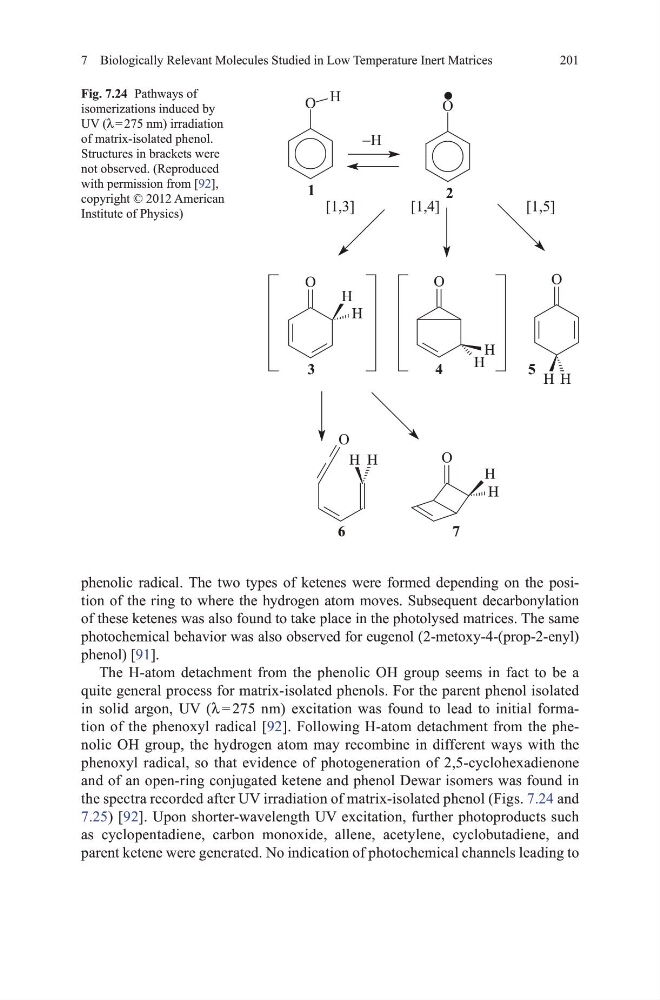
in solid argon, uv (λ = 275 nm) excitation was found to lead to initial formation of the phenoxyl radical [92]. Following h-atom detachment from the phenolic oh group, the hydrogen atom may recombine in different ways with the
phenoxyl radical, so that evidence of photogeneration of 2,5-cyclohexadienone
and of an open-ring conjugated ketene and phenol dewar isomers was found in
the spectra recorded after uv irradiation of matrix-isolated phenol (Figs. 7.24 and
7.25) [92]. upon shorter-wavelength uv excitation, further photoproducts such
as cyclopentadiene, carbon monoxide, allene, acetylene, cyclobutadiene, and
parent ketene were generated. No indication of photochemical channels leading to
O H
O
H
H
O
H H
[1,3]
[ 1,5]
[1,4]
O
H
H
O
−H
1
2
3
4
5
O
H
H
7
O
H
H
6
Fig. 7.24 Pathways of
isomerizations induced by
uv (λ = 275 nm) irradiation
of matrix-isolated phenol.
Structures in brackets were
not observed. (Reproduced
with permission from [92],
copyright © 2012 American
Institute of Physics)
201
phenolic radical. the two types of ketenes were formed depending on the position of the ring to where the hydrogen atom moves. Subsequent decarbonylation
of these ketenes was also found to take place in the photolysed matrices. the same
photochemical behavior was also observed for eugenol (2-metoxy-4-(prop-2-enyl)
phenol) [91].
the h-atom detachment from the phenolic oh group seems in fact to be a
quite general process for matrix-isolated phenols. For the parent phenol isolated
in solid argon, uv (λ = 275 nm) excitation was found to lead to initial formation of the phenoxyl radical [92]. Following h-atom detachment from the phenolic oh group, the hydrogen atom may recombine in different ways with the
phenoxyl radical, so that evidence of photogeneration of 2,5-cyclohexadienone
and of an open-ring conjugated ketene and phenol dewar isomers was found in
the spectra recorded after uv irradiation of matrix-isolated phenol (Figs. 7.24 and
7.25) [92]. upon shorter-wavelength uv excitation, further photoproducts such
as cyclopentadiene, carbon monoxide, allene, acetylene, cyclobutadiene, and
parent ketene were generated. No indication of photochemical channels leading to
O H
O
H
H
O
H H
[1,3]
[ 1,5]
[1,4]
O
H
H
O
−H
1
2
3
4
5
O
H
H
7
O
H
H
6
Fig. 7.24 Pathways of
isomerizations induced by
uv (λ = 275 nm) irradiation
of matrix-isolated phenol.
Structures in brackets were
not observed. (Reproduced
with permission from [92],
copyright © 2012 American
Institute of Physics)